Credible Vulnerability?

No wonder we are so challenged by the idea of vulnerability, especially personal vulnerability.  It was a revelation to me to do an internet search on the topic.  What came up first and most was this kind of explanation:

  • the inability to withstand the effects of a hostile environment
  • window of vulnerability as a time frame within which defensive measures are reduced, compromised or lacking
  • Achilles Heel
  • capable of or susceptible to being wounded or hurt
  • open to moral attack, criticism or temptation

No wonder most of us shudder when the topic of vulnerability comes up.  It is in our collective consciousness and organizational cultures as weakness not as strength although much research confirms the power of vulnerability as pointed out by Brene Brown – beautiful and powerful in her own vulnerability.

I an in a renewed deep dive into this exploration thanks to the conversation that may have surprised and delighted me the most at The Art of Participatory Leadership and Social Innovation in California at the end of August 2012.  A conversation I did not expect to be witness to or our high tech company participants to be in.

It arose out of a World Cafe conversation on complexity in response to the third question: what’s stirring in you now as you contemplate complexity (after exploring complexity they’ve been in and barriers and supports for being in complexity)?  My attention was caught by a table where two men and two women were deep in a shared reflection of where vulnerability meets credibility.

The conversation went something like this:

“Yes, I know it’s a good thing to be vulnerable, but how do I be vulnerable and still be credible as a leader, in my organization.”

“It’s not safe to be vulnerable. You are seen as weak.  How can you be vulnerable and not appear weak?”

“I would lose credibility.”

“First you need credibility, then you can be vulnerable.  But how much credibility is enough?”

“Maybe allowing yourself to be vulnerable will show your credibility.”  Is there such a thing as credible vulnerability?  What does that even mean?

All of this led me to wonder what we mean when we speak about vulnerability – what’s in the field?  A lot about weakness  and protection it seems. This resonates with my journey personal journey, one of Embracing the Stranger in Me: A Journey to Open Heartedness.  The invitation was to move beyond believing emotions make me weak to understanding them as a guidance system that will never steer me wrong if I pay attention.  In the context of leadership, particularly participatory leadership, vulnerability does not equal weakness, defense systems do, but how and why is that so?

Thankfully Brene Brown is turning vulnerability (shame too) on its head so we can lean into it differently.  She says, “Embracing our vulnerabilities is risky, but not nearly as dangerous as giving up on love and belonging and joy ~ the experiences that make us the most vulnerable.”  And also make us the most human.

Sounds pretty personal.  What does it have to do with work? Because as much as we try we cannot be one person at home and another at work.  We suffer from the incongruency and it shows up wherever we show up.  People sense it, even when, especially when, we try to hide and know, from the place of deep knowing, when they have encountered someone in the fullness of their authentic journey and their vulnerability.  They often name it as courage.

Brown says what we are most seeking is connection.  It is why we are here, it gives meaning and purpose to our lives.  I hear the yearning for it in so many people who are drawn to Art of Hosting and related gatherings.  In order to have connection, we have to let ourselves be seen.  Truly, fully, seen.  But then we risk people seeing our weakness, our shame, any inauthenticity or lack of integrity we feel we may be carrying. We make ourselves vulnerable.

Interestingly, when I looked up the definition of credibility it is the quality or power of inspiring belief; the quality of being believed or accepted as true, real and honest.  Seems to describe what I think of as one aspect of vulnerability.  And it’s simple.

Given this definition, the relationship between credibility and vulnerability is so intimately entwined it is hard to separate out which comes first and which you need more.  If we can begin to see vulnerability for the strength and authenticity that it is, instead of as a weakness we cannot show others, our credibility instantly begins to rise.  But how?

There is no simple solution to this.  It requires courage and risk and a path of hosting yourself, growing self awareness and presence.  It requires the courage of being imperfect and of compassion – for self and others, particularly for self.  Finding the way to allow ourselves to be vulnerable without inviting criticism or recrimination – the fear of which intimidates us and makes us believe we need to protect ourselves. This is the conundrum.

Vulnerability is part of an intentional journey of learning to find our voice from the depths of our strength, our sense of worthiness, love and belonging, from the place of whole heartedness.  It is also part of the art of what we do.  The only way to trust is to risk.  The only way to risk is to trust. The only way to do this is to do it.  Risk as much as we dare.  Pause. Reflect. Learn. Embody. Trust. Risk a little more.  Eventually we shift the shape of our experience, our understanding, our credibility and our vulnerability. We live into it as the asset it is rather than the deficit many of us have experienced it to be.  It is not our vulnerability that is the challenge.  It is our fear of our own vulnerability that brings the weakness.

We didn’t name this conversation.  It showed up in an unexpected place.  Speaks to the yearning.  Speaks to what’s missing.  Speaks to the invitation.  Speaks to the first step.  Easy.  Difficult. Complex. Simple.  Choose.
Slowing Down to Go Fast

Our world moves so fast we all want it done now, or yesterday – whatever “it” is. The paradox is, we don’t have time to go fast anymore. But it’s not just about slowing down. It’s slowing down, adding in intentionality, purposefulness and patterns of movement – often non-linear and iterative – to take us to places we’ve never been before but that we’ve dreamed and know have to be possible. We want to get to this new place but we keep repeating the patterns that have never gotten us there before – Einstein’s definition of insanity.

Add into the mix, the complexity of today’s challenges generally means it is not a straight path from A to B and even if it is, your destination is probably somewhere else.

What does slowing down mean?  One is taking the time to acquire new lenses with which to view the challenges and complexity we face.  Another is learning how to use conversational methodologies well – tuned into purpose and intention as a guiding principle for how to design, enter and engage the questions of most relevance to what’s needed now – in growing learning, tackling innovation or bridging organizational divides.  It is not simply a learning and development opportunity.  It can be a formidable strategy to grow an organization, engage a challenge, conceive of innovative processes and/or products that serve the mission or mandate of your organization – as you already know.

These things are all possible using the principles and practices alive in Art of Hosting practices and frameworks.  Art of Hosting is not just a training.  Seasoned practitioners use it in consulting work all over the world – in every sector, for small and large initiatives, to launch new organizations and teams and to shift whole systems.  It is not just theory.  It is today’s complex challenges made real.  And it takes time.

For the training work we do, we often get asked about three days.  When money is no issue the larger question that looms is, “Is it worth three days of my time?”  Well, that depends.  On how aware you are of the value of slowing down to go fast – slowing down to allow insight to percolate, new perspectives to digest into new approaches and new strategies to emerge in animated and reflective conversation with other bright lights called to gather together in three days.  Because there are an amazing number of bright lights who show up for any training – of all ages, backgrounds and perspectives.

The beauty of being in 3 days or more with the same group of people is it invites the pattern of divergence-groan zone/emergence-convergence to show up.  There are many times when I’ve been asked at the end of day 2 of a three day training how is it going?  If I write that story, it is a very different story of what emerges because even subtle things shift and change in one more overnight or one more conversation evoked through a powerful question.  There is something in a three day pattern that lets us sense more fully into what our questions are, explore them in the company of others also asking powerful questions, seeing not just synergy but emergence – where we all gain something that no one person brought into the room, and we begin to imagine, often with extensive detail, how we will use what we’ve learned when we go back to work.

Not everything needs to slow down of course.  Not everything needs three days.  Some need less.  Many need more. But we refuse to take the time – we believe we don’t have the time, other things are more pressing, we will get too far behind – lots of limiting beliefs we carry individually and collectively.   But what about the things that do need three days and maybe longer? Percolation does.  New perspectives often do.  Imagining – really imagining the new – does.  Shifting paradigms does.

When we give ourselves permission to slow down we also invite ourselves to be surprised by what emerges and how fast things move with new clarity.  It is a wise investment of time and necessary for those of us imagining how to shift the shape of the worlds we touch.

Innovation, Responsiveness, Imagination – Lessons from Apple

A few months ago, when I needed to replace my laptop, I considered switching to a Mac but was concerned about the learning curve. I put a note out on Facebook with an enquiry.  Of 20 responses, 19 were from Mac users.  “I love my Mac,” was the essential essence of the messages.  The lone PC user said, “I’ve used a PC for 20 years and never had any problem.”  which might have been a ringing endorsement if were not for the amazingly enthusiastic responses from Mac users.  I bought a MacBook Air.  I have no regrets.

Now, I’m reading Steve Jobs biography.  It doesn’t pull any punches.  It is a straightforward account of a brilliant, demanding, tyrannical, charismatic man, often running roughshod over people to get what he wanted.  He  had a love for art and technology – a combination that allowed him to imagine possibilities others just couldn’t see.  It was brilliant for Apple and more so for Pixar. He would never win any awards for his people leadership skills but he could dream the future, imagining products we didn’t know we wanted or needed and he followed his intuition all the way to the bank.

Reading his biography, the threads that contributed to Apple’s successful innovation, responsiveness to conditions and opportunity, and the imagination that brought so much alive in techni-colour, became apparent.

Jobs was obsessive about control and when he had an idea he fell in love with, he didn’t want to let go. He wasn’t always right, and he wasn’t impervious to influence, but when he was right he changed worlds.    He revolutionized the computer industry, then the film industry, the music industry and the book industry.

He didn’t treat people well, but he knew a thing or two about the business of innovation. A few themes caught my attention as I read:

  • beauty and intuitive
  • simplicity and focus
  • integration – not just of product design but of the people and departments responsible for all aspects of a product

Apple products were designed for beauty and intuitive use.  Anybody should be able to pick an Apple product up and figure out how to use it without a manual.  And they should love the look and feel of it. This influenced the design of products.  In the development of the iPod for instance, Jobs decided users should be able to get to anything they wanted intuitively in no more than three steps.  The guiding concept: a thousand songs in your pocket.  Products were designed with the user in mind.  The few times Jobs lost sight of that, like with NeXT his company after and before Apple, he didn’t do as well.

Simplicity and focus.  Apple picked a few key projects to work on in any given year and dedicated resources to the most promising of them.  Anyone could pitch an idea – without a powerpoint because formal presentations bored Jobs.  They had to know what they were talking about well enough to free flow it, discuss it (often heatedly) and not rely on a prop like a slide.  Although something tactile, put in people’s hands worked well.

For products under development, long weekly meetings were held with all departments represented to hash out ideas.  Prototypes were developed that could be picked up, turned over and handled to determine what worked, what could be improved and to know when they nailed it.  The conversations were no holds barred – animated, lively.  It all came out in the meetings.  The people who fared best were the ones who figured out how to stand up to Jobs, when to fight, when to wait, when to back down.

Jobs would not allow dissension between departments.  If they couldn’t get along, someone lost a job.  And when decisions needed to be made about product, design, colour or other relevant factors, it didn’t go to a committee for recommendations or a market study to figure it out – decisions were made, often on the spot, without hesitation.  They might not always have been right, but the speed of decision making capability enabled Apple to be responsive, resilient and a market leader more often than not.

Beauty, simplicity, focus, end to end control, responsiveness, imagination as hallmarks of innovation. Not that I’ve done it better than Jobs or come anywhere near to his success, but I would like to think adding in a strong people culture to this great list would only enhance capacity for innovation – so long as we really understand what this means, growing leadership and decision making capacity within an organization, not diluting it.  While there are one or two things that give me pause, there is a lot to be learned from Apple and from Steve Jobs.   After all, he did shift the shape of the world as we know it.

Explaining Art of Hosting for Beginner’s Wanting to Know What It Is

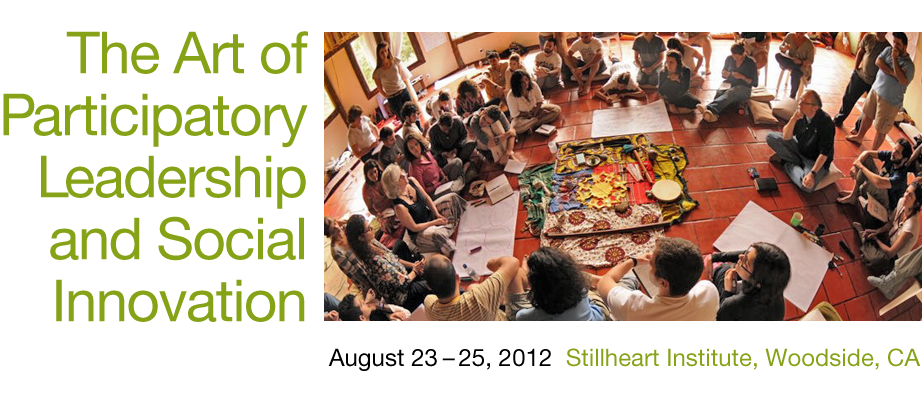
Every place we go has its own tone, texture and timing.  It is part of what makes Art of Hosting – or in the case of California in August 2012, the Art of Participatory Leadership and Social Innovation – so hard to define. “We” being whatever configuration of hosting and calling team has coalesced around an identified need or opportunity.  Every training is different because every place is different, every group that responds to the call is unique.

People who are just coming across Art of Hosting want to know, what is it?  One way to think of it is, at its core, a set of patterns and practices that help us be successful in complex circumstances.  Developing skill in using these patterns and practices is particularly helpful now at a time when long term strategic planning doesn’t work anymore (if it ever did) because we don’t know and can’t predict what ten, five or even two years down the road will look like.  One thing many of us have a growing awareness of is that what has worked in the past – strategies, practices, principles – doesn’t seem to work anymore – if it ever did.

The world is providing us with increasing complexity – in the environments in which we operate, our communities and in our organizations, especially as things seem to move faster and faster.  Social innovation is a response to this increasing complexity.  Rigid protocols have limited application in complexity.  Complexity calls for a different set of leadership skills – skills that tune in and are responsive to emergent circumstances.  Complex systems share behaviours that cannot be explained by their parts.  This requires a different set of frameworks to see and understand it.  In the Art of Participatory Leadership we draw on world view, chaordic path, divergence/convergence, the 2 loops of systems change, theory U and other frameworks as lenses through which to think about complexity and social innovation.  Social innovation looks for an alignment of circumstances that makes action possible – the relationship among elements.

One of the names we use for this type of experiential learning is the Art of Participatory Leadership because it also calls forth a new set of leadership skills required to deal with complexity and social innovation, quite different from how we think about traditional leadership.  Participatory leadership focuses on participation and engagement strategies, knowing from experience there is wisdom and knowledge that exists within a group, a team, an organization, a system.  When we make it visible in a group, it moves into the realm of collective wisdom, knowledge and understanding leading to a different kind of action and ultimately different results.

Participatory leadership  connects well in high pressure situations. Some of its core characteristics are curiosity or non-judgement, staying in the space of not knowing, generosity or openness, a belief that conversations matter and that good conversation leads to wise action.

It is not a quick fix or a magic bullet for problems that have existed and have been evolving over long periods of time.  However, there are often very immediate results for individuals as they examine and reflect on their own leadership practices.  This is also why we encourage teams to participate so they have a new common language and are more able to hold each other accountable to create a path of behaviour change and organization practices that will be sustainable.

A core element of the Art of Participatory Leadership is for each of us to deepen our own capacity to effect transformation – in ourselves and in a complex world.

Where have these practices and patterns been used? In community, private sector, academia, healthcare, and educational settings as well as social change efforts around the world.  The stories are only just beginning to be documented because many of us have been deep in the work rather than the writing about the work.  Stories are alive in Nova Scotia, Ohio, Minnesota, Europe and Brazil and many, many more places.

Art of Hosting is also a global self-organizing community of practitioners who use these integrated participative change processes, methods, maps, and planning tools (like circle practice, appreciative inquiry, world cafe and open space technology) to engage groups and teams in meaningful conversation, deliberate collaboration, and group-supported action for the common good.

The hosting and calling team for this first Art of Participatory Leadership and Social Innovation in California: myself, Jerry Nagel, Ann Badillo, Sherri CannonDana Pearlman and Mia Pond will weave stories of where this work is alive in the world into these three days of co-created emergent design and process – a little taste of what we do in the world and what is possible.

Navigating the Groan Zone is an Art

For a such a simple little concept, the divergence-emergence-convergence model we use in the Art of Hosting sure packs a punch.  It is a simple teach that can be done in 10 minutes – or longer – if time, space and the opportunity to engage others in the conversation allows.  It sheds light on design process, the groan zone and people’s experience.  Navigating the groan zone is an art form that often arises out of our ability to host ourselves well.  Stories from a recent Art of Hosting training a bit later in this post.  First a bit about the model.

Divergence-Emergence-Convergence – a simple model with an interesting challenge

The divergent phase of this model is akin to brainstorming.  We want as many ideas as possible to emerge so we can later select the best ones to develop further.  It has much broader application than brainstorming though.  It is about expansion.  It is where ideas are generated, information is collected,  issues or challenges are sensed into to gain more insight or shift perspective or simply where we holding open the space for possibilities to enter in.  It is not a time for evaluation.  We don’t need to know what we will do with the information.  We don’t even need to know whether the information is ultimately useful while we are in the divergent phase of the learning, the work, the project.

As we begin to feel overloaded, overwhelmed or uncomfortable, or we begin to question “the process”, or the leaders or hosts of the process, or we are just tired and grumbly, we are desiring understanding and often looking for convergence.  What does it all mean?  What should we do now?  When can we be done?  All questions that indicate we are near or in the groan zone.

In an effort to avoid discomfort, end discussion, or just get to the end now, we are often tempted to circumnavigate the groan zone by picking an idea, or a solution prematurely – any reasonably good one will do – and developing it into “the answer”.

Some things happen when we do this.  One is that we may miss the truly important things.  By prematurely closing a conversation, the essence or pattern of it often comes back.  We think we made a decision but the decision is questioned and we end up in a new round of conversation about things we thought were settled, growing frustration and dissatisfaction later on.  Staying with the discomfort just a bit longer might emerge a different idea or opportunity or a new understanding of where are at and why. What if we became curious about where we are instead of wanting to shut it down?  What might then emerge?  What if we ask the question, what else is going on here?  What is underneath the conversation, the unrest?

Navigating the groan zone is an art of discernment in many ways.  It is also a skill we can develop.  I recently had someone send me a note, asking me how a training was going.  The note arrived exactly in the groan zone at the end of day 2.  I thought about replying and knew it was just impossible to explain succinctly where we were in our process – unsettled, a bit disconnected as a group, unclear about what all was bubbling.  Sure enough, the next day things flowed together, the group became more cohesive and new possibilities emerged.  I had a new story to share about the groan zone and the importance of staying in it in our processes, not prematurely attempting to assess the success or failure of a conversation, a training or a process. We don’t just need to stay tuned to the groan zone, we need to be alert for convergence and good timing of it.

A couple of stories about the groan zone from recent hosting experiences.  These two stories come from the first AoH training for Rio de Janeiro in Brazil at the end of April 2012.  Two of my co-hosts (on a team of nine) were Jerry Nagel from the US and Maria Barretto from Brazil.

The first story is from the hosting/calling team.  We met, as is normal practice, the day before for our check-in and design process for the training that was in front of us.  In the couple of weeks just before the training, it filled so rapidly most of us had no idea we had reached our capacity of about 50 people in the lovely retreat centre we were at near Petropolis.  Even in this last night before we were to begin, people were sending emails saying they wanted to attend.  In the normal flux of what happens leading up to a training, some people were appearing, some were saying they couldn’t come and we were left trying to figure out what to do.  We had five people  on a waiting list.  There were two possibilities: begin the list for the next Rio AoH or refer them to an AoH that was to happen in Sao Paulo a few weeks later.  We circled around a decision several times, even as we tried to move on, but never landed.  We were clearly in the groan zone.  Maria was the first one to suggest this conversation was not about numbers, there was something deeper that maybe we needed to become curious about and pay attention to.

After two hours we agreed as a team that we would just say yes.  Full invitational energy.  You want to come?  If you can still come we will figure out how to make room.  Calls went out to the five people, three of whom showed up the next morning, two of whom had a 7 hour drive to make it happen.  What was our conversation about?  Letting go.  Inviting.  Trusting.  When we entered full invitation, we passed through the groan zone as a hosting team.  Something shifted for us. Beyond the decision itself. Into the collective space of being a team.

The second story – this time from the full group.  Day 3 of a 4 day training.  The morning is all about hosting self – embodiment, art, silence.  Not everyone is comfortable with meeting self.  We decide not do a collective harvest of the experience but to leave it with individuals.  The afternoon is Pro-Action Cafe – one of the best I’ve ever seen as my Brazilian friends take it to new levels, engaging the participants while the conversation/project hosts are reflecting on what they have learned so far.  “What does it feel like to host other people’s dreams?” is the question they ask, a question that touches me heart.

After the proaction cafe, we enter a debriefing space.  It’s been a long day.  First comments are quite positive and excited.  Then there is a shift. The comments and questions that are now coming into the space do not, in my perspective and through translation, seem to reflect the proaction cafe experience.  So, I become curious.  As I pay attention, I begin to wonder, what is the level of discomfort from the morning experience that seems to be bubbling up now?

The day before, Maria taught the divergence-convergence model, speaking about the groan zone.  In this moment, as I listen I know we are in the groan zone.  I listen for an intervention point and take the talking stick – a paint brush from the centre that many who speak are holding as if it is a microphone.  I step into the centre of the circle and begin to walk it.  I say, “Friends, yesterday Maria talked about the groan zone.  Today, now, we are in it.”

Someone says, “So we should be celebrating.”

I chuckle.  “Yes,” I respond, “We should be celebrating.” I pause, “We need to be careful that we do not assume that our individual experience is the experience of the group.  The things that really resonate with me might be the things you are most challenged by and vice versa.  This is an invitation for us to each own our own experience and to become curious.”

From here, I am not really sure where we want or need to go next.  I invite the hosting team into a transparent conversation about how we want to proceed.  There is one more thing we had been planning but we are now into the time for that process.  Things take on a life of their own and we enter into a fishbowl experience.  I’m still not sure how that happens, but we flow with what is emerging in the space.  As a host team we have a little conversation about what will serve best now.  Participants enter the fishbowl and offer their experience and their questions.  One person asks, “Why don’t you, as experts, just tell us what to do now?”  Good question.  We invite it to sit in the room with us til a bit later.

After hearing from more people one clarity emerges for me.  I  want to be sure we honour the stepping in of volunteers to host processes they had never hosted before and I feared itt was being lost in the ripples showing up in this groan zone.  The response to the question of why we didn’t just provide the answers for people?  “Looking for someone to provide the answers is a typical reaction when we are in the groan zone.  Learning to co-sense and co-learn into what is needed next is the learning edge we are all on.  An answer too soon might not be what we need at all.”  People are nodding.

As we have heard the feedback and sensed the room, I suggest maybe we need to wrap up.  One of the desires in the room is to end for the day and dance – beautiful Brazilian circle dance.  Jerry states, with a beautiful level of intensity, “I didn’t come all this way to just stop and dance now.  There is more learning to be offered.”  People around the room nod.  This is another thread very present in our space.  Maria finally suggests we wrap up for dinner and, for those who want to, we will reconvene after dinner to hear stories of where the methodologies have been used and the impact of them.  This is ultimately the path we choose.  Pretty much everyone shows up for the evening of storytelling.  There is a hunger in the room.  It is a good call.

In the middle of the groan zone we modeled how we can hold the intensity of it, offer up various points of view, and maintain integrity and depth of relationship in our field.  We feel the relief in the room and we know the tension we have been holding in this moment.  Many people later thanked us for modeling what we speak about, that it was a powerful moment for them.

The next morning, we know we need to converge well.  We invite triad conversations as a check in.  People are asked to reflect on their greatest learning and how they are going to take their learnings home.  It is a powerful convergence moment as people reflect on their experience and how to apply it.

Convergence is not necessarily something that happens half way through the process as is depicted in the diagram.  More likely it will happen 2/3 or 3/4 of the way through.  And, when we have navigated the groan zone well, it happens swiftly.

In a lot of our planning processes, I will often say they are front end loaded. If we take the time to sense into what is needed, and the time to be in conversations that take time, with the curiosity about why, we create the conditions for “magic” to happen. I’m not sure I’ve ever been in a process where “magic” happens when we haven’t had to navigate the groan zone with attunement, patience and awareness.  There are ingredients that lend themselves to magic and navigating the groan zone with presence, patience and attunement are some of them.  It is sometimes the most challenging space we hold, but the rewards are bountiful when we do it well.  And whether we do it well or not, the learning is rich.

Hosting Lessons from the Field – Presence and the Four Fold Practice

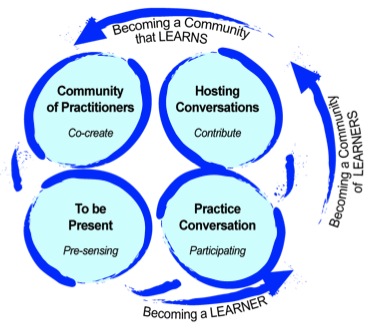
It is the last morning of our 3 day Art of Hosting training in St. Paul Minnesota in mid April 2012.  We have 40 participants plus our 6 person hosting team which includes 3 apprentices. The hosting team is starting our day by checking in. Day 2 was a good example of a groan zone kind of day.  The field felt a bit disconnected from itself.  There were little rumblings here and there that had been showing up since our opening circle on Day 1 that had our attention a bit and certainly our curiosity.  At the end of Day 2 during our check out as a hosting team, we noticed some of the dynamics that seemed to be in play, felt we didn’t have enough information to make informed determinations of what may or may not be in the field and let it go as we left for the day. On this last morning, the person hosting our check-in asks, “What are you anticipating in this day?”  The question gives me pause, although I’m not sure why — until I begin to answer it.  I start with, “Well, I’m anticipating a few good conversations with individuals – some of whom have already been identified.”  I hesitate.  What else am I anticipating in this day?  What do I want to anticipate?  Ah.  That is a good question.  My clarity begins to emerge. I continue, “I don’t think I want to anticipate anything else.  We know there are some dynamics in this field.  It is not fully clear what they are so I think I don’t want to anticipate anything.  What I do want to do, is be fully present and attentive, ready to tune into whatever emerges that needs tending, but without anticipating now what that might be.” This sentiment seems to resonate for all of us on the hosting team.  An invitation into being fully present, to not speculating, to not imagining how carefully we need to tend the field for certain things.  The first of the four fold practices – being present. The Four Fold Practice is a core pattern and practice in Art of Hosting and it has been receiving renewed attention lately in our teaches and our conversations. Self hosting. Not just being nice to self by going to the spa or eating dark chocolate.  Depth. Practice.  Discipline. The discipline of practice. Meeting oneself, sometimes in places one would prefer not to meet oneself. Being present is fundamental to good hosting.  This I knew.  What happens next for us as a hosting team is what has me reflecting still on the power of presence and what it means to hosting and, more than that, for me anyway, what it means in my life. As a team we decided not to try to figure out what may or may not be going on in the room, or who was holding the threads of what dynamics, but to let it go to sense into what was alive in the moment allowing us to more powerfully engage the next two folds in the practice – participating fully in those one-to-one conversations and contributing to the larger hosting process. Following our check in, I was coaching the proaction café team.  It was a large team, a bit chaotic to start, but everyone managed to find a role that worked for them with several teams of two hosting different sections.  I went off to find the members of the team to check in with them about their role and what, if anything, they needed from me. In entering the room, I began to encounter some of the people who seemed to be holding some of the threads of discontent and disconnect that had been popping up over the previous two days.  Spontaneously.  I didn’t seek them out.  I’m not even sure they sought me out.  We just bumped into each other. In this spontaneous connection in even just five to ten minutes, a depth of human to human connection happens on the level of story, being able to see and witness some extraordinary part of an individual’s journey.  What is even more surprising is that this spontaneous connection happens for many of our host team members. What we notice alive in our field now is that the threads of discontent and disconnect seem to dissipate and disappear.  They don’t go underground as often happens when not addressed, but they seem to disparate in the depth of human connection.  People feel seen, heard and acknowledged in their journeys in unanticipated and beautiful ways. Then, the proaction café weaves people, their stories and their gifts together in a beautiful way.  Nine projects/ideas expand in delightful ways.  The conversation hosts feel gifted.  The participants also feel gifted and honoured with holding and exploring other people’s dreams, realizing the power of contribution even when not directly connected to someone else’s project. One of the roles taken on in the proaction café is the deliberate and intentional holding of space – or the energetics in the room.  Two women stand on either side of the room, visibly and silently witnessing the room and hosting space.  When we debrief, they are asked to share what they have been doing and what their experience has been.  They describe the honour of it, of seeing the weave in the room, of deliberately fueling it with positive intention and love.  Participants describe their experience of it, what they feel corresponded to what they heard from the hosts of the energetic space.  It was one of the most deliberate explorations of what are we hosting really that I have been part of. When we do our closing, as often happens, we become aware of how powerful the three days have been for many who are there.  We are reminded of the power of the groan zone and how our assessment of where we are in our process influences our interpretation of whether we are successful or not.  On a day that ends in a groan zone it doesn’t always feel on track or successful.  Seeing the convergence in the next day reinforces the beauty and possibility of the groan zone. I’ve been through enough groan zones that I should know this but it is always a renewed awareness. As we close our hosting team circle at the end of the day, we bring curiousity about what has happened and a fresh wondering about the Four Fold Practice and the power of presence to shift the shape of the field and the possibility it can shake out some dynamics without needing to dive into them.  Is that what happened?  I don’t know with absolute certainty.  That’s my continued reflection.  Will full presence always be enough to dissipate shadow on its own?  Happy to experiment more to discover – rather than anticipate the answer to that. This experience has me reflecting on hosting self, specifically myself, my life and my relationships.  How often have I said about a situation, relationship or person, “I’m optimistic that…” or “I’m not optimistic that…” What is the anticipation that gets built into those kinds of statements?  What if I just met that situation, relationship, person, myself, in the moment of the experience and not as a precursor to what might or might not be but attentive to what, if anything, needs to be tended to in this moment?  How would this ongoing presence shift the shape of my experience now, shifting the shape of my relationships and my situation? I am deeply appreciative for the question, “What am I anticipating?”  It has made me aware of how much I do anticipate and how a lot of that does not serve.  The only journey I really need to pay attention to is mine.  Another person’s journey is not really my business and is certainly not my journey. My journey intersects with others, but they don’t define mine unless I let them.  I don’t define theirs unless they let that happen. Letting go of analysis and simply tuning in at the moment supports what wants to happen rather than fuels my own anticipation of what might or might not happen, possibly feeding something that didn’t need to be fed, creating something where it might not have existed except that my/our anticipation brings it into being.  Still ruminating on this one. Powerful lessons from the field on being present.

Deep Sensing Interviews

Deep sensing interviews are a powerful tool.  In the times I’ve used them I’ve seen them help deepen relationships, deepen a field of inquiry, shift the shape of  a team, organization or system.

Deep sensing interviews are one of the tools highlighted in the Sensing phase of Theory U,  where we begin to see how we see the world.  Once we become aware of our seeing, then we have the opportunity to focus our attention in more intentional ways.

The beauty of a deep sensing interview, when it is designed well, is that it takes the interviewee on a tangential or divergent journey to where you want to go which is usually the current situation you are wanting to inquire into.  When we take the direct route to where we want to go, we often get the first off-the-top of the head responses which also often are the responses aligned with role or positon in the team, organization or system.  It can be a good, helpful reflection and, often so much more is possible.

Deep sensing interviews take people out of their heads and invite them to embody the conversation or enquiry which takes them to a different place, allowing them to see their own experience and their own questions in new light.  They also help to build trust which is advantageous if you are embarking on any initiative requiring trust, openness and alignment.

It was through the four year Collaborative Care initiative, championed by the College of Registered Nurse of NS that I was first introduced to deep sensing interviews.  Phil Cass, who was on the hosting team with us, spoke about the impact in Columbus, Ohio. In health care work there designed to shift the system, they discovered, through sensing interviews, that the people interviewed seemed to have a public voice and a private voice.  The public voice was the one that came from their role or position and provided ideas or suggestions from that official voice. It was often also the voice looking to someone else to “fix” the problems.  The private voice was the one that tapped into both despair and hope, the embodiment of the conversation, the knowing that if change is really going to happen, it is going to happen through people and relationships first, then systems and that they just might have a role to play.

Phil’s experience with deep sensing interviews inspired us to use them too, but not without some trepidation at the start.  The structure of these interviews is a bit different and they take time – a good hour and sometimes more – which feels like a lot of time to ask of someone – especially someone busy, especially someone “high up” in a system or organization, especially since it doesn’t dive right into the information you’re after but takes the time to build the field of inquiry.  Now, however, having seen the impact and quality of response, it is an intentional strategy to draw upon when, of course,  it serves the purpose of the work underway.

There are four key phases to a deep sensing interview.  They are:

  • what was your path to here
  • why here, why now
  • what is here – issues and challenges that have led to this inquiry
  • imagining the future

Path to Here

I will tell people before we begin that this interview will start in a very different place, because I want to get to know them, because I want us to see connections across a journey.  The questions will be about where they grew up, what it was like to grow up there, what they wanted to be when they grew up, what did they do after high school, how they found their way there, what excited them, what they were passionate about.  These are not diversionary questions.  They are questions that help people reconnect with themselves, their dreams, their essence.

Why Here, Why Now?

What is their job now?  How did they get to this job? What did they aspire to when they began this job? What keeps them going on the difficult days or in the challenging times?  Why here, why now?

What’s Here Now?

This series of questions is intended to get at the issues and challenges – in the team, organization or system – that sparked the inquiry or the work. Why are we here?  What is the need?  What is their role in this? What could it be?  What are the barriers? What else gets in the way?  What conversations are not happening?  What are the costs – financial, human, other? What is the trajectory if nothing changes – how much worse could it get?  What would that cost?

Imagining the Future

Imagining the future – these are the questions to inspire what’s possible.  What one conversation, that’s not happening now, that if it did happen, could change everything?  Who would be in that conversation? What/who are your systems of influence?  What are we not seeing, that if we could see it, would allow us shift the shape of our experience?  What would an ideal future look like?  What would it take to move us in that direction?

The questions floated here are not the “right” questions, or the “exact” questions.  To be powerful, the questions need to be crafted to the purpose and intention of the work. Testing them improves them.  Leading people through a deep sensing interview invites them into a mindful reflection where just the asking of the questions begins to open up new possibilities.

Sometimes in the interview it is tempting to assume someone has already answered a question.  I will often say to someone, you may have already answered this, but I’m going to ask it anyway.  It is amazing what more turns up when you ask the question – something completely different sometimes, often a new level of reflection and depth.

I have used deep sensing interviews in systems work, in organizational work and with teams – particularly teams that are experiencing challenges in the moment.  Looking for themes and patterns across the interviews is a powerful tool for building momentum in the work.  We have, at times, reflected back the “voices” with direct quotes.  At other times, especially for teams, the themes and patterns have been mind mapped.  It is extraordinary how people begin to see things they could not see before, how illuminating themes and patterns provides a base for shifting to more of what’s working.  How people begin to recognize that their themes and patterns are collective – my story is also your story.  What a surprise it is to individuals when they begin to see this.

Deep sensing interviews.  A powerful tool when well crafted and clearly intended.

Recognizing and Releasing the Potency of Your Internal Judge

The potency of the internal critic/voice of judgment is insidious.  It is a master chameleon showing up in many different cloaks, rending itself almost unrecognizable.  It creeps up on you when you least expect it, plays havoc with your centre and your ground and runs wild until disempowered. It can be persistently in your experience and it can reappear after a long time away.

As soon as you try to debate it, convince it or argue with it, you engage it and increase its potency.  It loves a good argument.  It’s wily and it rapidly changes its stance to retain the upper hand.  You could be arguing a point and as soon as you get close to “winning”, it will change its direction.  Sometimes so much so that it now argues in the opposite direction and, if you are caught in the argument, you often miss the inanity of it.

My internal judge was running rampant yesterday but I didn’t recognize it until this morning – partly because it’s been awhile since it has been so present in me.

Yesterday I felt out of sorts, de-energized and unable to achieve any substantial progress toward my livelihood. Little things irritate me and make me impatient. I recently had a few days away on a little min-vacation.  My dad had a medical appointment yesterday that I attended with him and then went for lunch – a beautiful little pattern we have. My son is now beginning March break and I am dedicating time to being with him in some small adventures along  the way.

The internal critic is standing back with its arms crossed, shaking its head.  “Yup.  And just when are you going to get your work done?  Your emails sent? Meetings arranged?”  A little feeling of panic seeps in.  When am I going to do that? There is no time!  The panic rises up in me and now there are butterflies in my stomach and a promise of a headache in the offing.

“And, just what were you thinking, going off on a holiday when you have so much to do?”  it asks.

“Because we all know that a break away is important to maintaining energy and reinvigorating mind, body and soul so work and life flows easier.” I respond.

“True,” says the internal critic.  “But you know you couldn’t really afford it either.”

“I used points to fly.  I didn’t shop.  I shared accommodation.  I had some money tucked away for this break.” I argue, beginning to spin.  “And, in all that travel time, I did a full edit of my book.” I say, trying to find the positive, be appreciative, tune into what’s working.

The internal critic nods grimly, “Yes.  And what’s happened to your since then?  It’s been sitting beside your computer the last few days and nothing more has been done.”  (This would be a total of two days, by the way.) “Just how long do you think it’s really going to take to finish that puppy and get it published?  As if anyone is really going to read it.  Well, of course a few people will, but not the numbers you are hoping for.”

Wham. Wham. Wham.  Deeper and deeper in.  Fighting with myself to find my appreciative state.  To find my centre, my ground. Knowing in my mind I am my own worst enemy in this moment but not able to pull myself out of the spiral. Knowing I am out of my centre and it should be a simple matter to slip back in.  It’s not what I do – my actions that are important now, it’s finding the right internal vibration in me.  And my vibration is all out of whack which deepens my fear.  Tears of despondency show up as I believe into judgment, after judgment, after judgment.

Exhausted I fell into bed and dreamed.  I dreamed about flow.  I woke up this morning feeling better, feeling lighter.  Then the storylines began to filter in again.  Then the bolt of realization.  So self critical.  So self judging.  So the voice of my internal judge!  Big sigh.  Of course.  How had I not recognized this insidious internal berating voice taking me backwards and forwards in my imaginings, giving me no peace in the present moment.

A lesson I learned before: whenever my emotions run amok, it is a good clear sign that my internal voice of judgment is lurking in the shadows of my mind, making me a crazy woman!

In simply recognizing it and naming it, its potency is released.  Whoosh! I felt myself shift completely into the present moment, smiling at how this internal judge had found its way into my experience and rocked my core enough to have me questioning myself, my self worth and my path, once again.   No longer fighting and resisting it, simply naming and noticing.  Not arguing.  Acknowledging the power of an adversary that has so much to teach me when I pay attention; even the not paying attention is teaching me.  All it took to shift me back to my centre and my usual sense of joy, delight and calm was to pay attention, notice, name. Now I prepare to bake with my child and dance into this day in a whole new and renewed way thankful for the moments when I see the choices clearly.

Hosting Lessons from the Field – Dancing with Design Flow in Brazil

How many of us have had the opportunity to enter into hosting a day or a training (Art of Hosting style) without any design for the day, completely sensing into what is needed in the moment and fluidly dancing with five other hosts with offerings to meet what was emerging in the field moment by moment?  How would you meet that invitation?  Excitement? Trepidation? Both and anything in between?

It is one thing to do this on your own or with one other person as Bob Wing and I did last summer in work we’d been invited into that turned into Hosting Ceremony.  It is a whole other thing to do it with a new hosting team  constellation of six of us on the third and last day of working together – in this case for the first Warrior of the Heart training completed in Brazil in January 2012.

Warrior of the Heart is the work of Toke Moeller and Bob Wing coming out of many opportunities they had to jam together combining Art of Hosting and Aikido practices and principles.  Playing together they imagined Warrior of the Heart training into being.  I’d participated in a couple of Warrior of the Heart trainings – on Bowen Island in August 2010 and then at Windhorse Farm in Nova Scotia just this last October, 2011 with my 9 year old son.  I’d also had the chance to work with Bob where Warrior of the Heart became a component of the Art of Hosting training we were delivering.

In September 2011, after the Art of Hosting training in Porto Alegre, Brazil that I’d been co-hosting, Thomas Ufer, Najara Thamiz and I sat down with Jose Bueno and crafted an invitation to Bob and Toke to bring Warrior of the Heart to Brazil for the first time to seed the field for more and build the ground for the amazing expansion of the Art of Hosting and social change movements happening there.

Working with a larger hosting team for a training the two of them were used to offering on their own invited Bob and Toke to some new learning edges. They invited the rest of us to go there right along with them.  There was already a huge reservoir of trust in our hosting field even before we began. We built on it during our preparation and hosting time together.  On our last day, it was Toke who invited us into the dance of hosting together without an agreed to advance plan.

I felt in me my own skepticism at the invitation which arrived after morning practice, before breakfast, where we had actually invoked this flow already.  I really wasn’t sure how it would work and whether we would all find our own place to play in this day – but I was willing to step into the challenge – because with this team there was nothing to lose and lots to gain.

As the six of us stood in a tight circle on the stone patio outside the training building, a staff was in the centre with the challenge of who would take it first and offer something to the group to begin our day.  Silence.  A deep collective breath or two.  I could feel the tremble in me.  Another breath and then I reached for the staff.

I had been preparing during our time together to do a teach with the sword – in this case the wooden representation of the sword – a bokken.  Bob had been coaching me.  Perhaps because I was preparing to step into the challenge of a teach on something I was still very much learning myself, I had taken Bob’s feedback and coaching in in a whole new way, embodying the teaching and the sword movements with more fluidity and confidence than I ever remembered feeling.  I had been preparing for a teach and this was apparently the moment it would be offered.

I started the teach – the four directions – and forgot how to do the step to turn from one direction to another.  Without being hard on myself, I asked Bob to step in and help — and he did because he had my back.  All six of us had each other’s backs and none of us needed to shine or take up too much space and yet we were all invited to offer our brilliance when we felt the call.

It was the beginning of a rich dance that included all six of us throughout the day.  The experience was playful and fun and ended with a touching and powerful ceremony.

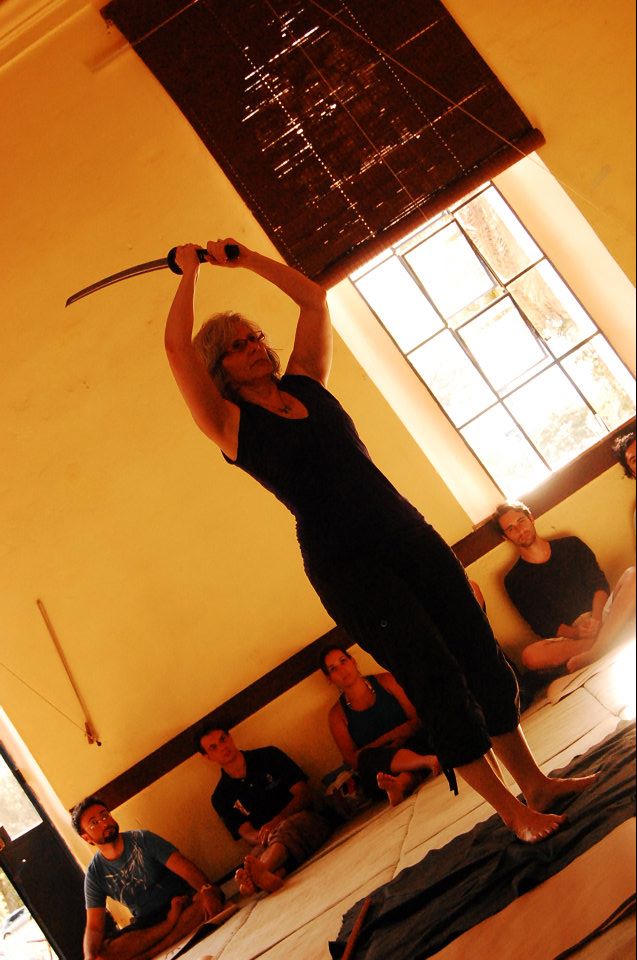
Raising the Sword in the Warrior of the Heart (Brazil 2012) Closing Circle

The willingness to let go of control and design flowed into the Brazil Stewards Gathering that followed the Warrior of the Heart – in its own way and to its own degree because, of course, the team and the circumstances were different.  But the fluidity of the dance was just as hesitant and joyful in its own way.

I’ve been reflecting on what makes this kind of dance possible?  One is definitely trust in the individuals and the collective of the team – knowing that each individual is there to serve the good of the whole and with no need to shine on an individual basis – although, as I mentioned above, of course each person does shine because of the gifts they have to offer in service of the whole.

A sense of knowing when what I have to offer as an individual is exactly what is needed now.  This is a complete dance with the subtle energies, with intuitive capacity.  The courage to offer it when it is called.  A certain level of trust or confidence in my own skills and abilities.  A willingness to let other people shine in their mastery or even in their apprenticeship.

It takes a certain level of maturity in each individual, the team and even in the field.

Would I want to completely free flow it every time?  I don’t think so.  Every situation requires us to be tuned into what is wanting and needing to happen.  Different situations will call out different things. And many situations invite a free flowing of design and offerings to different degrees.  I and we are already practiced with working with emergence.   Practicing to this degree honed my skill and my sensing capacity and invited me into new levels of mastery.  It is embodied in a new way.  It will always be with me – and with each of us.

Having had the opportunity to host immediately after this experience, I know it’s in me in a new way and for that I am grateful.  Looking forward to the next opportunity to dance in the ultimate emergent design – and to all the other variations of that that will show up along the way.  Thanks Toke for the invitation and to Thomas, Narjara, Jose and Bob for being willing to dance the beautiful dance that shifted the shape of my hosting experience to new depth.

Interrelationship of Circle-Triangle-Square

Many people are so frustrated working within hierarchy and bureaucracy that when they are introduced to beautiful engagement processes like World Cafe, Circle Practice and Open Space, a new love affair begins.  These methodologies are powerful in re-igniting passion, hearing every voice, creating mindful and thoughtful conversational spaces that take individuals and groups into new territory.

The love affair becomes a bit jaded when people begin to say, “Conversation is great, but what about doing something?  Where is the action in these methods?  Where does decision making rest?”  As if creating meaningful and relevant conversational space and decision making or action are mutually exclusive.  In many cases though, people haven’t figured out how to make them work well together.  It is not either/or.  It is and. What is the leadership and understanding necessary to find the balance that invites both broad based engagement and effective decision making leading to wise action and movement on initiatives, especially social change initiatives inside organizations and systems?  What does it take to truly shift the shape of the world we live and work in?

Recent conversation with with Toke Moeller and Bob Wing in Brazil has sparked my curiosity and reflection on the relationship between the circle, triangle and square that we often reference in the Art of Hosting.

The circle represents the social technologies that engage people in deeper, more inclusive ways, tapping into human longing for connection and meaning.  Circle is an ancient and universal symbol of unity, wholeness, infinity, the goddess, and feminine power. It represents the sacred.

The triangle represents  hierarchy and structure within which so much work happens and decision making takes place. When the triangle points upwards, it symbolizes fire, male power and the masculine archetype.  The energy of doing and of action.

The square represents the physical world in contrast to the sacred.  In relationship with the circle and triangle, the square represents new forms of governance, stewardship or strategic thinking partnerships.

Power of Circle-Triangle-Square Interrelationships

Much of the intention behind or underneath circle or engagement strategies is to share leadership and responsibility more broadly.  We are not always clear on what that means. Sharing it doesn’t mean foregoing it as sometimes happens as people begin to experiment and play with engagement strategies.  A point is often reached where things feel stalled because we are not always clear where decision making fits or how to do it well.

Sometimes change processes fail because leaders are not clear on how decisions will be made in conjunction with engagement methodologies. They then “take back” decision making which seems to disempower the move toward shared leadership and shared responsibility.

Yet, very little gets done without decisions being made.  Clarity around decision making allows for stronger relationships and more powerful work processes.  Understanding the need for and how the circle and the triangle work together creates the space for more intentionality in processes and relationships.

There is not just one form of decision making that should always be used.  Sometimes consensus decision making is the most appropriate decision mechanism.  Other times decision making will be vested in an individual or a team that sits elsewhere in the organizational structure.  The lack of clarity around who makes what decisions when and how information flows is more likely to lead to problems more than the type of decision making structure.  The degree of trust inside of the relationships also has an impact.  In organizations or systems where the trust is high, decisions are trusted and respected no matter who makes them.  In organizations or systems where the trust is low, of course decisions are questioned and sometimes disrespected.  Quality of relationship can be improved through the circle, thus supporting the triangle better.  Clear decision making processes improve quality of relationship.

The circle and triangle  are nested inside of the square.  If the square is equated to stewarding or governance, the role of the square is about holding space and perspective from a strategic, bigger picture point of view.  Not so active in the decision making structures or in the conversational space but bringing the awareness of deeper patterns that relate to or underly any given process, initiative or movement, providing insight and perspective that then feeds back into the engagement (circle) and decision making (triangle) processes.

The danger lies not in any of these specific shapes. It is in becoming enamoured with any one of them to the exclusion of the others or disenchanted with one to the point of not wanting to engage it at all.  As I consider the work in front of me now, I will bring this deeper curiousity about the interrelationship between the circle, triangle and square into my process and coaching considerations, particularly as it relates to new leadership competencies required in a rapidly changing world.