Unknown's avatar

About Kathy Jourdain

Kathy Jourdain is a co-founder of Worldview IntelligenceTM consulting, curriculum development and program offerings as well as a steward and practitioner of the Art of Hosting Conversations That Matter. This has her traveling internationally working mostly in Canada, Brazil, Europe and the United States. In 2009, she launched Shape Shift Strategies Inc. for her consulting practice. She is an author and keynote speaker. Her first book, Embracing the Stranger in Me: A Journey to Openheartedness has been hailed as an inspirational, deeply authentic sharing of the journey that has contributed to who she is today. She is contributing author to Gift of the Hit where she shares the story of her own soul journey with her mother, dementia and death.

Your Emotions are Your Guidance System

This week has taken me to some deep places in my journey yet again.  Depth invites exploration – if we want it to, of course. In a conversation a few days ago,  a good friend who is near and dear to my heart asked me how I was.  I said, “I’m discombobulated and my emotions are near the surface.”

“My emotions are near the surface.”  What an interesting turn of phrase.  What I meant is that sadness, sorrow, angst, tears were all near the surface and tears would spill easily and effortlessly with the slightest provocation – sorrow or joy.

In a later email to my friend, I dug a little deeper to discover what was stirring in my soul that caused these emotions to be so near the surface.  In that exploration, I identified and released things that had been swirling around  and in me about decisions and choices I have no idea if I will even need to make.   I began to settle into a place of not knowing and not needing to know in this moment, trusting clarity will arise in due course.  No need for decisions or choices today.
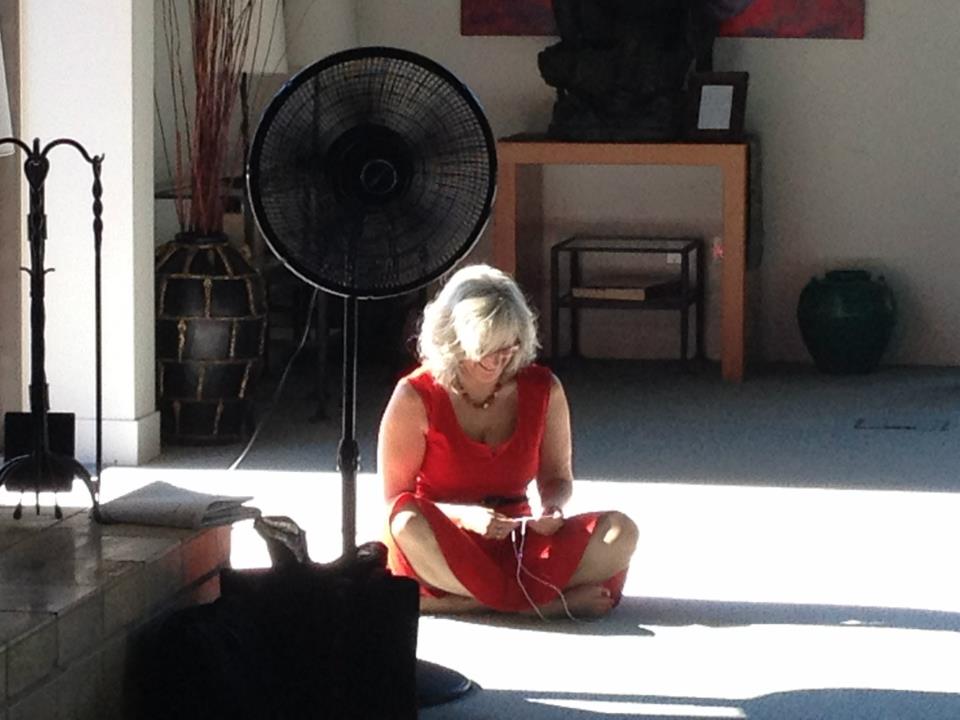
a moment of reflection

A moment of reflection

I surrendered back into peace, joy and delight.  As I awoke in this state today, I had a little realization, an aha moment.  My emotions are near the surface.  They are just different emotions than yesterday or the day before.  Which got me to wondering.  Do I even think of joy, delight, peace as emotions?  Seems I do.  But not in the same way as I think of sorrow, sadness, anger and grief as emotions.  Without being conscious of it, I’ve been making value judgments about my emotional experiences – just like I tell people we do in the coaching and teaching work I do.

Yup.  Here I am, doing it too.  Sorrow, sadness, anger, frustration, anxiety – bad.  To have those emotions near the surface is bad.  Like they need to be contained.  We don’t really know what to do with them but many of us have learned that trying to contain them, while it might work in the short term, just doesn’t work in the longer term.

How many times people apologize for their tears, one on one, in circle, in some meeting or gathering, and how many times I say, “I look forward to the time we no longer feel the need to apologize for our tears.”  I have, for the most part, stopped apologizing for mine.  So it is always delicious to discover what all is still alive in me as I explore my own emotional state.

Today, my emotions are near the surface. Instead of a tear sliding down the side of my face, a smile might break out for no reason in particular, when I’m by myself, with my son, directed at a stranger or, as it turns out, the two Mormon missionaries who just rang my doorbell.

The strange thing is, just like we don’t necessarily know what to do with the emotions we judge as bad or negative, many of us also don’t know what to do with joy, love, peace, delight.  We can be pretty good if it’s episodic.  If there is a reason – like we have to have a reason.  We’re not so good at knowing what to do with prolonged bouts of happiness, joy or delight – but what a beautiful challenge to embrace.

If we are used to chaos and negativity in our lives, it just feels different to shift into a new normal – of peacefulness.  A new pattern.  A new way of being in the world. Shifting the shape of our experience. Quite delightful to cultivate actually.  And this state of being does grow on a person.  Thankfully.

What I’ve been learning in the course of my life’s journey is that our emotions – the full range of them – offer us guidance.  I used to think they made me weak – at least the ones I judged as bad.  I use to think being vulnerable was the opportunity for someone to attack me.  Now I know differently.  There is strength and power in vulnerability when it comes from authentic open hearted space.  And it takes courage to step into vulnerability.

My emotions are my guidance system.  They tell me how close or far away I am from my centre, from my soul essence. They are a clue to what I’m thinking, whether I’m present or living in the past or future.  If I inquire into my emotional state I can find myself.  And I can change my state of well being by paying attention to my thoughts, discovering what I’m holding onto that doesn’t serve me.

I like finding myself in a place of peace and joy but it’s okay if I find myself somewhere else too.  My preference now, through the journey of life, is to find my way back to a steady state of feeling good.

So today, my emotions are close to the surface.  I wonder what beautiful mischief might ensue?
Ingredients for Hosting Team Success – An Inquiry

How is it we can take a group of people who may or may not know each other, throw them into a prep or planning day together and have them emerge out the other side as a team, ready to co-create and co-host a three or four day Art of Hosting training, to greater or lesser degrees as a cohesive, fluid team?

In the last few years, I have had powerful experiences of this happening in Atlantic Canada, in Brazil, in the United States, as I’ve invited or been invited onto hosting teams with a wide variety of backgrounds and experience, different levels of readiness to step more fully into hosting and different size teams from six to fourteen. And these days, in my experience, although individuals on the team know each other, the whole team has only met each other in person on that prep day.

Cohesive, fluid hosting teams hasn’t always been my experience.  Especially in my early days of hosting.  Having contrasting experiences offered me opportunities to notice and reflect on what worked and what didn’t.  Hosting myself, I became aware of how to, more often, invite the kind of experiences that work well.    Recently a good friend invited me into a deeper inquiry of, in my experience, what makes strong teams possible?  What are the ingredients for hosting team success?  These are not definitive by any stretch of the imagination, but they are some of the themes I’m noticing that consistently support strength and capacity in hosting teams I’ve been part of.

Some of it is in what happens in prep day.  Most of it is the quality of invitation to all of us on the team whether we are seasoned hosts or stewards, practitioners, apprentices, or logistics coordinators to show up fully.  We are all equally human, equally beautiful, equally valuable and  each of us holds a part of the whole.

There is no question the space for this invitation is held by the stewards.  It is not just a verbally issued invitation, it is one that is fully and authentically supported in all our actions and in our energetic field, in the space we create and hold for others to step into, in the responsiveness to all the voices that show up.  When, as seasoned hosts, we are able to step into our own humility and support the field from what might seem a less visible place, we open the space for others to step in more fully.

There are, of course, times that what we have to offer from our experience is what is needed – a thought, an observation, a question, a teach, a framing for what’s in the room, making something visible, stepping into our own brilliance in service of what is needed now. Knowing when to step in and offer what is needed now is also important – a part of the art.  Doing it in a way that builds on what others have offered, in the spirit of expansion and illumination, is a gift to self, a gift to others and a gift to the field in which we work.

To seed this field of invitation I want to have at least one other person on the team I know well, where mutual full trust exists, with whom I know we can handle anything that comes along.  With a minimum of the two of us (and one or two more is even better), we can hold the space for whatever wants or needs to show up in the team – and then in the gathering we are co-hosting.

Co-hosts and apprentices are wanting to know and understand their role, what they can contribute and how welcome their contribution may or may not be.  We are all wanting to know where all our learning edges are, what each of us wants to step into and how this can best be supported.  In particular, I am wanting to support people stepping up to their next level of learning, hosting or offering.  It is a thing of beauty when people publicly step into their learning edges, usually with some fear, some trepidation and loads of courage.

Prep day itself begins with its own welcome, framing and flow.  And an invitation to the full team to find the places they want to step in.  We begin open heartedly.  Infusing the space with welcome, invitation and confidence.  We move to  a check-in process. First on a  personal level.  What draws us to this work? What are we most excited about? Whatever question that personally brings us into the work and into the team.  Then we move onto what we know about who is coming, what their questions are, what they might be hoping for.

The harvest from these two rounds of check in is a co-created purpose statement to guide our planning and design process.  From there we take a first crack at design.  What is the invitation for each day? How will we invite people in, invite them to stay in, create the space for what they want to do and the opportunity for them to reflect on what they will do when they leave.  It is at this point I often notice the energetic threads weaving amongst the team.  People connecting more deeply.  Similar thoughts and ideas emerging at the same time.  Laughter in the room as synchronicities show up.  The awareness we have tapped a deeper place.

We take a look at what we’ve crafted.  Identify day hosts, hosting opportunities, coaching opportunities.  We invite hosting team members to offer where they most want to play.  We step in where we know our wisdom, knowledge and learning will most serve and we look for balance in the offerings.  We create a field of caring and intention and we prepare ourselves to welcome the larger group in the same open hearted invitation instilled with curiosity and generosity.

As a team, we stay tuned into and aware of each other in subtle and obvious ways.  We continue to invite each other’s brilliance and to support each other.  We work with the ebb and flow of individual and collective energy and know that we have each other’s backs. We ask for what we need and offer what we can. We invite each other.  We check in at the beginning of the day and we check out at the end of the day.  Openly.  Honestly.  Speaking what is in our hearts, minds and awareness.  Tuning in to what is in the space.

I don’t know if this is a recipe for hosting team success.  I know it’s been working in the places I’ve been and in the teams I have the pleasure of being in learning with.  I am certain there are other ingredients, other recipes that work equally well and will continue to be in co-learning and inquiry to continue to grow my own capacity to support hosting team success.

A question very much alive every time we step into a team, those we’ve worked with before and those we are working with for the first time is: what is the humility, generosity, open heartedness and also the brilliance that needs to be present and available in me, in each of us and collectively that supports the environment of co-learning in service of the field we are entering and committed to holding?

Art of Hosting – Universal or Not?

When people ask me if I do “this” for a living, the answer is, of course, yes. But they don’t really know what they are asking.  They are asking about what they are witnessing or experiencing in this given moment – a specific Art of Hosting training, a planning process, a team building session, a leadership development training, a community engagement process, a World Café or any other range of possibilities and possible places I might be invited to host or show up in.  And this is not just true for me.  It is true for many of my good friends and colleagues who are in this work.

It is a matter of what you see is what you get and what you get is far more than what you see. Going away from any of these singular events thinking this is it, that you know what it is, that you know it, is an easy assumption to make – and it misses the point.  It often seems so simple, often seeming to flow easily and effortlessly, even in groups or situations where tension or conflict has been evident.

Yet, when people get the “behind the scenes” invitation through being on a hosting team or a design and delivery team for a training or for client consulting work, they will often say that is where the real learning starts.  They begin to see what we mean when we say that 80% of the work happens before we ever get in the room.  It is also why some of us believe in being as transparent as possible in our process.

These days, when I describe the Art of Hosting to people, I’ve been borrowing from Jerry Nagel from the Meadowlark Institute because I love the clarity and simplicity with which he speaks it.  As a set of patterns and practices to work with complexity, that invites non-judgment or curiosity and generosity of spirit, of listening.  It invites us to be present, to stay in the place before the knowing until clarity, and knowing from a different place and quality, emerges – all of us and especially the hosting team.  We believe that conversations matter and good conversation leads to wise action and different results.

I am in deep reflection about the universality of art of hosting patterns and practices and the trap we set for ourselves if we believe universality equals one map, one path, one way to do it.  Overlay the successful work of one organization or one training on everything as if that was THE way to do it.  There is no one way to do it, no one practice or pattern that responds to everything.

It is the variety of hosting situations I’ve been in recently that have me in this deep reflection.   In Palo Alto in August 2012 for the first Art of Hosting training in California.  High tech, consultants to high tech, social innovators and a few pastors in the room.  Wanting to do business better.  In the Phillips Community of South Minneapolis in September 2012 with a remarkedly culturally diverse group of people, many of whom are community activists. Wanting to live in community together better. In Nova Scotia, also in September, working with a brand new charity Nourish NS responding to the need for a new structure for the delivery of breakfast programs in schools, birthed a year ago and still in it using the chaordic stepping stones, birthed out of need, chaos, confusion and pain.  In Fredericton in October 2012, a little AoH taster to sense into the need, opportunity and timing in that province for a second Art of Hosting training there, responding to themes of social change and community engagement.

Very different situations.  The “art of hosting” “worked” in each one.  I use quotations to remind myself that even what I’m writing about is nebulous and that the words evoke certain images, assumptions and expectations as I use them and you read them.

In California, knowing that getting people in the room required us to think very strategically about what would attract them, working with the calling team to find language that bridged Art of Hosting and business; finding that language that invites is a common practice and part of the invitation process no matter where we go.  Working with the concerns of the calling team about whether this group would sit still long enough to experience a deep circle, to dive into a three day process and stay present.  Yes, they wanted to get to action.  And they wanted to meet each other human to human, wondering how to do that in a world that does not always invite the human to human exchange.

In the Phillips Community, when we asked the people who came where they are from, beyond where they live, you could feel the ripples out into the world and then even more ripples when we asked them where their ancestors are from, circling the globe. Coming together to address tensions and violence in the community, their community, to imagine the kind of community they want to create, they want to live in, together.  Finding their way past commonality and past difference.  Human to human.  Getting to action that has the potential to shift the dynamic of their community, co-creating through new quality of relationship and understanding.  Practicing generosity with each other.

For Nourish NS, deep in a question of how to shift their shape from the “kitchen table” to the “board room”, grow their board, grow their capacity as an organization, adhere to Revenue Canada charitable guidelines and maintain the culture they have been intentionally cultivating over the last year or more that is creating an organization that looks different, feels different and invites people into a different experience.  Living their mandate.  Living their principles.  Prototyping how to be and work together and knowing they are in an experiment with clear deliverables, creating decision trees and governance structures to bring clarity and still allow emergence and nimbleness of response.

In Fredericton, a beautifully diverse group of people from the Department of Health, Renaissance College, students, city councilors, the provincial government, university professors, community activists.  Just three hours to dive into what might be possible with Art of Hosting and feeling like we had just begun a three day training but now everyone needed to go home percolating the vast array of questions we invited into the room about social change and community engagement.  Not leaving it nice and tidy, wrapped up in a bow with all the answers. Leaving it in the messiness that invites curiosity, invites exploration, invites a deeper dive together to discover what some of the answers might be.

AoH is only “universal” because it is adaptable, responsive, tuned into who’s coming, what their questions are, who and what shows up in the space, guided by a deep sense of purpose.  Tuning into the ebb and flow of patterns, energy in the room or field in which we are operating, cultivating emergence, leaning into what is wanting to show up in the space – not a set agenda, not a beautiful power point presentation, not all the answers or solutions but a living, breathing individual and collective experience.

In November, I’m invited back to Minnesota to go into another community experiencing many of the same challenges as the Phillips Community.  The core hosting team of four of us will be together again with some of the members of our apprenticing team and more people from the local community.  Our biggest mistake would be to assume that because we did it once well in the Phillips community that now we know what to do.  Of course, we have some beautiful learning from the Phillips community and from our individual and collective experiences from all the places we go.  But the only way we will really know what is needed the next time is to sense into the need and opportunity, the people who are coming, where they are from, the questions they bring, the hopes we are discerning and allow a purpose that is relevant to that work to emerge, let it guide the pattern we identify for the work of the days we are together and then be prepared to let it all go as people show up, we meet them where they are, see more deeply the questions, experiences and aspirations and let that guide what wants and needs to happen there.

I know from where I travel in the world, from the conversations I have, that AoH is universally applicable. But if we stop at that statement then we truly miss how this is so.  It is not the practices, frameworks, methodologies or even the patterns.  It is our ability as a hosting team to continuously sense into what is there, be prepared to let go of any of our own notions of what needs to happen, co-design on the fly from our individual and collective experience, wisdom and knowledge and to be responsive to all that shows up – the tension, the beauty, the joy, the humanness, the messiness and then work with the patterns, practices frameworks and methodologies to co-create the conditions to allow us to go deeply and well into the places waiting to be called forth.  There is a reason why it is called the Art of ….

Anyone who’s ever been to more than one well hosted gathering will tell you, it’s different every time.  And if that hasn’t been your experience, maybe you need to become curious about why that was so, challenge your own knowing and prepare to dive deeper into your own learning – or co-learning – because we are in it together.

The Field Beyond Difference

Out beyond ideas of wrong-doing and right-doing,

there is a field.
I will meet you there.

Rumi

Rumi’s words, with a slight variation, encapsulate the experience of an amazingly culturally and age diverse group of participants, apprentices and hosts who gathered September 11-14, 2012 in the middle of the Phillips Community of South Minneapolis where all of us discovered there is a field beyond difference and we are willing to meet each other there.

Image

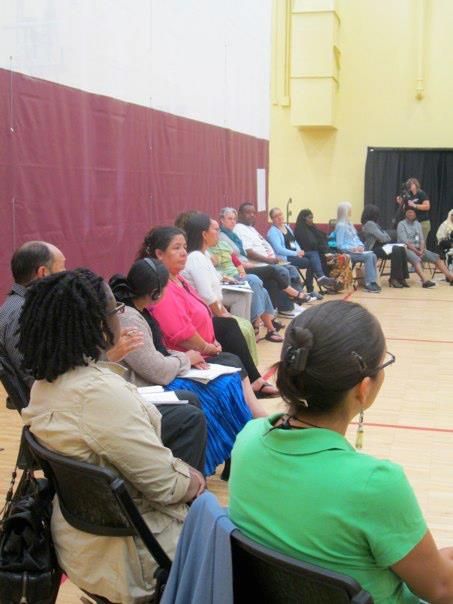
There was a tremble in our fourteen member hosting team as we prepared to welcome over seventy Somalis, Native Americans, African Americans, Anglo Americans, Latinos, people from Liberia, Ethiopia, Malaysia, Mexico, Costa Rica, Columbia and more, together with two translators: one for Somali and one for Spanish.  We were not sure how many would come, how many would stay or how many would come back the next day.

This Art of Hosting training, supported by the Bush Foundation’s InCommons in partnership with the Meadowlark Institute, was called by Amina Saleh a co-founder of the Native American Somali Friendship Committee, in the hopes that bridges could be formed across the  multiplicity of cultures that have come to reside in the Phillips residential area of South Minneapolis.  The original residents of this community were primarily African Americans, Native Americans and Anglo Americans.  In the 1990s immigrants and refugees began moving into the area in search of affordable housing.  Over the years, the cultures clashed, tensions rose and violence across the cultures, particularly between the Native Americans and Somali communities, occurred.

Amina found herself at an Art of Hosting training in March 2012 and became curious about what might be possible if a training was hosted right in the middle of her community, in the community centre, where the children congregate after school.  Well, we found out!

We started with a beautiful Lakota sage ceremony offered by Lemoine Lapointe from our hosting team, to open the space, to cleanse ourselves, open our minds and, even more so, our hearts.  An offering from one of the cultures present in the room, inviting others to also offer in a right moment or opportunity.

Lemoine Lapointe

Each one of us was then invited to bring our voices into the circle by responding to: my name is…, I live…, I’m from…, my ancestors are from… and I speak …. languages. As we listened, we became aware, beyond the diversity of skin colour already visible in the room, of the richness and multiplicity of cultures and languages represented in the space, the richness that showed up sometimes in a single individual as well as in our field.  It took our breath away and opened our curiosity.

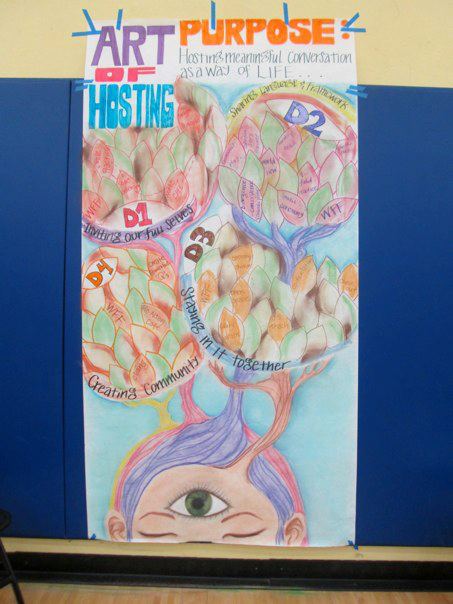
The purpose that emerged for the four day training was: Hosting meaningful conversations as a way of giving life, (1) inviting in our full selves and each other, (2) sharing language and frameworks, (3) staying in it – together and (4) building “whole” community. The phrases in the purpose statement framed each of our four days; scheduled to begin around 9:00 with a hard stop at 3:00, because this is when the children arrived in the community centre we were in and when some of the single moms in attendance also needed to be home to greet their children.

Beautiful visual depiction of our 4 day flow by Nou Ka Yang

Our first afternoon was a caféWhat is in your heart that brought you here today? What is in your heart for your community? What would you like to give life to here for your neighbourhood?  Powerful, surprising questions, giving pause like unexpected questions do.  Silence at the first café round while people let the question sink in, then decided how fully they wanted to bring themselves into the room, into the conversation, into the others also at their table. Cautiously, at first. What is in your heart? Not, why are you here? Not, what’s in you mind?  What is in your heart? Are you willing to go there yourself, let alone speak it into the centre of the table?

By the third round there was a beautiful buzz in the room as people began to relax into the invitation to bring their full selves.   In the harvest, one man offered, “Unlike Vegas where what happens in Vegas stays in Vegas, what happens in this room should not stay in this room. We all need to take it back out into our communities.”  This became a mantra for participants for our full time together.

People were ready and willing to offer their rituals, ceremonies and stories into our collective space.  In addition to the opening sage ceremony, we experienced a Somali coffee ceremony, an Aztek ceremony and a Hmong ritual and an African American dramatic story telling: Sojourner Truth, in addition to Native American ceremony, song and round dance from the Dakota and Lakota cultures. We gifted each other with prayers and blessings.

Sometimes it was a bit uncomfortable with the varying perspectives and cultural norms around touch, song, dance and partaking in another culture’s ceremony; but only just in that moment before understanding blossomed and more ease entered with the witnessing of things precious.  Graciousness, curiosity and respect filled the space and the conversations. Deepening our individual and collective listening skills invited us all to show up even more fully.

The realization that issues, concerns and passions arc across cultures invited people into bridge building. Education, children, community housing, racism, racial profiling, relationship with police, healing, well being.  Learning to navigate the dominant culture and stand up, both for what is right and for rights of an individual no matter each person’s roots or ancestral history.  Awareness of commonality in the diversity. People care about many of the same things even if their way of approaching them or their cultural norms may be different.

Invitation to Open Space

As we gathered in our check out team: Amina Saleh, Kadra Ahdi, Lemoine Lapointe, Molly Matheson Gruen, Susan Phillips, Bob-e Epps, Anne Gomez, Lori Lindgren Voit, Nou Ka Yang, Marcela Sotela, Jerry Nagel, Tuesday Ryan-Hart, Ginny Belden Charles and me, there were tears.  Tears of hopes realized, connections made, community strengthened, deep sense of belonging.

Our work began in the hosting team itself on our prep day.  It was the first time many of us had met in person as is common in these trainings.  There was a great variety of experience and understanding of the Art of Hosting in the team, from lots to little to almost none, with people eager to deepen their skill, grow their capacity.  The team quickly became strong and cohesive with each person stepping in, contributing, supporting as one fluid movement, offering what we each could, asking for what we needed. We formed community.

We became a field to welcome the larger field of community activists and organizers from across cultures who showed up.  And came back. Day after day.  For four days. They sensed something different. Became engaged in possibility in new ways. They made plans for next steps on very specific projects. Co-creating a new hope for the future. Giving life to community from a different place.  Stepping into courage, transcending fear, reaching out, seeing the human face of diversity and knowing that shifting the shape of the communities they live in and touch is possible to ever greater degrees.  Humbled, touched, delighted to be in this work that matters so deeply.

Credible Vulnerability?

No wonder we are so challenged by the idea of vulnerability, especially personal vulnerability.  It was a revelation to me to do an internet search on the topic.  What came up first and most was this kind of explanation:

  • the inability to withstand the effects of a hostile environment
  • window of vulnerability as a time frame within which defensive measures are reduced, compromised or lacking
  • Achilles Heel
  • capable of or susceptible to being wounded or hurt
  • open to moral attack, criticism or temptation

No wonder most of us shudder when the topic of vulnerability comes up.  It is in our collective consciousness and organizational cultures as weakness not as strength although much research confirms the power of vulnerability as pointed out by Brene Brown – beautiful and powerful in her own vulnerability.

I an in a renewed deep dive into this exploration thanks to the conversation that may have surprised and delighted me the most at The Art of Participatory Leadership and Social Innovation in California at the end of August 2012.  A conversation I did not expect to be witness to or our high tech company participants to be in.

It arose out of a World Cafe conversation on complexity in response to the third question: what’s stirring in you now as you contemplate complexity (after exploring complexity they’ve been in and barriers and supports for being in complexity)?  My attention was caught by a table where two men and two women were deep in a shared reflection of where vulnerability meets credibility.

The conversation went something like this:

“Yes, I know it’s a good thing to be vulnerable, but how do I be vulnerable and still be credible as a leader, in my organization.”

“It’s not safe to be vulnerable. You are seen as weak.  How can you be vulnerable and not appear weak?”

“I would lose credibility.”

“First you need credibility, then you can be vulnerable.  But how much credibility is enough?”

“Maybe allowing yourself to be vulnerable will show your credibility.”  Is there such a thing as credible vulnerability?  What does that even mean?

All of this led me to wonder what we mean when we speak about vulnerability – what’s in the field?  A lot about weakness  and protection it seems. This resonates with my journey personal journey, one of Embracing the Stranger in Me: A Journey to Open Heartedness.  The invitation was to move beyond believing emotions make me weak to understanding them as a guidance system that will never steer me wrong if I pay attention.  In the context of leadership, particularly participatory leadership, vulnerability does not equal weakness, defense systems do, but how and why is that so?

Thankfully Brene Brown is turning vulnerability (shame too) on its head so we can lean into it differently.  She says, “Embracing our vulnerabilities is risky, but not nearly as dangerous as giving up on love and belonging and joy ~ the experiences that make us the most vulnerable.”  And also make us the most human.

Sounds pretty personal.  What does it have to do with work? Because as much as we try we cannot be one person at home and another at work.  We suffer from the incongruency and it shows up wherever we show up.  People sense it, even when, especially when, we try to hide and know, from the place of deep knowing, when they have encountered someone in the fullness of their authentic journey and their vulnerability.  They often name it as courage.

Brown says what we are most seeking is connection.  It is why we are here, it gives meaning and purpose to our lives.  I hear the yearning for it in so many people who are drawn to Art of Hosting and related gatherings.  In order to have connection, we have to let ourselves be seen.  Truly, fully, seen.  But then we risk people seeing our weakness, our shame, any inauthenticity or lack of integrity we feel we may be carrying. We make ourselves vulnerable.

Interestingly, when I looked up the definition of credibility it is the quality or power of inspiring belief; the quality of being believed or accepted as true, real and honest.  Seems to describe what I think of as one aspect of vulnerability.  And it’s simple.

Given this definition, the relationship between credibility and vulnerability is so intimately entwined it is hard to separate out which comes first and which you need more.  If we can begin to see vulnerability for the strength and authenticity that it is, instead of as a weakness we cannot show others, our credibility instantly begins to rise.  But how?

There is no simple solution to this.  It requires courage and risk and a path of hosting yourself, growing self awareness and presence.  It requires the courage of being imperfect and of compassion – for self and others, particularly for self.  Finding the way to allow ourselves to be vulnerable without inviting criticism or recrimination – the fear of which intimidates us and makes us believe we need to protect ourselves. This is the conundrum.

Vulnerability is part of an intentional journey of learning to find our voice from the depths of our strength, our sense of worthiness, love and belonging, from the place of whole heartedness.  It is also part of the art of what we do.  The only way to trust is to risk.  The only way to risk is to trust. The only way to do this is to do it.  Risk as much as we dare.  Pause. Reflect. Learn. Embody. Trust. Risk a little more.  Eventually we shift the shape of our experience, our understanding, our credibility and our vulnerability. We live into it as the asset it is rather than the deficit many of us have experienced it to be.  It is not our vulnerability that is the challenge.  It is our fear of our own vulnerability that brings the weakness.

We didn’t name this conversation.  It showed up in an unexpected place.  Speaks to the yearning.  Speaks to what’s missing.  Speaks to the invitation.  Speaks to the first step.  Easy.  Difficult. Complex. Simple.  Choose.

There’s a Reason Why It’s Called The “Art of …”

What is art without technique and is technique alone really art?  “Art” could mean art as it evokes the image of artwork but, really, it is much broader than that –  dance, fitness, sport, yoga, meditation, music, hosting, the work we are in.

I’ve been in a beautiful reflection after a delicious conversation recently with good friend and hosting colleague Jerry Nagel. We were discussing upcoming work in California, Brazil and Minnesota and just after he’d been listening to an interview with Rosanne Cash. She spoke about working with her muse – the muse being the source of inspiration for creative work.  She said she works with her muse all the time.  All the time.  Not just sometimes.  All the time.  A discipline.  A practice.   In little whispers along the way and in more structured forms.

She also noted how performing in front of an audience is not a one-way street although she used to think that early on in her performing career.  Now she knows through experience there is an energetic exchange between the performer and the audience.  Tuning into the energetics.  Fuelling and being fuelled.

My conversation with Jerry started with a curiosity about how working with the muse relates to our work in Brazil at the end of October: Hosting From a Deeper Place with two Brazilian friends, and the purpose of that gathering.  Perhaps it is about how we each individually work with and cultivate our muse, our source of inspiration.  How we move technique to art or if we are already in art, how we grow our artistry in our work and life? Because it is a practice.  It is a discipline.  It is not just present some of the time.  It is present most or all of the time.

We then moved into an exploration of what we do in Art of Hosting trainings, in our work with clients and what’s happening in the field in Minnesota where hundreds of people have been to an Art of Hosting training in the last year or two and some are stepping into a deeper journey to be a trainer but wondering really, what is the path to artistry and what does it take to get to the field beyond good technical skill?

People will often say they come to an Art of Hosting training for a technique – like World Cafe or Open Space Technology.  Or, as some like to say, “to expand their tool kit”.  And technique, particularly good technique, is fundamentally important to what we do and what we offer.  We need to know and practice the foundation or the fundamentals to get good.  An artist practices technique – whether with paint, music chords, performance basics, fitness basics.  I wonder if artists talk about expanding their took kit or if they talk about growing their craft?

Most of us don’t just sit down at a piano and have beautiful music come out unless we are some sort of musical prodigy.  Nor would we expect that.  We would expect, if we were inspired enough, to learn the foundations and know that after we learn the foundation then we have the opportunity to become more and more intricate with the music, the style, the mix of technique.

Some never move into artistry from being a technician and, for sure, not everyone must. However, there is a quality we can observe, hear or sense, that lets us know when we are listening to music from a good technician and when we are listening to music from an artist.  It comes from the heart, from the soul.

It seems to come when we can relax in the technique and live in the art – just as true in hosting work as any other kind of artistry.  Art  bolstered by working with the muse all the time.  Even, maybe especially, when we are not working with groups, we are working with the muse.  Developing a discipline of practice. The practice is the work.  The practic is holistic – involving fitness, health, spiritual and personal practice that allows us to know ourselves – the first fold in the four fold practice – hosting self, being present.  The more we know ourselves, really know ourselves, in addition to the solid foundation of knowing the technique, the more we dip into artistry.

The difference between being a technician and an artist is subtle and dramatic at the same time.  It is something we sense but can’t always name.  It is tuning into this energetic exchange between host and hosted.  Sensing what is there rather than looking for it.  In the looking for it we sometimes miss what’s really there.  In tuning in, we sense the subtleties in the room, in the energy that is present that requires hosting in quiet and/or more obvious ways.  We become like a well tuned instrument.  And it can take years of intentional practice for this to happen.

I am aware in my summer of presencing, where I have not been hosting groups, I have continued to be in the work, practice, discipline of hosting myself – with new levels of awareness and new patterns of joy emerging.  When I begin co-hosting groups again in a couple of weeks, I know in the depths of being, it will come with a whole new level of presence.

With practice, the discipline begins to call on the host.  Time to exercise.  Time to meditate.  Time to invite a conversation – to host and be hosted.  Time to be curious.

Hosting from a deeper place is what happens as we move beyond being good technicians into artistry.  There’s a reason why, when we name a training, workshop or intensive, we often call it the “art of…” The first or surface invitation is into technique and process.  The deeper invitation is into practice and discipline that tips us over into artistry, the understanding of the deeper patterns, the energetic architectures and sensing into the subtleties that show intervention points that are much harder to grow awareness or understanding of when we are in the technical learning of our craft.  It is why one art of hosting training does not a practitioner make.

Technical competence and expertise?  Yes we need it.  It builds a strong foundation.  Artistry?  Where and how does your soul call you into your hosting artistry and what are the subtleties you notice – in others, in yourself – as you tip over?  What muse inspires you to deeper places in your being and invites you to bring more of who you are to what you do?  What journey do you need to embark on to host for a deeper place?

Half Way Through 50 – Deepening In

I’m half way through being 50. Well, maybe a bit more than half way but it is summer and I think the whole summer can count as half way if I want it to. And it’s not that I’m trying to resist or sugar coat the reality of linear time moseying along at sometimes frightening speed. I’m excited about being 50 – and for what comes after that.

Recently I have had the awareness of how much this year is a U journey for me. Maybe every year is, but it is particularly prominent this year.  There are three big chunks of Theory Usensing, presencing and realizing. They do flow, but they are also iterative and there are many U journeys within overall bigger, longer, more expansive U journeys. And thank goodness for that.

I was excited to recognize I am in the presencing phase.  I felt invited to more fully relax into the summer and the continual unfolding of my journey, of me.  The transition to realizing energy will arrive as I go to California in late August, the first of many trainings with good people in varied environments.  Even as the energy shifts, sensing and presencing will continue to be a rhythm in each day, each experience, each movement.

So, what does this mean for me to feel the presencing energy of these moments this summer? And why the heck is it even important? In a post from a few months ago on turning 50, I wrote:  “This is a time for me to break old, limiting patterns, to step more fully into what is mine to do, to completely embrace my purposeful path and live into all that has been on my own edges for awhile.”  The ability to do this is activated,  amplified and accelerated by presencing.

Part of presencing is being in stillness.  The summer has been providing me with this opportunity.  The stillness that comes from not too many meetings or other obligations and lots of choice along the way about where to tune in time and attention.

Presencing is also about letting go and letting come.  Being in the stillness allows not just the witnessing of this but the embodiment of it.  I feel it fully in my body and in my spirit, in my being.  I sense the deep movement I am in and know with that sense of deep knowing that I am embracing my path, my unfolding and yes, my living into what has been on the edges.

It is evidenced by how fast I have been spinning into and out of turmoil in these last few months.  Faster than I ever have before.  I’m learning how to be in it without being overwhelmed by it or projecting it onto someone else – trying to make my experience someone else’s fault; enquiring into my experience to understand what is mine to own, what is projection from someone else, what I need to let go of and grab hold of, what is mine to learn.  I feel a bit of joy and anticipation in it and am not needing to rush into the next phase.  When I feel my anxiety rising because my book still needs editing and is sitting waiting for me and I don’t yet know how I will publish it or any other of a myriad of things I’m in the middle of, I breathe, let go of following those thoughts into the future of doom and trust the book’s energy will invigorate me in the right moment.

Work opportunities arrive, some land, some flow away.  Trusting the right things will show up.  Seeing where the invitations are, the openness, the readiness for me, what I have to offer and my journey.  Seeing where the energy isn’t.  Feeling how it is guiding my path.  No need to try to grab everything that might be within reach but being intentional about moving with the flow of what is mine to do, where I am needed, where I’m not.

I’m witnessing the evolution of my own spiritual growth, my knowing who I am.  I find myself leaning in, not jumping to conclusions, not lashing out at others but sharing my experience and my questions, and breathing through experiences that would have spun me out not even that long ago.  At the end of each of these periods of turbulence, I come out more grounded, more deeply connected to my core and my purpose and less attached to people, places and things – ready to let go of anything that hooks me and anything where the energetic openness is not available.

Trusting the guidance from the subtle realms and feeling more deeply connected – with a sense of, “of course this is how it is, how simple, easy and available.”  Opening more fully.  Yes, the journey to open heartedness and somehow even more than that.  Surrendering with joy and delight into the shifting shape of my world.

Slowing Down to Go Fast

Our world moves so fast we all want it done now, or yesterday – whatever “it” is. The paradox is, we don’t have time to go fast anymore. But it’s not just about slowing down. It’s slowing down, adding in intentionality, purposefulness and patterns of movement – often non-linear and iterative – to take us to places we’ve never been before but that we’ve dreamed and know have to be possible. We want to get to this new place but we keep repeating the patterns that have never gotten us there before – Einstein’s definition of insanity.

Add into the mix, the complexity of today’s challenges generally means it is not a straight path from A to B and even if it is, your destination is probably somewhere else.

What does slowing down mean?  One is taking the time to acquire new lenses with which to view the challenges and complexity we face.  Another is learning how to use conversational methodologies well – tuned into purpose and intention as a guiding principle for how to design, enter and engage the questions of most relevance to what’s needed now – in growing learning, tackling innovation or bridging organizational divides.  It is not simply a learning and development opportunity.  It can be a formidable strategy to grow an organization, engage a challenge, conceive of innovative processes and/or products that serve the mission or mandate of your organization – as you already know.

These things are all possible using the principles and practices alive in Art of Hosting practices and frameworks.  Art of Hosting is not just a training.  Seasoned practitioners use it in consulting work all over the world – in every sector, for small and large initiatives, to launch new organizations and teams and to shift whole systems.  It is not just theory.  It is today’s complex challenges made real.  And it takes time.

For the training work we do, we often get asked about three days.  When money is no issue the larger question that looms is, “Is it worth three days of my time?”  Well, that depends.  On how aware you are of the value of slowing down to go fast – slowing down to allow insight to percolate, new perspectives to digest into new approaches and new strategies to emerge in animated and reflective conversation with other bright lights called to gather together in three days.  Because there are an amazing number of bright lights who show up for any training – of all ages, backgrounds and perspectives.

The beauty of being in 3 days or more with the same group of people is it invites the pattern of divergence-groan zone/emergence-convergence to show up.  There are many times when I’ve been asked at the end of day 2 of a three day training how is it going?  If I write that story, it is a very different story of what emerges because even subtle things shift and change in one more overnight or one more conversation evoked through a powerful question.  There is something in a three day pattern that lets us sense more fully into what our questions are, explore them in the company of others also asking powerful questions, seeing not just synergy but emergence – where we all gain something that no one person brought into the room, and we begin to imagine, often with extensive detail, how we will use what we’ve learned when we go back to work.

Not everything needs to slow down of course.  Not everything needs three days.  Some need less.  Many need more. But we refuse to take the time – we believe we don’t have the time, other things are more pressing, we will get too far behind – lots of limiting beliefs we carry individually and collectively.   But what about the things that do need three days and maybe longer? Percolation does.  New perspectives often do.  Imagining – really imagining the new – does.  Shifting paradigms does.

When we give ourselves permission to slow down we also invite ourselves to be surprised by what emerges and how fast things move with new clarity.  It is a wise investment of time and necessary for those of us imagining how to shift the shape of the worlds we touch.

Innovation, Responsiveness, Imagination – Lessons from Apple

A few months ago, when I needed to replace my laptop, I considered switching to a Mac but was concerned about the learning curve. I put a note out on Facebook with an enquiry.  Of 20 responses, 19 were from Mac users.  “I love my Mac,” was the essential essence of the messages.  The lone PC user said, “I’ve used a PC for 20 years and never had any problem.”  which might have been a ringing endorsement if were not for the amazingly enthusiastic responses from Mac users.  I bought a MacBook Air.  I have no regrets.

Now, I’m reading Steve Jobs biography.  It doesn’t pull any punches.  It is a straightforward account of a brilliant, demanding, tyrannical, charismatic man, often running roughshod over people to get what he wanted.  He  had a love for art and technology – a combination that allowed him to imagine possibilities others just couldn’t see.  It was brilliant for Apple and more so for Pixar. He would never win any awards for his people leadership skills but he could dream the future, imagining products we didn’t know we wanted or needed and he followed his intuition all the way to the bank.

Reading his biography, the threads that contributed to Apple’s successful innovation, responsiveness to conditions and opportunity, and the imagination that brought so much alive in techni-colour, became apparent.

Jobs was obsessive about control and when he had an idea he fell in love with, he didn’t want to let go. He wasn’t always right, and he wasn’t impervious to influence, but when he was right he changed worlds.    He revolutionized the computer industry, then the film industry, the music industry and the book industry.

He didn’t treat people well, but he knew a thing or two about the business of innovation. A few themes caught my attention as I read:

  • beauty and intuitive
  • simplicity and focus
  • integration – not just of product design but of the people and departments responsible for all aspects of a product

Apple products were designed for beauty and intuitive use.  Anybody should be able to pick an Apple product up and figure out how to use it without a manual.  And they should love the look and feel of it. This influenced the design of products.  In the development of the iPod for instance, Jobs decided users should be able to get to anything they wanted intuitively in no more than three steps.  The guiding concept: a thousand songs in your pocket.  Products were designed with the user in mind.  The few times Jobs lost sight of that, like with NeXT his company after and before Apple, he didn’t do as well.

Simplicity and focus.  Apple picked a few key projects to work on in any given year and dedicated resources to the most promising of them.  Anyone could pitch an idea – without a powerpoint because formal presentations bored Jobs.  They had to know what they were talking about well enough to free flow it, discuss it (often heatedly) and not rely on a prop like a slide.  Although something tactile, put in people’s hands worked well.

For products under development, long weekly meetings were held with all departments represented to hash out ideas.  Prototypes were developed that could be picked up, turned over and handled to determine what worked, what could be improved and to know when they nailed it.  The conversations were no holds barred – animated, lively.  It all came out in the meetings.  The people who fared best were the ones who figured out how to stand up to Jobs, when to fight, when to wait, when to back down.

Jobs would not allow dissension between departments.  If they couldn’t get along, someone lost a job.  And when decisions needed to be made about product, design, colour or other relevant factors, it didn’t go to a committee for recommendations or a market study to figure it out – decisions were made, often on the spot, without hesitation.  They might not always have been right, but the speed of decision making capability enabled Apple to be responsive, resilient and a market leader more often than not.

Beauty, simplicity, focus, end to end control, responsiveness, imagination as hallmarks of innovation. Not that I’ve done it better than Jobs or come anywhere near to his success, but I would like to think adding in a strong people culture to this great list would only enhance capacity for innovation – so long as we really understand what this means, growing leadership and decision making capacity within an organization, not diluting it.  While there are one or two things that give me pause, there is a lot to be learned from Apple and from Steve Jobs.   After all, he did shift the shape of the world as we know it.

“Until recently”…. a Very Simple Strategy

“Until recently, my office was really cluttered.  Now, I’m in the process of organizing it.”

“Until recently, even though I liked you and wanted to be in touch, I was a little afraid of you.  Now, I promise to stay in touch because I’m no longer afraid of the questions you’ll ask.”

“Until recently, I didn’t know how to approach difficult conversations.  Now, I’m learning strategy and gaining courage.”

“Until recently, I was just walking through the experience of my life because I was afraid of my emotional response.  Now, I’m living into it. And, it’s not as scary as I imagined it to be.”

“Until recently, I was struggling.  Now, I’m feeling more flow and a smoother road ahead.”

It is a simple little strategy that, until recently, I hadn’t heard about.  But, now that my friend Robert Newman from Columbus Ohio shared it with me when I saw him in June, I’ve been using it and I’ve been sharing it with my coaching clients.

One of the aims of coaching is to become aware of old patterns that no longer serve and awaken new patterns that serve us better, generating greater self awareness, one of the goals of hosting self in the Four Fold Practice.  It is really easy to get stuck in the story of what was instead of engaging the story  or the future we want to invite, the one that shifts the shape of our world and our interaction in it intentionally in the direction we envision, the way we want to show up for ourselves and in relation to other people.

It invites a gentle noticing: “until recently this is the way it was” – and it invites an intentionality: “now, this is what I choose. ” There is no harshness, no self judgment but a delightful invitation to choice.  To choose a better feeling story and invite ever increasing better feeling results.  It is like a mantra and a habit that can be remembered mid sentence in an old pattern:” I don’t keep in touch very…” pause, notice… “until recently, I wasn’t very good at staying in touch. Now, I’d like to set up a regular pattern of calls”.

It invites lightness into whatever it is we want to shift and grows the potential we will create the shift we want.  Try it.  Recently, I have discovered it is a very simple yet effective strategy.