Hosting From A Deeper Place: The Art of Hosting the Subtle

The subtle and the physical.  Both are all around us all the time.  The eyes see the physical and we perceive it as “real”, tangible.  It often takes more than the eyes to “see” or sense the subtle.  Since we have learned to rely on our eyes, we have lost much of our conscious connection to the subtle. Yet, it is all around and within us even as many of us are oblivious to it.  It is a natural extension of the physical phenomena or/and the physical is a natural extension of the subtle.  Yet we complicate our understanding of the subtle, ignore it, believe it inaccessible or non-existant.  Or, believe that if it does exist, only a few really gifted people can access it.

Speaking for myself, up until a few years ago, I didn’t believe those gifted people included me. Now I know we all have this “gift”.  It is a sense many of us are re-learning, remembering how to tune into.

This understanding was one of the things at the heart of the call for Hosting From a Deeper Place: The Art of Hosting the Subtle, co-hosted by Narjara Thamiz, Gustavo Prudente, Jerry Nagel and me. Our time together was guided with the purpose of “joining together in a learning field to deepen  individual and collective capacity to host complexity.”  Implicit in that purpose statement is the notion that in order to host complexity well, we need to tune into, discern and understand the subtle, the energetics, the deeper patterns that are also at play.  Tapping into this in an intentional way has the potential to shift the nature of the work we are in and the results we achieve.

Openly talking about the subtle has challenged many of us in the work we do.  Too many times we have bumped up against hearing that this way of working is “woo-woo“. “Don’t want any of that “woo-woo” stuff here, we need practical results.”  Yet, when work is in flow, when it is emergent and generative, people understand that something different happened, that something impactful, useful and powerful has influenced the results, the actions flowing out of the work.  We have been trying to find ways to describe it, words and phrases that are understood and accepted in the world of business, government, non-profit.  Yet truly hosting from this deeper place is beyond words, beyond knowing and beyond not knowing.  This is the exploration that called us.  What does it means to access this place with intentionality, a place of presence.

The first time I explicitly remember hosting from a deeper place was with Jerry Nagel the first time we hosted together in Nova Scotia in 2011.  We looked beneath individual behaviours that were sparking to discover the patterns underneath, working with the subtle field.  Tapping into the deeper patterns elicited design ideas that produced a complete shift in energy, in relationship and conversation within the group.  We happened upon this through inquiry and, when we noticed the palpable shift in the space, became curious about what we had tapped into.

In my last post, I wrote about our design process, about being in the not knowing and riding the waves of emergence that kept surfacing during our time together at Hosting From a Deeper Place in Brazil.  It was all part of working with the subtle and working with the subtle went much deeper than that.

Some of the people who came, came because of an intense curiosity about the subtle, including people who have had near death experiences, experiences with shifts in consciousness, with tapping into different dimensions.  They arrived with curiosity about what we meant by the subtle, invisible forces, that which is before the naming.  Their experiences, our experiences, as diverse as the number of people who came.

The subtle field showed up, in subtle and not so subtle ways.  The beautiful property of Espaço Arco-Íris was designed for this kind of work and hosts groups in this kind of energetic field.

Despite interest from many parts of the world, the people who responded live in North and South America.  In our opening circle, Narjara remembered a dream she had in the early days of our conversation about this gathering.  She had dreamt of a condor, not knowing what it was, discovering the Hopi prophecy of the Eagle and the Condor, a meeting of cultures and energies, a shift from leadership from the mind (North America) to leadership from the heart (South America).

The hosting team designed for the first day and a half.  The third day was co-created with participants.  The fourth day was open space.  We were holding the mystical and practical in our field and this too showed up in the open space.  A session on tarot cards was offered for messages related to our gathering and other events in Brazil at the moment.  Jerry offered the flow game, a mystical tool itself applied to deep and often practical questions people bring as they host themselves.

I offered a question about spirit guides, guardian angels and power animals, what do they have to do with our work?  As I write this I notice my own tension between wanting to share this story and my uncertainty about how it will be perceived by people who read it, who were not there, wanting to honour the integrity of each of us who were part of this overall experience of Hosting From a Deeper Place, not all of whom were part of the session I called.

Taking a deep breath, I am continuing to share, inviting those who continue to read to bring your curiosity and open heartedness to what you read.

My open space session turned into two as someone in the circle shared that one of the participants channels a guardian and would we welcome the guardian into our circle with any messages meant for us?

the circle in the woods

Anita Gomes joined our circle, noticing that the guardian she channels was indicating she wanted to share with our circle.  The guardian’s name is Vó Antônia or Grandma Antônia. She is a “Preta Velha”, from Umbanda, a Brazilian religion that blends African religions with Catholicism, Spiritism, and considerable indigenous lore.

Vó Antônia is an old black woman with completely different characteristics and mannerisms than Anita.  She also has a lovely manner and a beautiful sense of humour.  Those in our now expanded circle had both personal questions and broader questions for her.

There were key messages that resonated for me.  Vó Antônia shared with us there is no need to doubt the existence of the subtle.  It is as real as the physical.  There are entities, beings, guides that support each and every one of us, whether we are aware of them or not. We are on the same team, we just live in different houses.  When asked if we should be looking for signs she told us it is long past the time when we need to look for signs.  No books falling off of shelves, windows being rattled, doors opening mysteriously, smoke signals being sent.  It is far simpler than we make it out to be.

We rely on our eyes too much. They give us false information. We look for physical beauty.  We look for ways to show how special we are, how gifted we are.  Seeing through the heart allows us to see through many false pretences.   Seeing in this way we will be in our knowing.  We will be able to trust our knowing, trust ourselves.

It is not too late to save the planet.  We are already working in service of the planet.  We do not need to be afraid.  As above, so below.  As within, so without.  As in the physical, so in the subtle.

Our gathering might seem small but its impact is significant.  When we leave, we simply need to keep doing what we are doing, seeing from the heart, knowing all is intertwined.  Walking the paths that call us, living purposefully, meaningfully, intentionally.  We are weaving the web of the past and the future together for the present moment.

For me, I came home from this experience in Brazil in the space of expansiveness, remembering from time to time to take a breath and sense beyond my physical form to where the boundaries blur and my consciousness swims, intermingled with other essences of and from the subtle.  To remember that it is not two separate things – the physical and the subtle – it is all part of the same essence, each in its own way.  To remember that my spiritual journey, my life journey, my career path are not separate things that I need to think about how to combine, work and the sacred are all essences of the same thing.

It was and is, of course, different for every one who was there.  The group is still alive and sparking in beautiful, interconnected ways of story sharing.  Many are sharing how they are hosting from a deeper place and what that means to them.  Most of us are still in the discovery of what it means, how it is showing up, how the subtle and the practical are dancing together in powerful, beautiful, noticeable ways.

We are curious to see what more the story is becoming, what more we are each becoming, individually and collectively.

And, while we were told we didn’t need to look for signs, the pictures taken on our last day in our opening circle outside showing orbs of light in the sky and around each person in the circle no matter where we were standing seems a pretty good reflection of the energy field expanded by our time together in exploration of the practical and the subtle.  Tricks of light or just light?  Simple, really.  Beauty and grace.  Expansiveness from the heart.

orb of light in the treesorbs of light

Hosting From A Deeper Place – Working with Not Knowing and Emergence

It was a long time in the planning, a conversation begun two years ago in earnest, a few twists and turns along the way with possible hosting team members and dates.  If you trust in the timing and flow of things, it was clear, Hosting from A Deeper Place: The Art of Hosting the Subtle happened in exactly the right timing at the end of February 2013 near Sao Paulo, Brazil at Espaço Arco-Íris.

The gathering was inspired by Marianne Williamson‘s quote from A Return to Love:

“Our deepest fear is not that we are inadequate. Our deepest fear is that we are powerful beyond measure. It is our light, not our darkness that most frightens us. We ask ourselves, Who am I to be brilliant, gorgeous, talented, fabulous? Actually, who are you not to be? You are a child of God. Your playing small does not serve the world. There is nothing enlightened about shrinking so that other people won’t feel insecure around you. We are all meant to shine, as children do. We were born to make manifest the glory of God that is within us. It’s not just in some of us; it’s in everyone. And as we let our own light shine, we unconsciously give other people permission to do the same. As we are liberated from our own fear, our presence automatically liberates others.”

Since it was the first gathering with the specific intent of exploring what it means to host from a deeper place, the hosting team of myself, Narjara Thamiz, Gustavo Prudente and Jerry Nagel sensed the need to spend additional time together beforehand, preparing ourselves, preparing the field for what wanted to happen and we decided on three days.  In hosting work these days, there are typical patterns we draw on in our design process.  For this gathering, there were no particular patterns to draw on.  We felt in the not knowing of new patterns, of what wanted to emerge.  We were intentional in inviting ourselves to stay in our own not knowing about what exactly the gathering was and about what was to happen during those days together.

The purpose that emerged through our deliberate enquiry into a statement that would guide our design process was: Joining together in a learning field to deepen individual and collective capacity to host complexity.

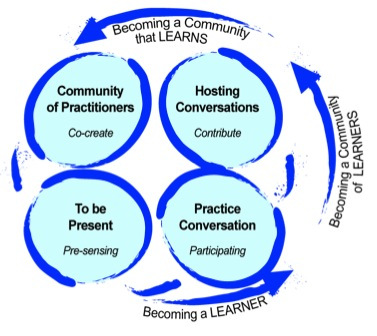
We decided to draw on Theory U to map out our five days together and to incorporate the Four Fold Practice as fully and intentionally into each day as we could, looking for the interplay between hosting self and hosting others, and the dynamic relationship between the mystical and the practical and how that shows up in each of the four practices.

four-fold-practice

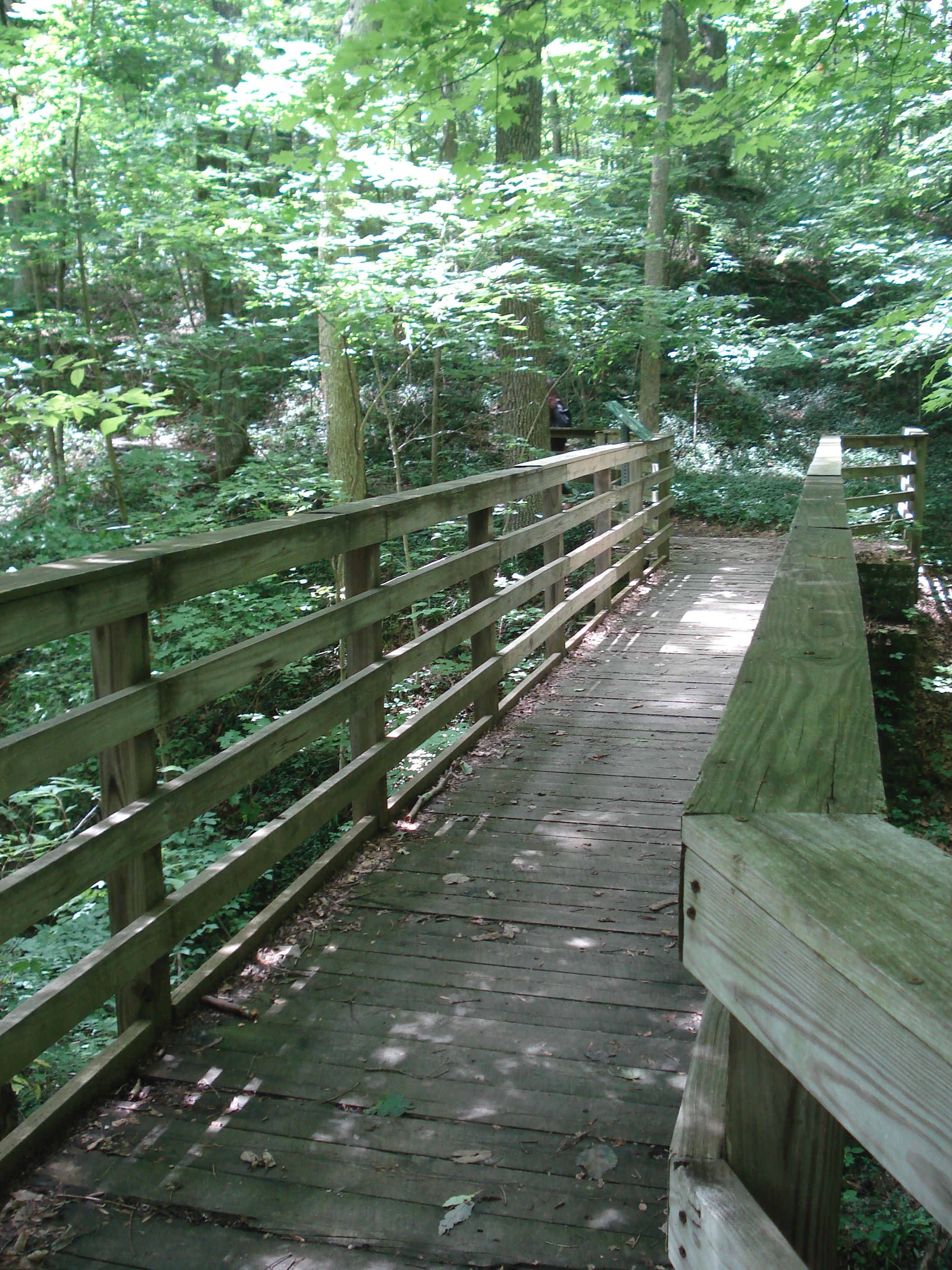
Day 1, started after lunch, beginning with a walk through the woods of the beautify retreat centre to ground us in the energy of the place, the energy and intention of our time together and then moved to a circle check-in.

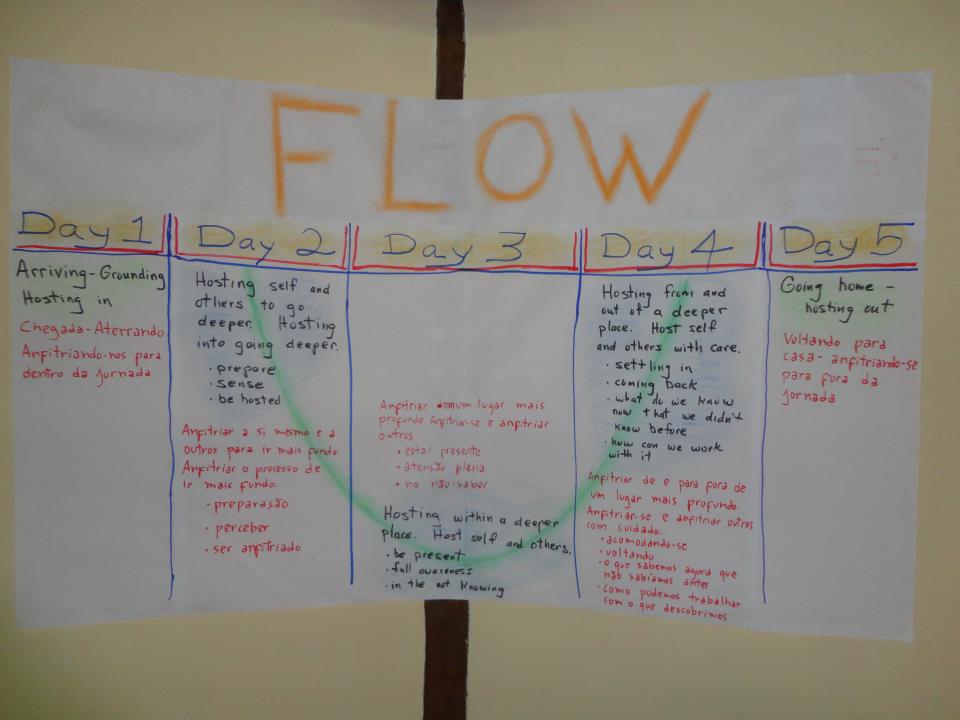
The theme of Day 2 was hosting self and others into a deeper place, moving down the left hand side of the U.  We used body movement and guided visualization to invite an expanded sense of being, enquired about people’s experience with not knowing for a powerful world cafe and open space to invite “conversations would help me host myself and others to go into a deeper place”.

As people arrived this was the extent of the design development we had done as a team even after being together already for three days, holding ourselves in our individual and collective not knowing.  Days 3-5 were completely blank other than knowing the theme or intention for each day.  They needed to be that way, to tune into what wanted to emerge from and for the collective.

Flow of our retreat

The theme of Day 3 was Hosting within a Deeper Place at the bottom of the U.  At the end of Day 2, as a hosting team, we recognized the divergence of our own world views in this work from more practical to more mystical.  Wanting to be in service of the people there rather than any of our own individual needs, we invited any who wished to join our hosting team meeting.  When they arrived, first we asked them why they came to the meeting and then we asked them what going deeper meant to them.

I’m not sure we realized we carried an expectation that going deeper somehow meant diving into shadow and fear until someone spoke about how the Marianne Williamson quote had sparked goosebumps and shivers, imagining illuminating our light.  It was one of those moments when shift happens and everything seems to open up.  The design for Day 3 began to emerge and by the time we were done and names appeared next to each design element, I realized I’d hosted myself out of hosting.  A beautiful and disconcerting thing at the same time.

The design for Day 3 began with movement to begin the embodiment of light and playfulness and set the stage for a guided visualization, after which there was a short period of time for reflection through silence, art, poetry, journaling or being in nature – whatever called to each one.  We moved into appreciative triads with the following questions:

  1. Tell a story of a time when stepping into your deepest fear liberated powerful things in your life?
  2. What is the gift you have you don’t fully acknowledge?
  3. What are you learning about your own talents, gift and light?
  4. Who must you step into being in honour of your fullest potential?

This was followed by three hours of silence, including a silent lunch and then back into our triads, paired with another triad to reflect on what we are learning about our hosting now, followed by a long check out circle, people wanting to share reflections and insights gleaned throughout the day. Celebration, story telling and music around the fire at night.

The next day, Day 4, was clear.  Open space all day.  A world cafe at the end to harvest the day.  The field was now hosting itself.  Noticing synchronicities. Hosting from within and out of a deeper place.  This day seemed to invite the deep mystical to show up in many different forms and conversations.  The field was ready to be in this exploration.  And always we carried the curiosity of how does this inform the practice, how does it translate into the practical.

Day 5.  Getting read to go home.  Saying good byes. Departures. Hosting out of a Deeper Place.  Gently.  For re-entry.  More embodiment.  A visualization of taking it home. Back in our triads.  “When I leave here, how will I balance and integrate my knowing with my internal and external worlds? And what help might I need?”  Then an embodied harvest of our days together, angel corridor and collective poem.  Moments of pause and silence.  Nobody wanting to break the circle.

A field alive with all that had flowed in and emerged over our days together, still deeply curious about the mystical and the practical of hosting.  A clear swirling around hosting self as central, core to all the other practices in the four fold practice, core to hosting from a deeper place.

A group so connected and field so alive it continues to spark and shine across North and South America.  Connected in depth.  Connected in love.  Connected in journey of work that calls each of us to step in, lean in further, challenge ourselves in how we show up so we invite others to show up differently and more fully.

The stories of impact are already emerging and we imagine it will only be in the weeks to come that we more fully understand the impact of this gathering on our individual and collective hosting capacity, especially as we work in more and more complex situations.  We plan to touch back in with deliberateness to harvest more, to learn more, to understand how we host from a deeper place and what it means when we are able to do so.

Hosting Self: Practice Informs the Practice

Practice does not make perfect, thank goodness.  Practice informs the practice. If we pay attention, lean into what we are discovering and allow ourselves to be in the place of not knowing or in the space before the naming, just long enough for an awareness to arise, shift to happen, peace to arrive, clarity to emerge. Maybe just one of those things, maybe none of them, but something that signals to us that a shift has happened, is happening, within us.

This is all part of hosting self.  Like you, I don’t have it all figured out.  I’m in the thick of learning every single day.  Learning to be in my experience in any given moment – the moments I enjoy and the ones I’d rather not be in.

This is not always an easy practice, particularly in those days when we are experiencing challenge.  Hosting self  is only something we can draw on in those times when we really need it if we have been in the practice on a regular basis. In the practice on the days we don’t think we really need it. Days that are inspired, beautiful, peaceful, joyful.  And on the days that are just kind of blah.  If we are not in the practice during those days, on the days when hosting self is most needed to help reground and centre we will have no practice from which to draw on.

There are wearying days .  Even for people in regular, ongoing practice.  When I posted that sentiment on Facebook recently – that sometimes this hosting self thing is wearying before it transmutes into peacefulness and joy, someone asked me what I do to host myself.  A beautiful invitation into a little reflection and exploration.

There are a number of practices I cultivate on a regular basis to draw from on those days I most need to host myself.  In the midst of feeling challenged or feeling hooked, hosting myself usually starts with a noticing that I’m feeling “off” or hooked, acknowledging something is “rumbling” in me that I have not yet named and am not yet able to articulate with any clarity.

In the soonest moment I can – which might be immediately or in a few hours or after a few days – I become curious and invite myself into a little bit of sensing to see if I can source what’s been triggered in me.

It is important to acknowledging that whatever’s been triggered, whatever is rumbling, it doesn’t have to completely influence everything else that is happening in the moment or my day, week or month. It is simply one thread, not the only thread. If I allow myself to notice, I  may also notice that many of the other threads are light, positive, purposeful, delightful.  It is okay to absorb those threads too.  Just because one “rumble” might need some of my attention, it is not a disservice to it to still allow in joy and light.

My Shape Shifting Lion Friend - on for the Soul Journey

My Shape Shifting Lion Friend – on for the Soul Journey

I’m not sure why those moments of challenge call so loudly for attention we think we need to cloak ourselves in them.  We don’t.  We can learn whatever it is we need to know without becoming lost in it.  Most of us have become so conditioned to going full on into it we have to teach ourselves to slow down and broaden our view with deliberateness.  We also need to give ourselves permission to relax a bit and to treat ourselves with compassion.  As we sense into what’s going on we can also sense into what form of hosting self is being called forth within us.  There are many possibilities. Here I offer a few I personally draw on with regularity.  You may also have some of these and likely you have many more of your own.

Physicality is a good antidote to those off moments.  Sometimes I run or do other exercises.  Aside from wanting to enjoy a certain degree of health, mostly I crave physical exercise or movement to take me out of my head and into my body, to release tension or let my body have the movement it craves.  When I start to run or exercise, my mind is still often on whatever challenge has my attention.  I need to remind myself to let go of the thoughts or to intentionally bring in thoughts and images that will make me feel better.  Usually surrendering into the moment allows images or symbols to arrive on their own that contain beauty, joy and meaning.

Meditation is a great way to host yourself.  It’s not as difficult as most of us think.  There are many approaches, no one right way and, thankfully, perfection is not required.  I meditate almost every day even if for just a few minutes and usually for fifteen to thirty minutes. It’s a great way to start and/or end a day. Often I use a guided meditation because it helps to keep me in my meditation longer – even if I am not always (or even usually) tuned into the words, I know they are getting through to my unconscious.  In the moments I lose focus I am less likely to go into full distraction mode and get up and go do something else after just a couple of minutes.

One of my practices is to devour all the positive reflections, mantras and good news messages I can, to really absorb them – especially in those moments I’m feeling off.  It is amazing what they can do to lighten my spirit when I allow it.

Gratitude and appreciation are two amazing counter acting forces to those rumbling, grumbling, or worse kinds of days. I remind myself of all the things I’m grateful for, the path I’ve journeyed, how far I’ve come.  There is an abundance of things to be grateful for and they are a good reminder of how things always work out and sometimes in surprising ways.  It is helpful to remind myself I don’t have to have the how of it all figured out in order to begin.  Time over time I discover that when I let go of the how, miracles really do happen.

Journaling is a beautiful way to reflect.  Just sitting to write for a few minutes in  stream of consciousness can shed light on whatever has been triggered, make patterns and themes visible and bringing new insights that create the space to release what has been troubling us.

Finding a friend willing to listen with curiousity and compassion, without judgment.  Just to be there.  Not even to offer advice and certainly not to commiserate with us in a way that keeps us stuck.  Sometimes in talking it out, insights arise that help us move forward or understand how to address an issue or challenge or conversation in a way that serves us and whoever or whatever may have triggered us.

Tarot cards, prayer or other spiritual practices are another way of hosting self.  Anything that helps us be more present and aware.

It is good, almost essential, to remember that what’s happening in this moment is transitory and doesn’t make me – or you –  a dismal failure, just like successes do not lead to infallibility or guru-ness, just real human beings doing the best we can every day.  Some days are better and more masterful than others, but it’s all there in the mix.  Just people on a journey with good, delightful moments and challenging moments too.

All in the flow of things. There is far more flow of things when we are in a regular ongoing practice of hosting self.  How do you host yourself?  What are your practices?  What do you come back to over and over again that helps you regain your ground or stay centered?  Where you grow your self awareness, your curiosity and your self compassion?

Hosting self is an integral aspect of being able to host others. It is the first practice in the Four Fold Practice for a reason.  It is a beautiful inquiry to be in every day and in any given moment – not by making yourself a self improvement project but by surrendering into the unfolding journey.

Four Fold Practice

Seeing and Being Seen, Having Voice

St. Cloud is a small city in Minnesota known euphemistically as “White Cloud” because of its reputation as a racist town.  Some residents of this community have decided this is a reputation that needs to shift.  They are taking action in the form of Conversations that Matter.

Mayuli Bales became aware of the Art of Hosting a couple of years ago through one of the early trainings in Minnesota.  She began to dream of what might be possible in her home town and the seeds of the multi-cultural community gathering for conversation began to take shape, seeds just harvested mid-November 2012.

It was the first gathering in St. Cloud about race and culture convened by people of colour.  Mayuli pulled together a local calling team despite not being able to explain clearly what the Art of Hosting is and they got to work, supported by InCommons and the Meadowlark Institute.

Some of the most passionate discussions in the hosting team were about seeing and being seen, having voice that is acknowledged and recognized. The experience of so many people of color is that they are invisible, not seen, not heard. Heartbreaking. For them. For those of us on the hosting team too.  For me.

The dream was to Color the Cloud. The purpose for our gathering co-evolved by the hosting team the day before was:

Discovering together our community, to build the future by:

  • Seeing each other
  • Contributing all of our voices
  • Getting skillful at being in conversations that matter to us
  • Co-creating the evolving story

So much anticipation.  So much hope.  So much anxiety. Could it really happen? The three day design that emerged used the themes in the purpose as themes for each day.  Day 1 was Discovering Community: Seeing and Being Seen.  Day 2 was Building Community: Getting skillful together. Day 3 was Practicing Community: Co-creating the evolving story.  The design included the usual interweave of patterns, practices and teaches.

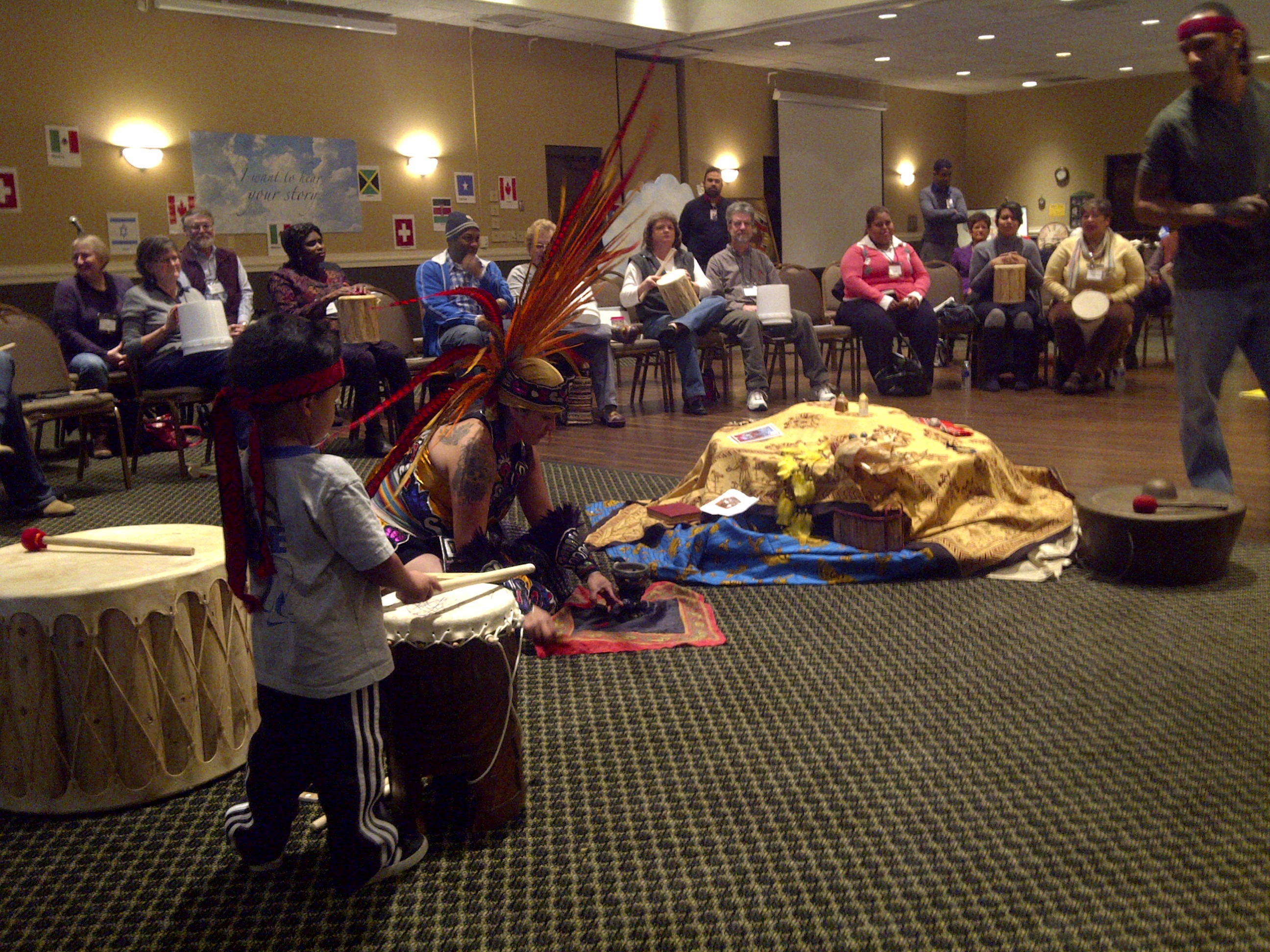
Drummers who opened the community conversations in St. Cloud

We were welcomed into our space by drummers – three members of a family with Aztec heritage, a father, mother and their three year old son who took up his place as a drummer.  The father shared with us, “You’ve been told in school and in your museums that Aztec’s are extinct.  But here we are, my wife, my son and me.  We are not extinct.  Neither is our culture.”  Culture must adapt to survive while cherishing those elements which make the culture distinctive.

He shared with us the story of the drum – as a grandfather, as a heartbeat, as part of community voice with its own message for each of us.  We were all invited to drum.  All of us.  Latinos, Somali’s, Oromo, African Americans, White Americans (and Canadians too) – broad categories of culture which do not do justice to the full multiplicity of culture in the room.  One world where many worlds fit.  Could fit.  Could be invited to fit.

The container was set, to be strengthened over the next few days. The invitation to see.  To see who else is in the room.  Who else cares enough about coloring the cloud to show up – for a morning, an afternoon, a meal, for three days. To be seen.  To contribute voice.  All voices.  Welcoming the languages present to be spoken aloud for all to hear.  Slowly at first but building so that by our check out circle, people were freely speaking their language, interpreted for the English speaking among us to comprehend, to see, to witness.

We became aware, as a hosting team, that these people, showing up day after day, did not need to hear our voices introducing teaches into the room.  They needed to hear each other’s voices, each other’s stories.  In ways and on a scale that had not yet happened in this community.  They needed and wanted to become skillful in practicing conversation with each other.  And to use conversation to support each other in initiatives and projects called out during the proaction café.  So we let the teaches of frameworks go and we focused on processes, ways and means of continually inviting them into conversation with each other.

The story of the new began to emerge during Open Space, Collective Storytelling, World Café, Proaction Café and smaller deep check in circles.  Surveying the small groups at any given time or in any given process, it was easy to see the diversity in each circle.  It was heartwarming.

Two of many stories to share here.

The first is of a member of our hosting team, a beautiful Somali woman dressed in the full traditional garb of her culture and often in the most brilliant of colours.  At the end of Day 1 she is part of the check out team.  Sensing the energy is low, she has a plan.  She looks down at her dress, begins to pull up the top layer of it, tying it in a knot, exposing the next layer of dress which still goes down to the floor.  Just this is so unexpected she has our full attention.  Then, she invites all of us to imagine with her that we are cats, to get down on the floor moving around on all fours, meowing.  Amidst gales of laughter, all who were able in the room, get down on all fours and move through the room with varying degrees of gracefulness and hilarity.  Be prepared to be surprised!  How many stereotypes did she smash through with this simple gesture of fun and delight?

The second story is of a self-proclaimed native son of St. Cloud, an older and retired white man.  He was asked to share his story in the collective story harvest and, to be honest, I wasn’t sure how it would unfold.  He offered his story, not only as his story, but as the story of his mother and his grandparents too.  Among the people in his group were three young Somali women.  Later in the collective harvest, one of these young women stood up and said, “We are always asked about my culture and what it’s like to live here. I have realized that we don’t stop to ask the people who have always lived here about their culture and what it’s like for them to live here.”

Later, when we reconvened in our full circle, someone pointed out to me that this man was now sitting in the middle of these Somali women.  Still later, when I thanked him for bringing his story to the group, he thanked me for the opportunity.  He told me he had arranged for these women to meet his mother and hear her story directly.  Delight all around.

These are just two small examples of how we the purpose of our gathering gained life and vibrancy.  People were beginning to see each other and to feel seen by each other, to give voice and be heard.  It is a beginning for a town that is coloring the cloud, shifting the shape of its reputation and sending out the message that the future is being co-created by people who care about where they live and about each other.

Resilience, Grief and Collective Consciousness

Human beings are remarkably resilient.  We have this amazing capacity to pick ourselves up, dust ourselves off and get on with getting on after all imaginable and unimaginable nature of horrors, calamities, catastrophes, shocks to the system – that happen to us, to our families, our communities, our organizations, globally.   Hope really does spring eternal even though at times it is hard to access.  It’s like the grass, flower or weed that pushes it’s way through concrete to bloom again in the light of day.

I find myself in a deep contemplation of this resilience, despite, at times, overwhelming odds and continued attempts at suppression.  My contemplation of resilience is weaving together with grief and what is alive and communicated in the collective consciousness, without it being visible. This is alive and emerging for me because of work and conversations I’ve been in and over the last few months in particular.  What I write today are half formed thoughts percolating more with each conversation.

Recently I worked with a client – a department in a large organization – that has gone through a significant amount of change, restructuring, everyone applying for remaining positions and no one knowing the outcome.  This was the most recent in a series of changes.  I know I could be referring to almost any organization.  The conversation they wanted to have was how to work more horizontally in a hierarchical structure and how to be more transparent with communication.

We began with a circle, asking people what makes them hopeful.  Eleven people in the room.  Responding with a talking piece but popcorn style.  Nine spoke about what made them hopeful.  The tenth person, with tears just beginning, spoke about not having hope.  Not anymore.  Not after so much change and so little care for human collateral along the way.  The eleventh person went deeper in this vein, apologizing because she had nothing hopeful to offer.

We welcomed the tears into our circle.  Thank you for your courage and honesty.  For sharing what is alive for you in this moment.  Hearing about the hope expressed by so many was too much.  It evoked the other truth sitting in the room.  The truth of grief.  Before we knew it, many in the circle were in tears.  I was not surprised it was there.  I was a bit surprised at the depth of it.

Our organizations tend to make it hard to tell truth – not “the” truth, but the multiplicity of truths that exist in the same space.  And in change efforts, there is a tendency to just want to get it done, to move from A to B.  The fear is that if we factor in the human response, the emotional response, nothing will get done, we will be overwhelmed.  Yet not creating space for it drives it underground, like rivers under the earth that can destabilize what appears to be a solid foundation and where sink holes spring up unexpectedly.  We seem surprised when they show up, caught off guard.  I wonder why?

With this group, after welcoming tears, exploring the change curve which is predicated on the grief curve, looking at circles of influence, in just a couple of hours the group was collectively ready to turn toward the future – with collective hope and inspiration now bubbling through.  It was relatively simple though I don’t, by any means, believe or mean to say that all it takes all the time is just a couple of hours.  But I am curious about what it does take and how much more simple it likely is than we imagine through our fear and structures designed for effectiveness and professionalism.  Emotions?  Not so professional. Trying to banish them from the workplace?  Not so effective.

In a conversation with a friend after this event, she said to me, “We have forgotten how to grieve.  We think we are supposed to grieve alone, but really we need to grieve in ‘community’ – with others. Witnessing each other.  Holding space for each other.”  That’s what I witnessed with this group.  A collective experience of grief that showed up differently for each person.  Those better off feeling excited about opportunity but afraid to speak it knowing others were worse off.  Those worse off afraid to speak their disappointment and disillusionment Almost everyone experiencing some kind of survivor guilt after so many left.

For me, it sparked reflections on the grief embedded in collective consciousness.  I am by no means an expert on collective consciousness.  I understand it is “how an autonomous individual comes to identify with a larger group or structure.  It implies an internal knowing known by all, or a consciousness shared by a plurality of persons.”  Most of it is not conscious or articulated but it becomes visible through the patterns which show up over time – even embodied in individuals. It seems to show up in lineages.  I have witnessed the pain and grief of generations no longer alive in their descendants who were not even alive at the time of the harm – the pain and grief as alive as the time it happened, as in the people it happened to.  It makes me deeply curious about how this is possible, what it takes to release the grief, to open the space for healing?  I don’t have the answers of course.  But I yearn for the spaces where this can happen. Where we can show up with curiosity, with compassion, humility and grace allowing despair, sorrow, grief and pain to come in – the grief alive in this moment, the grief alive in the lineage from days gone by without resolution, yet.  Seeking the ways love, joy, delight, happiness can co-exist – in each of us, in how we show up, in our lineages too.

It brings me back to resilience. Everyday resilience as we arise each morning and go about our day, our lives, our business with varying degrees of success, the resilience of families, of generations, of communities and of our organizations.  I am in awe.  I am relieved.  I am inspired.  Feeling the call, as always, to perpetuate resilience, perpetuate hope.  To boldly, or quietly, bring my healing gifts to the shifting shape of the world and the regeneration of its people, to evoke and invite that in others.

This is the call that invites so many of us to continue to dive deeper into the journey of personal transformation and the call, by the way, to Hosting from a Deeper Place, the Art of Hosting the Subtle, in Brazil at the end of February 2013.

“If you want to awaken all of humanity, then awaken all of yourself.  If you want to eliminate the suffering in the world, then eliminate all that is dark and negative in yourself.  Truly the greatest gift you have to give is that of your own self-transformation.” Lao Tzu

As we each do our own healing work, we contribute to healing in the collective consciousness.  But what more becomes possible when we do this work in community – with each other?  This is one of the questions I carry everywhere I go.

Ingredients for Hosting Team Success – An Inquiry

How is it we can take a group of people who may or may not know each other, throw them into a prep or planning day together and have them emerge out the other side as a team, ready to co-create and co-host a three or four day Art of Hosting training, to greater or lesser degrees as a cohesive, fluid team?

In the last few years, I have had powerful experiences of this happening in Atlantic Canada, in Brazil, in the United States, as I’ve invited or been invited onto hosting teams with a wide variety of backgrounds and experience, different levels of readiness to step more fully into hosting and different size teams from six to fourteen. And these days, in my experience, although individuals on the team know each other, the whole team has only met each other in person on that prep day.

Cohesive, fluid hosting teams hasn’t always been my experience.  Especially in my early days of hosting.  Having contrasting experiences offered me opportunities to notice and reflect on what worked and what didn’t.  Hosting myself, I became aware of how to, more often, invite the kind of experiences that work well.    Recently a good friend invited me into a deeper inquiry of, in my experience, what makes strong teams possible?  What are the ingredients for hosting team success?  These are not definitive by any stretch of the imagination, but they are some of the themes I’m noticing that consistently support strength and capacity in hosting teams I’ve been part of.

Some of it is in what happens in prep day.  Most of it is the quality of invitation to all of us on the team whether we are seasoned hosts or stewards, practitioners, apprentices, or logistics coordinators to show up fully.  We are all equally human, equally beautiful, equally valuable and  each of us holds a part of the whole.

There is no question the space for this invitation is held by the stewards.  It is not just a verbally issued invitation, it is one that is fully and authentically supported in all our actions and in our energetic field, in the space we create and hold for others to step into, in the responsiveness to all the voices that show up.  When, as seasoned hosts, we are able to step into our own humility and support the field from what might seem a less visible place, we open the space for others to step in more fully.

There are, of course, times that what we have to offer from our experience is what is needed – a thought, an observation, a question, a teach, a framing for what’s in the room, making something visible, stepping into our own brilliance in service of what is needed now. Knowing when to step in and offer what is needed now is also important – a part of the art.  Doing it in a way that builds on what others have offered, in the spirit of expansion and illumination, is a gift to self, a gift to others and a gift to the field in which we work.

To seed this field of invitation I want to have at least one other person on the team I know well, where mutual full trust exists, with whom I know we can handle anything that comes along.  With a minimum of the two of us (and one or two more is even better), we can hold the space for whatever wants or needs to show up in the team – and then in the gathering we are co-hosting.

Co-hosts and apprentices are wanting to know and understand their role, what they can contribute and how welcome their contribution may or may not be.  We are all wanting to know where all our learning edges are, what each of us wants to step into and how this can best be supported.  In particular, I am wanting to support people stepping up to their next level of learning, hosting or offering.  It is a thing of beauty when people publicly step into their learning edges, usually with some fear, some trepidation and loads of courage.

Prep day itself begins with its own welcome, framing and flow.  And an invitation to the full team to find the places they want to step in.  We begin open heartedly.  Infusing the space with welcome, invitation and confidence.  We move to  a check-in process. First on a  personal level.  What draws us to this work? What are we most excited about? Whatever question that personally brings us into the work and into the team.  Then we move onto what we know about who is coming, what their questions are, what they might be hoping for.

The harvest from these two rounds of check in is a co-created purpose statement to guide our planning and design process.  From there we take a first crack at design.  What is the invitation for each day? How will we invite people in, invite them to stay in, create the space for what they want to do and the opportunity for them to reflect on what they will do when they leave.  It is at this point I often notice the energetic threads weaving amongst the team.  People connecting more deeply.  Similar thoughts and ideas emerging at the same time.  Laughter in the room as synchronicities show up.  The awareness we have tapped a deeper place.

We take a look at what we’ve crafted.  Identify day hosts, hosting opportunities, coaching opportunities.  We invite hosting team members to offer where they most want to play.  We step in where we know our wisdom, knowledge and learning will most serve and we look for balance in the offerings.  We create a field of caring and intention and we prepare ourselves to welcome the larger group in the same open hearted invitation instilled with curiosity and generosity.

As a team, we stay tuned into and aware of each other in subtle and obvious ways.  We continue to invite each other’s brilliance and to support each other.  We work with the ebb and flow of individual and collective energy and know that we have each other’s backs. We ask for what we need and offer what we can. We invite each other.  We check in at the beginning of the day and we check out at the end of the day.  Openly.  Honestly.  Speaking what is in our hearts, minds and awareness.  Tuning in to what is in the space.

I don’t know if this is a recipe for hosting team success.  I know it’s been working in the places I’ve been and in the teams I have the pleasure of being in learning with.  I am certain there are other ingredients, other recipes that work equally well and will continue to be in co-learning and inquiry to continue to grow my own capacity to support hosting team success.

A question very much alive every time we step into a team, those we’ve worked with before and those we are working with for the first time is: what is the humility, generosity, open heartedness and also the brilliance that needs to be present and available in me, in each of us and collectively that supports the environment of co-learning in service of the field we are entering and committed to holding?

Art of Hosting – Universal or Not?

When people ask me if I do “this” for a living, the answer is, of course, yes. But they don’t really know what they are asking.  They are asking about what they are witnessing or experiencing in this given moment – a specific Art of Hosting training, a planning process, a team building session, a leadership development training, a community engagement process, a World Café or any other range of possibilities and possible places I might be invited to host or show up in.  And this is not just true for me.  It is true for many of my good friends and colleagues who are in this work.

It is a matter of what you see is what you get and what you get is far more than what you see. Going away from any of these singular events thinking this is it, that you know what it is, that you know it, is an easy assumption to make – and it misses the point.  It often seems so simple, often seeming to flow easily and effortlessly, even in groups or situations where tension or conflict has been evident.

Yet, when people get the “behind the scenes” invitation through being on a hosting team or a design and delivery team for a training or for client consulting work, they will often say that is where the real learning starts.  They begin to see what we mean when we say that 80% of the work happens before we ever get in the room.  It is also why some of us believe in being as transparent as possible in our process.

These days, when I describe the Art of Hosting to people, I’ve been borrowing from Jerry Nagel from the Meadowlark Institute because I love the clarity and simplicity with which he speaks it.  As a set of patterns and practices to work with complexity, that invites non-judgment or curiosity and generosity of spirit, of listening.  It invites us to be present, to stay in the place before the knowing until clarity, and knowing from a different place and quality, emerges – all of us and especially the hosting team.  We believe that conversations matter and good conversation leads to wise action and different results.

I am in deep reflection about the universality of art of hosting patterns and practices and the trap we set for ourselves if we believe universality equals one map, one path, one way to do it.  Overlay the successful work of one organization or one training on everything as if that was THE way to do it.  There is no one way to do it, no one practice or pattern that responds to everything.

It is the variety of hosting situations I’ve been in recently that have me in this deep reflection.   In Palo Alto in August 2012 for the first Art of Hosting training in California.  High tech, consultants to high tech, social innovators and a few pastors in the room.  Wanting to do business better.  In the Phillips Community of South Minneapolis in September 2012 with a remarkedly culturally diverse group of people, many of whom are community activists. Wanting to live in community together better. In Nova Scotia, also in September, working with a brand new charity Nourish NS responding to the need for a new structure for the delivery of breakfast programs in schools, birthed a year ago and still in it using the chaordic stepping stones, birthed out of need, chaos, confusion and pain.  In Fredericton in October 2012, a little AoH taster to sense into the need, opportunity and timing in that province for a second Art of Hosting training there, responding to themes of social change and community engagement.

Very different situations.  The “art of hosting” “worked” in each one.  I use quotations to remind myself that even what I’m writing about is nebulous and that the words evoke certain images, assumptions and expectations as I use them and you read them.

In California, knowing that getting people in the room required us to think very strategically about what would attract them, working with the calling team to find language that bridged Art of Hosting and business; finding that language that invites is a common practice and part of the invitation process no matter where we go.  Working with the concerns of the calling team about whether this group would sit still long enough to experience a deep circle, to dive into a three day process and stay present.  Yes, they wanted to get to action.  And they wanted to meet each other human to human, wondering how to do that in a world that does not always invite the human to human exchange.

In the Phillips Community, when we asked the people who came where they are from, beyond where they live, you could feel the ripples out into the world and then even more ripples when we asked them where their ancestors are from, circling the globe. Coming together to address tensions and violence in the community, their community, to imagine the kind of community they want to create, they want to live in, together.  Finding their way past commonality and past difference.  Human to human.  Getting to action that has the potential to shift the dynamic of their community, co-creating through new quality of relationship and understanding.  Practicing generosity with each other.

For Nourish NS, deep in a question of how to shift their shape from the “kitchen table” to the “board room”, grow their board, grow their capacity as an organization, adhere to Revenue Canada charitable guidelines and maintain the culture they have been intentionally cultivating over the last year or more that is creating an organization that looks different, feels different and invites people into a different experience.  Living their mandate.  Living their principles.  Prototyping how to be and work together and knowing they are in an experiment with clear deliverables, creating decision trees and governance structures to bring clarity and still allow emergence and nimbleness of response.

In Fredericton, a beautifully diverse group of people from the Department of Health, Renaissance College, students, city councilors, the provincial government, university professors, community activists.  Just three hours to dive into what might be possible with Art of Hosting and feeling like we had just begun a three day training but now everyone needed to go home percolating the vast array of questions we invited into the room about social change and community engagement.  Not leaving it nice and tidy, wrapped up in a bow with all the answers. Leaving it in the messiness that invites curiosity, invites exploration, invites a deeper dive together to discover what some of the answers might be.

AoH is only “universal” because it is adaptable, responsive, tuned into who’s coming, what their questions are, who and what shows up in the space, guided by a deep sense of purpose.  Tuning into the ebb and flow of patterns, energy in the room or field in which we are operating, cultivating emergence, leaning into what is wanting to show up in the space – not a set agenda, not a beautiful power point presentation, not all the answers or solutions but a living, breathing individual and collective experience.

In November, I’m invited back to Minnesota to go into another community experiencing many of the same challenges as the Phillips Community.  The core hosting team of four of us will be together again with some of the members of our apprenticing team and more people from the local community.  Our biggest mistake would be to assume that because we did it once well in the Phillips community that now we know what to do.  Of course, we have some beautiful learning from the Phillips community and from our individual and collective experiences from all the places we go.  But the only way we will really know what is needed the next time is to sense into the need and opportunity, the people who are coming, where they are from, the questions they bring, the hopes we are discerning and allow a purpose that is relevant to that work to emerge, let it guide the pattern we identify for the work of the days we are together and then be prepared to let it all go as people show up, we meet them where they are, see more deeply the questions, experiences and aspirations and let that guide what wants and needs to happen there.

I know from where I travel in the world, from the conversations I have, that AoH is universally applicable. But if we stop at that statement then we truly miss how this is so.  It is not the practices, frameworks, methodologies or even the patterns.  It is our ability as a hosting team to continuously sense into what is there, be prepared to let go of any of our own notions of what needs to happen, co-design on the fly from our individual and collective experience, wisdom and knowledge and to be responsive to all that shows up – the tension, the beauty, the joy, the humanness, the messiness and then work with the patterns, practices frameworks and methodologies to co-create the conditions to allow us to go deeply and well into the places waiting to be called forth.  There is a reason why it is called the Art of ….

Anyone who’s ever been to more than one well hosted gathering will tell you, it’s different every time.  And if that hasn’t been your experience, maybe you need to become curious about why that was so, challenge your own knowing and prepare to dive deeper into your own learning – or co-learning – because we are in it together.

The Field Beyond Difference

Out beyond ideas of wrong-doing and right-doing,

there is a field.
I will meet you there.

Rumi

Rumi’s words, with a slight variation, encapsulate the experience of an amazingly culturally and age diverse group of participants, apprentices and hosts who gathered September 11-14, 2012 in the middle of the Phillips Community of South Minneapolis where all of us discovered there is a field beyond difference and we are willing to meet each other there.

Image

There was a tremble in our fourteen member hosting team as we prepared to welcome over seventy Somalis, Native Americans, African Americans, Anglo Americans, Latinos, people from Liberia, Ethiopia, Malaysia, Mexico, Costa Rica, Columbia and more, together with two translators: one for Somali and one for Spanish.  We were not sure how many would come, how many would stay or how many would come back the next day.

This Art of Hosting training, supported by the Bush Foundation’s InCommons in partnership with the Meadowlark Institute, was called by Amina Saleh a co-founder of the Native American Somali Friendship Committee, in the hopes that bridges could be formed across the  multiplicity of cultures that have come to reside in the Phillips residential area of South Minneapolis.  The original residents of this community were primarily African Americans, Native Americans and Anglo Americans.  In the 1990s immigrants and refugees began moving into the area in search of affordable housing.  Over the years, the cultures clashed, tensions rose and violence across the cultures, particularly between the Native Americans and Somali communities, occurred.

Amina found herself at an Art of Hosting training in March 2012 and became curious about what might be possible if a training was hosted right in the middle of her community, in the community centre, where the children congregate after school.  Well, we found out!

We started with a beautiful Lakota sage ceremony offered by Lemoine Lapointe from our hosting team, to open the space, to cleanse ourselves, open our minds and, even more so, our hearts.  An offering from one of the cultures present in the room, inviting others to also offer in a right moment or opportunity.

Lemoine Lapointe

Each one of us was then invited to bring our voices into the circle by responding to: my name is…, I live…, I’m from…, my ancestors are from… and I speak …. languages. As we listened, we became aware, beyond the diversity of skin colour already visible in the room, of the richness and multiplicity of cultures and languages represented in the space, the richness that showed up sometimes in a single individual as well as in our field.  It took our breath away and opened our curiosity.

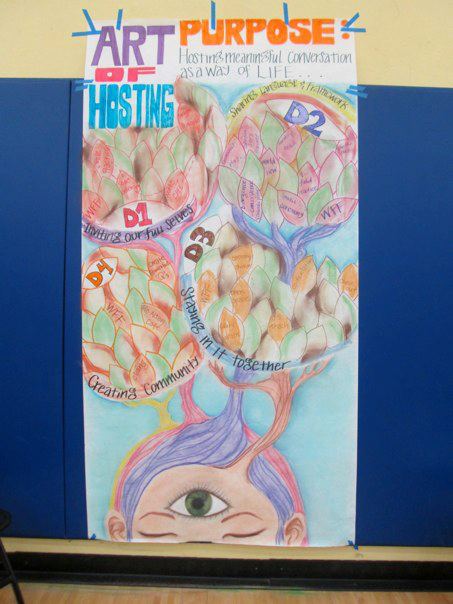
The purpose that emerged for the four day training was: Hosting meaningful conversations as a way of giving life, (1) inviting in our full selves and each other, (2) sharing language and frameworks, (3) staying in it – together and (4) building “whole” community. The phrases in the purpose statement framed each of our four days; scheduled to begin around 9:00 with a hard stop at 3:00, because this is when the children arrived in the community centre we were in and when some of the single moms in attendance also needed to be home to greet their children.

Beautiful visual depiction of our 4 day flow by Nou Ka Yang

Our first afternoon was a caféWhat is in your heart that brought you here today? What is in your heart for your community? What would you like to give life to here for your neighbourhood?  Powerful, surprising questions, giving pause like unexpected questions do.  Silence at the first café round while people let the question sink in, then decided how fully they wanted to bring themselves into the room, into the conversation, into the others also at their table. Cautiously, at first. What is in your heart? Not, why are you here? Not, what’s in you mind?  What is in your heart? Are you willing to go there yourself, let alone speak it into the centre of the table?

By the third round there was a beautiful buzz in the room as people began to relax into the invitation to bring their full selves.   In the harvest, one man offered, “Unlike Vegas where what happens in Vegas stays in Vegas, what happens in this room should not stay in this room. We all need to take it back out into our communities.”  This became a mantra for participants for our full time together.

People were ready and willing to offer their rituals, ceremonies and stories into our collective space.  In addition to the opening sage ceremony, we experienced a Somali coffee ceremony, an Aztek ceremony and a Hmong ritual and an African American dramatic story telling: Sojourner Truth, in addition to Native American ceremony, song and round dance from the Dakota and Lakota cultures. We gifted each other with prayers and blessings.

Sometimes it was a bit uncomfortable with the varying perspectives and cultural norms around touch, song, dance and partaking in another culture’s ceremony; but only just in that moment before understanding blossomed and more ease entered with the witnessing of things precious.  Graciousness, curiosity and respect filled the space and the conversations. Deepening our individual and collective listening skills invited us all to show up even more fully.

The realization that issues, concerns and passions arc across cultures invited people into bridge building. Education, children, community housing, racism, racial profiling, relationship with police, healing, well being.  Learning to navigate the dominant culture and stand up, both for what is right and for rights of an individual no matter each person’s roots or ancestral history.  Awareness of commonality in the diversity. People care about many of the same things even if their way of approaching them or their cultural norms may be different.

Invitation to Open Space

As we gathered in our check out team: Amina Saleh, Kadra Ahdi, Lemoine Lapointe, Molly Matheson Gruen, Susan Phillips, Bob-e Epps, Anne Gomez, Lori Lindgren Voit, Nou Ka Yang, Marcela Sotela, Jerry Nagel, Tuesday Ryan-Hart, Ginny Belden Charles and me, there were tears.  Tears of hopes realized, connections made, community strengthened, deep sense of belonging.

Our work began in the hosting team itself on our prep day.  It was the first time many of us had met in person as is common in these trainings.  There was a great variety of experience and understanding of the Art of Hosting in the team, from lots to little to almost none, with people eager to deepen their skill, grow their capacity.  The team quickly became strong and cohesive with each person stepping in, contributing, supporting as one fluid movement, offering what we each could, asking for what we needed. We formed community.

We became a field to welcome the larger field of community activists and organizers from across cultures who showed up.  And came back. Day after day.  For four days. They sensed something different. Became engaged in possibility in new ways. They made plans for next steps on very specific projects. Co-creating a new hope for the future. Giving life to community from a different place.  Stepping into courage, transcending fear, reaching out, seeing the human face of diversity and knowing that shifting the shape of the communities they live in and touch is possible to ever greater degrees.  Humbled, touched, delighted to be in this work that matters so deeply.

Credible Vulnerability?

No wonder we are so challenged by the idea of vulnerability, especially personal vulnerability.  It was a revelation to me to do an internet search on the topic.  What came up first and most was this kind of explanation:

  • the inability to withstand the effects of a hostile environment
  • window of vulnerability as a time frame within which defensive measures are reduced, compromised or lacking
  • Achilles Heel
  • capable of or susceptible to being wounded or hurt
  • open to moral attack, criticism or temptation

No wonder most of us shudder when the topic of vulnerability comes up.  It is in our collective consciousness and organizational cultures as weakness not as strength although much research confirms the power of vulnerability as pointed out by Brene Brown – beautiful and powerful in her own vulnerability.

I an in a renewed deep dive into this exploration thanks to the conversation that may have surprised and delighted me the most at The Art of Participatory Leadership and Social Innovation in California at the end of August 2012.  A conversation I did not expect to be witness to or our high tech company participants to be in.

It arose out of a World Cafe conversation on complexity in response to the third question: what’s stirring in you now as you contemplate complexity (after exploring complexity they’ve been in and barriers and supports for being in complexity)?  My attention was caught by a table where two men and two women were deep in a shared reflection of where vulnerability meets credibility.

The conversation went something like this:

“Yes, I know it’s a good thing to be vulnerable, but how do I be vulnerable and still be credible as a leader, in my organization.”

“It’s not safe to be vulnerable. You are seen as weak.  How can you be vulnerable and not appear weak?”

“I would lose credibility.”

“First you need credibility, then you can be vulnerable.  But how much credibility is enough?”

“Maybe allowing yourself to be vulnerable will show your credibility.”  Is there such a thing as credible vulnerability?  What does that even mean?

All of this led me to wonder what we mean when we speak about vulnerability – what’s in the field?  A lot about weakness  and protection it seems. This resonates with my journey personal journey, one of Embracing the Stranger in Me: A Journey to Open Heartedness.  The invitation was to move beyond believing emotions make me weak to understanding them as a guidance system that will never steer me wrong if I pay attention.  In the context of leadership, particularly participatory leadership, vulnerability does not equal weakness, defense systems do, but how and why is that so?

Thankfully Brene Brown is turning vulnerability (shame too) on its head so we can lean into it differently.  She says, “Embracing our vulnerabilities is risky, but not nearly as dangerous as giving up on love and belonging and joy ~ the experiences that make us the most vulnerable.”  And also make us the most human.

Sounds pretty personal.  What does it have to do with work? Because as much as we try we cannot be one person at home and another at work.  We suffer from the incongruency and it shows up wherever we show up.  People sense it, even when, especially when, we try to hide and know, from the place of deep knowing, when they have encountered someone in the fullness of their authentic journey and their vulnerability.  They often name it as courage.

Brown says what we are most seeking is connection.  It is why we are here, it gives meaning and purpose to our lives.  I hear the yearning for it in so many people who are drawn to Art of Hosting and related gatherings.  In order to have connection, we have to let ourselves be seen.  Truly, fully, seen.  But then we risk people seeing our weakness, our shame, any inauthenticity or lack of integrity we feel we may be carrying. We make ourselves vulnerable.

Interestingly, when I looked up the definition of credibility it is the quality or power of inspiring belief; the quality of being believed or accepted as true, real and honest.  Seems to describe what I think of as one aspect of vulnerability.  And it’s simple.

Given this definition, the relationship between credibility and vulnerability is so intimately entwined it is hard to separate out which comes first and which you need more.  If we can begin to see vulnerability for the strength and authenticity that it is, instead of as a weakness we cannot show others, our credibility instantly begins to rise.  But how?

There is no simple solution to this.  It requires courage and risk and a path of hosting yourself, growing self awareness and presence.  It requires the courage of being imperfect and of compassion – for self and others, particularly for self.  Finding the way to allow ourselves to be vulnerable without inviting criticism or recrimination – the fear of which intimidates us and makes us believe we need to protect ourselves. This is the conundrum.

Vulnerability is part of an intentional journey of learning to find our voice from the depths of our strength, our sense of worthiness, love and belonging, from the place of whole heartedness.  It is also part of the art of what we do.  The only way to trust is to risk.  The only way to risk is to trust. The only way to do this is to do it.  Risk as much as we dare.  Pause. Reflect. Learn. Embody. Trust. Risk a little more.  Eventually we shift the shape of our experience, our understanding, our credibility and our vulnerability. We live into it as the asset it is rather than the deficit many of us have experienced it to be.  It is not our vulnerability that is the challenge.  It is our fear of our own vulnerability that brings the weakness.

We didn’t name this conversation.  It showed up in an unexpected place.  Speaks to the yearning.  Speaks to what’s missing.  Speaks to the invitation.  Speaks to the first step.  Easy.  Difficult. Complex. Simple.  Choose.

There’s a Reason Why It’s Called The “Art of …”

What is art without technique and is technique alone really art?  “Art” could mean art as it evokes the image of artwork but, really, it is much broader than that –  dance, fitness, sport, yoga, meditation, music, hosting, the work we are in.

I’ve been in a beautiful reflection after a delicious conversation recently with good friend and hosting colleague Jerry Nagel. We were discussing upcoming work in California, Brazil and Minnesota and just after he’d been listening to an interview with Rosanne Cash. She spoke about working with her muse – the muse being the source of inspiration for creative work.  She said she works with her muse all the time.  All the time.  Not just sometimes.  All the time.  A discipline.  A practice.   In little whispers along the way and in more structured forms.

She also noted how performing in front of an audience is not a one-way street although she used to think that early on in her performing career.  Now she knows through experience there is an energetic exchange between the performer and the audience.  Tuning into the energetics.  Fuelling and being fuelled.

My conversation with Jerry started with a curiosity about how working with the muse relates to our work in Brazil at the end of October: Hosting From a Deeper Place with two Brazilian friends, and the purpose of that gathering.  Perhaps it is about how we each individually work with and cultivate our muse, our source of inspiration.  How we move technique to art or if we are already in art, how we grow our artistry in our work and life? Because it is a practice.  It is a discipline.  It is not just present some of the time.  It is present most or all of the time.

We then moved into an exploration of what we do in Art of Hosting trainings, in our work with clients and what’s happening in the field in Minnesota where hundreds of people have been to an Art of Hosting training in the last year or two and some are stepping into a deeper journey to be a trainer but wondering really, what is the path to artistry and what does it take to get to the field beyond good technical skill?

People will often say they come to an Art of Hosting training for a technique – like World Cafe or Open Space Technology.  Or, as some like to say, “to expand their tool kit”.  And technique, particularly good technique, is fundamentally important to what we do and what we offer.  We need to know and practice the foundation or the fundamentals to get good.  An artist practices technique – whether with paint, music chords, performance basics, fitness basics.  I wonder if artists talk about expanding their took kit or if they talk about growing their craft?

Most of us don’t just sit down at a piano and have beautiful music come out unless we are some sort of musical prodigy.  Nor would we expect that.  We would expect, if we were inspired enough, to learn the foundations and know that after we learn the foundation then we have the opportunity to become more and more intricate with the music, the style, the mix of technique.

Some never move into artistry from being a technician and, for sure, not everyone must. However, there is a quality we can observe, hear or sense, that lets us know when we are listening to music from a good technician and when we are listening to music from an artist.  It comes from the heart, from the soul.

It seems to come when we can relax in the technique and live in the art – just as true in hosting work as any other kind of artistry.  Art  bolstered by working with the muse all the time.  Even, maybe especially, when we are not working with groups, we are working with the muse.  Developing a discipline of practice. The practice is the work.  The practic is holistic – involving fitness, health, spiritual and personal practice that allows us to know ourselves – the first fold in the four fold practice – hosting self, being present.  The more we know ourselves, really know ourselves, in addition to the solid foundation of knowing the technique, the more we dip into artistry.

The difference between being a technician and an artist is subtle and dramatic at the same time.  It is something we sense but can’t always name.  It is tuning into this energetic exchange between host and hosted.  Sensing what is there rather than looking for it.  In the looking for it we sometimes miss what’s really there.  In tuning in, we sense the subtleties in the room, in the energy that is present that requires hosting in quiet and/or more obvious ways.  We become like a well tuned instrument.  And it can take years of intentional practice for this to happen.

I am aware in my summer of presencing, where I have not been hosting groups, I have continued to be in the work, practice, discipline of hosting myself – with new levels of awareness and new patterns of joy emerging.  When I begin co-hosting groups again in a couple of weeks, I know in the depths of being, it will come with a whole new level of presence.

With practice, the discipline begins to call on the host.  Time to exercise.  Time to meditate.  Time to invite a conversation – to host and be hosted.  Time to be curious.

Hosting from a deeper place is what happens as we move beyond being good technicians into artistry.  There’s a reason why, when we name a training, workshop or intensive, we often call it the “art of…” The first or surface invitation is into technique and process.  The deeper invitation is into practice and discipline that tips us over into artistry, the understanding of the deeper patterns, the energetic architectures and sensing into the subtleties that show intervention points that are much harder to grow awareness or understanding of when we are in the technical learning of our craft.  It is why one art of hosting training does not a practitioner make.

Technical competence and expertise?  Yes we need it.  It builds a strong foundation.  Artistry?  Where and how does your soul call you into your hosting artistry and what are the subtleties you notice – in others, in yourself – as you tip over?  What muse inspires you to deeper places in your being and invites you to bring more of who you are to what you do?  What journey do you need to embark on to host for a deeper place?