Unknown's avatar

About Kathy Jourdain

Kathy Jourdain is a co-founder of Worldview IntelligenceTM consulting, curriculum development and program offerings as well as a steward and practitioner of the Art of Hosting Conversations That Matter. This has her traveling internationally working mostly in Canada, Brazil, Europe and the United States. In 2009, she launched Shape Shift Strategies Inc. for her consulting practice. She is an author and keynote speaker. Her first book, Embracing the Stranger in Me: A Journey to Openheartedness has been hailed as an inspirational, deeply authentic sharing of the journey that has contributed to who she is today. She is contributing author to Gift of the Hit where she shares the story of her own soul journey with her mother, dementia and death.

Transformative Questions Can Shift Worldview – Guest Author Jerry Nagel

authored by Jerry Nagel (Originally published at Growing Hosting Artistry, January 3, 2014)

 “The success of the intervention is dependent upon the inner condition of the intervener.” William O’Brien (deceased), former CEO of Hanover Insurance

QuestionsQuestions. It seems that when one adopts inquiry as a core part of a way of being in the world there are always questions. Some are simple: “How are you today?” Some are reflective: “Why did I say that? How can I help in this situation?” Some challenge us to explore areas of interest more deeply: “What is the theory behind…? How can we be intentional about collective transformation?” Some are at the core of our worldviews: “What is really real? Who am I? Why am I here?”  And sometimes a question can change our lives by creating the conditions to alter our worldview. The asking of a simple question can be a transformative experience.

Jerry Nagel Floor Teach ed

July 3rd, 2003 I experienced the transformative question that started me on a journey that would shift my worldview, although I didn’t know it at the time. I was part of a small group of people working on agriculture and rural policy issues in the United States that had traveled to Europe to examine how environmental and social values were impacting European agriculture practices.  During dinner one evening a powerful question emerged within the group that influenced our conversations for the rest of the trip.  The question was “Have we been asking the same questions [about rural development policies] over and over for so long that we don’t even know what the right question is anymore?”

This transformative moment started me on a journey of exploration, learning and self-reflexivity that has led to a shift in my worldview, a change in professional focus and a reconnecting with a curiosity about human behavior that I had explored in my early teens. It also reconnected me to a strongly held belief in human possibility that developed in my late teens and twenties and a deeper awareness of our connections to something greater that, for me, is sensed most during my times in nature.

in nature

As I explored ideas, methods and programs to find the right questions for addressing the current rural policy issues in my work back home in Minnesota in a change lab initiative called the Meadowlark Project and through my participation in the Donella Meadows Leadership Program, I couldn’t escape a similar question that was simmering within me, “What was my own personal ‘right’ question?” Having spent my professional and intellectual life working as a research economist on rural development with a worldview that assumed that if we created investments in the material well-being of people and communities (jobs, buildings, roads, etc.) then rural communities would thrive, it surprised me to discover that when I challenged my professional worldview I was also challenging my own personal worldviews and related sense of self or identity as an economist.

There were two big learnings from my work with the Meadowlark Project Change Lab. First was a recognition that while we all wanted to have the difficult conversations about the challenging and complex issues the Change Lab was working to address, we didn’t have the skills to have them. Second was a realization that while addressing the material well-being of a community was important and necessary, it was not sufficient to build a wholly healthy community. To do so both the material and human side of a community’s life needs to be addressed.

I found myself drawn more and more to actions that connected the work of rural development with one’s own or a community’s set of values and beliefs, which also connected with the work of my own personal explorations.

 “The essence of our leadership journey is about growing into our true identity as a leader and, by doing so, accessing an intelligence that is greater than ourselves and encompasses the whole.” – Petra Kuenkel, Mind and Heart, 2008

As someone trained in economics, my worldview was deeply embedded in the notion of ‘man’ as an independent actor making rational choices of pure self-interest. I found myself challenged by the paradox that we humans experience ourselves as separate, unique and free individuals, and the social constructionist perspective, which I was learning about and coming to accept while writing my doctoral thesis on worldview and Art of Hosting, that everything that we are and all that matters actually comes from our relational experiences as humans and that this begins the moment we are born (and possibly before).

These paradoxes troubled me for some time, as I also sensed that exploring them was part of the journey to connecting with my life journey. So, while keeping one foot solidly planted in the work of answering the emergent questions about rural development policy I also committed to an even more intentional self leadership exploration of the deeper questions of “Who am I? What is my nature?”

The challenge it seemed to me in this exploration was to let go of attachments to specific images of myself that would prevent me from not only participating in whatever evolutionary changes this journey might offer, but also prevent me from seeing the whole and my relatedness to it. I was beginning to understand that my journey was becoming an exploration of the ‘range’ of me rather than the ‘one’ of me.

The work my colleagues and I have taken on through the Art of Hosting Conversations that Matter invites us into a wholeness – a way to connect how we are in the world with practices that support our actions. It also invites us to continually be aware of our worldview(s) and the impact on our hosting.  For me, as an AoH practitioner and host, this is an essential element in the exploration of growing hosting artistry.
Blinded by White Privilege

“We need an advisory committee to advise the steering committee on how to involve the communities that are not here.”

 “We just need to empower…”

 “We could provide mentors or buddies for people so they don’t feel uncomfortable coming into the room.”

 “Maybe we need someone to come and help us get comfortable with having the conversations.”

All seemingly innocuous comments that are meant to be helpful in addressing a lack of diversity in a room full of forty or so almost all white, highly educated, corporate like people for a conversation about the next steps of a voluntary organization whose mission is dedicated to creating an inclusive society.  Innocuous because, as white people, we do not even know what we are saying.  We are saying, “How do we make it possible or more comfortable for others – the other – to come into our world?”  (And it was a diversity discussion that also included seniors, disabled and very young people as well as people of colour.)

There is no consideration or thought that maybe others don’t want to come into our world or that there are other worlds and world views that exist that maybe we should be more curious about. That we should meet at some point other than in our own world view.  That the invitation to “come and join us and we’ll figure out ways to make it easier for you” might not be all that inviting.

It is the difference between being in your own home and being a cautious guest in the home of another.  Sometimes as guests, we are on our best behaviour. We try to fit into the context of the environment we are in but maybe we never fully relax, never really feel invited to show up fully.  It might even look like we are fitting in but when we go back to our own home, our own environment, we are finally able to relax, knowing someone is not going to judge us or patronize us because of assumptions they are carrying they cannot even see – even when it might be right in front of them in full living colour.  Cannot see because white privilege is blinding.  It blinds us to the things we take for granted without knowing we take them for granted.  In 1988, Peggy Wellesley wrote a thoughtful and eye opening piece on White Privilege: Unpacking the Invisible Knapsack.  Twenty-five years later what she writes is just as relevant and real as it was then.

I never have to wonder if I will be followed by store staff or security guards when I go shopping.  I never have to worry about being arrested at night while locking up my place of employment (and certainly not more than once), keys in hand, police parked in the parking lot. I will never be mistaken for the janitor as I move furniture prior to an Art of Hosting training to get the room ready.  But these things have all happened to friends of mine whose skin is not white.

And it is simple but powerful things that often get overlooked, partly because we are not even aware and partly because we don’t understand how important these things are.  Language is one of those things.  I am paying attention to the language and invitation in a way I never did before and it is taking me on a deep journey.  The opening sentences of this post are a beautiful example of how I am listening with new ears and hearing through the lenses of some of my friends who keep challenging, in loving, gentle but fierce ways, my world view.

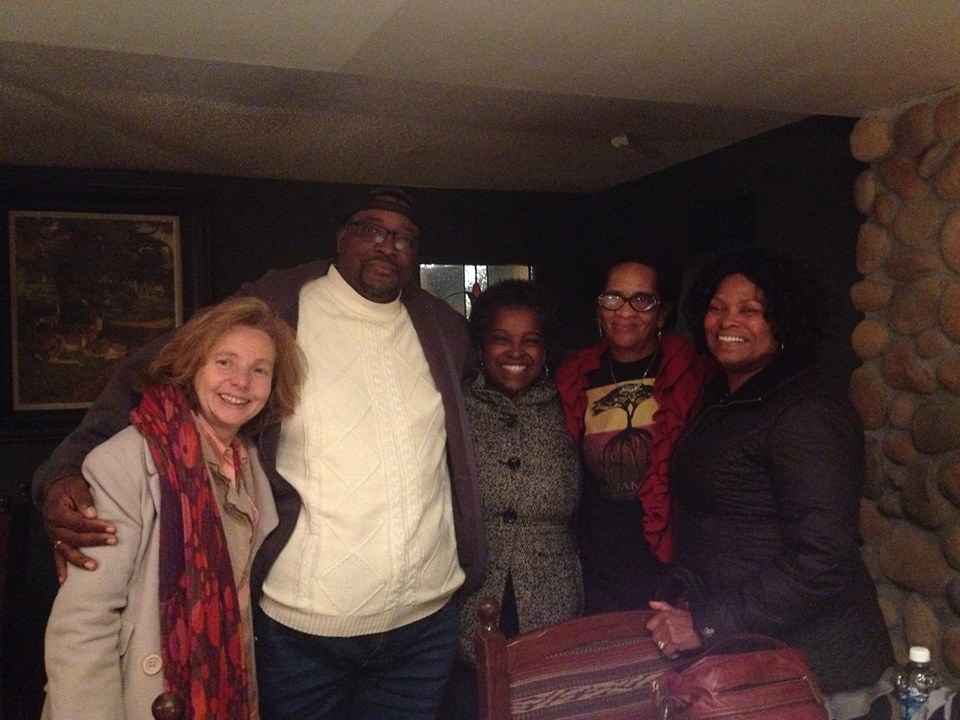
Carolann and new friends

Ursula Hillbrand, Dave Ellis, Renee Hayne, Carolann Wright-Parks and Barbara (Bob-e) Epps-Simpson – a few of these people (Dave, Carolann and Bob-e in particular) have been instrumental in helping me expand my world view.

Pictures are another thing.  When I asked my good friend Carolann Wright-Parks, with whom I have had the privilege of co-hosting with in service of the African Nova Scotian Faciltiators Guild, if she knew of any African New Brunswickers who might be interested in attending the Art of Hosting training there this past November, she said to me, “Kathy, I looked at that invitation but I didn’t see myself there.”  She wasn’t meaning herself – she was meaning there were no people of colour in the pictures.  The pictures were from the previous AoH training in New Brunswick.  There were no people of colour at that training.

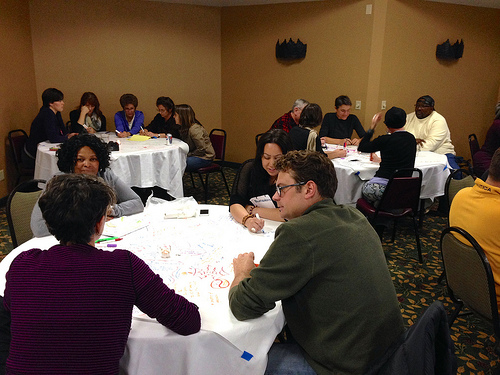
World Cafe with Diversity

Now I have pictures I use of my friends that illuminate the greater diversity that is showing up.

Not too long ago, in my own naivety, I would have shaken my head, wondering why it mattered.  Wondering why we were not attracting people of colour into our trainings.  Wondering why, even though we keep trying to invite it, we cannot achieve greater diversity.  But now I know why it matters.  It matters because I don’t see it when I look at pictures. Blinded by the white, I do not even realize I identify with the people in the pictures.  I am already there.  Many of my friends haven’t been able to identify with the people in the pictures in the same way.  I am much more aware now of the pictures I use in invitations.

In Minnesota, there are a few good friends in an exploratory conversation – Dave Ellis, Barbara (Bob-e) Simpson-Epps, LeMoine LaPointe, Nancy Bordeaux, Jerry Nagel and myself about what it takes to generate transformative conversations on power, privilege, race and racism – because the ones we’ve been in aren’t yet creating the kind of shift we believe could be possible.  The language of social justice, restorative justice and racial justice has only taken us so far.  What is the language that is needed to take us – all of us – to a different conversation, to a different reflection, to a different perspective, where equality is based on diversity, not on sameness?  What is the language that is a door opener and invitation to shifting the shape of the conversation as we’ve known it?  We don’t know it yet.  We don’t presume to know it.  We know it is needed and we feel now is a time of greater receptivity.  We are excited and hopeful to be in the exploration.  Just like we are in the exploration of Growing Hosting Artistry at the end of January 2014 in Minnesota where we will explore world view, creating safe containers, working with shadow and a few other themes that seem central to growing our depth and capacity as hosts.

Now when I am in a meeting like the one I described above, I find myself stirred up and agitated, sometimes even outraged whereas I know a couple of years ago I would not have seen it.  I would only have seen how progressive the people and the thinking are – which is also true.  And that makes me curious. More and more I am aware of bringing expanded listening and awareness and a willingness to speak up from gained experience and exposure to questions and friends who will not let me rest in naivety or white blindness. And I am grateful to my friends for their boldness, courage and willingness to be in the openness of challenging our limiting beliefs so we can host ourselves into what will hopefully be the transformative space, individually and collectively, that will show us the way into the transformative conversations we are yearning for.

Sit by the River or Engage?

“If you sit by the river long enough you can watch the bodies of your enemies float by.”  – The Art of War

This is an expression offered often by my good friend and colleague Jerry Nagel, particularly when conflict surfaces, and it comes from The Art of War. It is a provocative and intriguing statement and I have been viewing it as invitation.  An invitation to pause.  An invitation to host self. An invitation to sense whether to engage a conversation or situation with someone else or let it be.

Mississipi river

Not every conversation is worthy of engaging.  Not every conversation will produce results or take you to a clearer place. Not every conversation will do what you think or hope you want it to do. Coming from an Art of Hosting Conversations That Matter perspective, you might wonder if that is almost a sacrilegious thing to say; but perhaps part of the discernment is in whether ultimately the conversation will matter – and to whom?

To truly invite a conversation that might be powerful, it is helpful to discern your own desire and motivation in wanting the conversation.  This is part of the inquiry in the pause, in hosting self.  What is the reason for the conversation? Are you really wanting a conversation or do you just want to make your point or download on the other person and not care about or hear their point of view?

This is where a second bit of advice is useful:  “Feedback should be given from the part of you that wants to grow and learn to the part of them that wants to grow and learn.”  I’m not sure where it is from but I heard it in an Open Space session that Juanita Brown initiated on World Café at the Art of Hosting Stewards Gathering in October 2013 in Minnesota.  It gave me pause and invited me to reflect about some situations requiring my discernment – whether to invite a conversation or not – or a few.

When you ask yourself if you want to give feedback from the part of you that wants to learn and grow, it becomes pretty clear.  If you are willing to be in conversation, if you can do it without attachment to how the other person takes it in, you might be ready to invite the conversation.  If you are only wanting to download and don’t want to hear the other person’s perspective then it might not be wise to engage the conversation – because it is not a conversation you are wanting, only an opportunity to express yourself, your frustration or your hurt.  An opportunity to blame someone or point out where they are not hosting themselves – from your perspective of course – because how do you know they are not hosting themselves in whatever way they relate to that practice of presence?  It is your assumption, your lens, your perspective, your judgment and it might not be true. And, in all likelihood, it is not true in their experience of themselves – as hard you might find that to believe.

And it also quite likely the other person’s actions have nothing to do with you and more to do with them, what they need, what they hope for.  You just happen to seem to be in the way.  Sitting by the river will help you discern that.  If it has nothing to do with you, and the other person is either intentionally or unintentionally trying to cause harm, eventually it will catch up to them and they will, metaphorically of course, float down the river. We see or feel lack of alignment in others, even when it is not clear, even when we cannot put a name to things.  Simply waiting may reveal far more than engaging – in some situations, since we are our own worst enemies and motivation and intention eventually reveal themselves.

Sometimes when you are being challenged it has nothing to do with you. By hosting yourself you might be able to sort that out.  If you engage something in a defensive or challenging way you are more likely to fuel the situation than turn it into a powerful conversation. And you can ask yourself questions like: What is the point of engaging?  Will it be a learning field?  Is there an ongoing relationship that needs to be tended to? Can it be left alone?

When you do engage, engage the conversation, not the person. Invite the conversation with as much clarity as you can and bring the level of fierceness to it that will make it powerful.   Sometimes that is a light touch and sometimes it is very fierce and it can be more fierce when it comes from a place of clarity and compassion.

And sometimes the conversations “just” happen on their own – ready or not. Right timing. Right moment. Right circumstance. And if you’ve been in an exploration of your own motivations, intent and clarity, you will be ready, even if you don’t feel ready. And it is always a choice – even in the times you might feel it is not. Sit by the river or engage?

Power and the Four Fold Practice

 ~co-written by Jerry Nagel, President of Meadowlark Institute and Kathy Jourdain, Founder of Shape Shift Strategies Inc.~

“Power is the strength and the ability to see yourself through your own eyes and not through the eyes of another.  It is being able to place a circle of power at your feet and not take power from someone else’s circle.”Lynne V. Andrews, Flight of the Seventh Moon

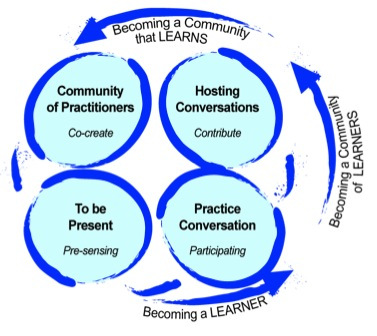
One of the underpinnings of the Art of Hosting Conversations That Matter is the Four Fold Practice. This is a set of practices that invite us to host self, others, processes or groups and to be in co-creation or community of practice with others. Serendipitously coming across the above quote in a little offering about the energy of the magician, generated a whole new level of reflection about power and the first two practices for us.

four-fold-practice

The first practice for the Four Fold Practice is to host yourself, to be present or have presence.  When you focus on and grow this practice you know your center and ground and the strategies, personal practices or disciplines that enable you to access this place within yourself.  You can then stay present more often in more and more challenging situations and you can find your way back to presence more quickly should you find yourself off balance for any reason – as we all do from time to time in the flow of life.  In essence, you become more powerful in presence because, like the above quote says, “power is the strength and the ability to see yourself through your own eyes and not through the eyes of another.” Your understanding of who you are is internally rather than externally validated.  For us, what this affirms is the benefit of having a regular practice of self-reflection, not as a process for self-criticism, but out of knowing self or seeing self.  This is a life practice.

The second practice in the Four Fold Practice is to participate by hosting another and allowing yourself to be hosted.  It is a reciprocal relationship when you are tuned in enough to feel the balance between listening and speaking for each of you, which does not necessarily mean equal time.  Sometimes you listen more, sometimes you speak more. Sometimes you need to host someone else and sometimes you need to be hosted. “It is being able to place a circle of power at your feet and not take the power from someone else’s circle.”  If you show up powerfully present you have no need to try to take away someone else’s power nor do you feel threatened by them because your sense of self comes from self rather than from needing anything from another.

“Knowing others is intelligence, knowing yourself is true wisdom. Mastering others is strength, mastering yourself is true power.” Tao Te Ching

This does not mean you cannot be in a space of shared power.  When you are truly powerful, you are also able to fuel the other person’s circle of power without lessoning your own, inviting and allowing them to step more into their own humanity and to bring it fully into the space between you and shared by you. Through this you build the relational field.  This is particularly important when you are part of teams, building the relational field to host groups and processes from a place of individual and collective presence and attention to what is present in the moment. It lends itself to the conditions for co-creation in a team or in a community of practice. It opens up the possibility to move into the generative space at the bottom of the U (from Theory U).  And this is where we often say magic happens – the magic in the middle.

“Magic makes it possible to use the limitless power of spirit to reshape the world in accordance with the fondest desires of the soul.” Donald Tyson, New Millennium Magic

This is part of the exploration we will be in at the end of January 2014 as we co-host with others Growing Hosting Artistry, to be offered in Minnesota. A sneak peek, since the invitation is not quite ready, is that we will explore world view as a lens to deeper work, what it takes from us as hosts to create containers for powerful work, become curious about new narratives that want to live in the world now, how to skillfully deal with shadow and projection, the impact of the relational field including among members of the team on our hosting artistry and how to design for the work at hand.  Hosting artistry begins with knowing self and our power and being in the place of centeredness with individual and shared power.

Jerry-me-others outside for opening ritual

Jerry Nagel and Kathy Jourdain – co-authors, co-hosts, friends and colleagues

Container Holding as a Hosting Practice

In the work and exploration of the Art of Hosting (AoH) Conversations that Matter we often talk about the container, creating the container, holding the container – but what does it mean, really? We tend to speak of it in the same breath as hosting, as if it is the same thing.  But, is it?

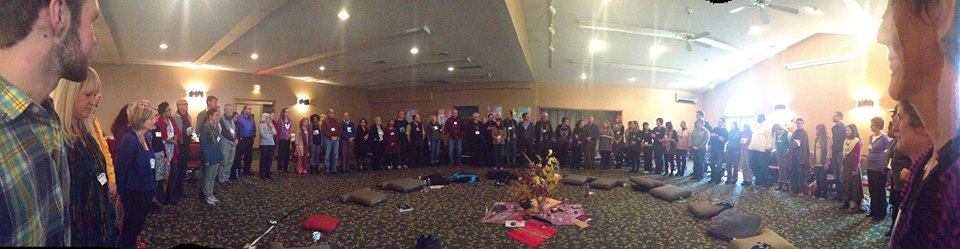
In preparation for a gathering of sixty five AoH Stewards from thirteen countries that took place in Minnesota in October 2013, Jerry Nagel, Stephen Duns, Bob Wing and I became deeply curious about what it would take to hold a dynamically complex field that included three breaths of Art of Hosting – founders, early adopters and new or emerging stewards, many of whom did not know each other and had never met in person – who were holding, each in their own way, many similar questions percolating in local fields around the world, centering on what it means to be a global self-organizing system.

panoramic photo of circle

We began a series of calls to see what we could learn about container holding that we could apply at the Stewards Gathering, recognizing that some who would be holding the container would not be present in person but would be holding from the rim – wherever they happened to be geographically located.  For our inquiry, we separated out container holding, design and hosting recognizing they often are intertwined, happening together at the same time and that they are distinct in and of themselves.  It was – and is – rich learning.

Container holding is part of the subtle arts.  It is metaphysical, meaning of or relating to things that are thought to exist but cannot be seen. So much of what we pay attention to in hosting, beyond process, people and design, is the invisible – the energetics, consciousness.  It is why we have offerings of Hosting from a Deeper Place or the Art of Hosting the Subtle.

The invisible is alive all on its own and it shows up in the physical in group dynamics, ease or tension, flow or disruption, to name just a few ways it manifests.  We know that in any offering that is co-hosted, the frequency of the team is also alive in the field.  When the team has challenges within, those challenges show up in the larger field.  When the team has an ease of relationship, infused with trust (and usually joy), this also shows up in the field.  What is in the team is reflected back to the team.  A well connected, trustful, aligned team – which does not mean members all think alike – can hold the larger field from a place of trusting what wants to emerge and not be knocked off balance when challenges spark – at least not so off balance that they cannot recover.  The more coherent the team, the deeper they can host and the more process will flow through them rather than the team trying to control design or over-design.

Container holding might look inactive whereas design and hosting might look more active.  When we are hosting, it doesn’t mean we ignore elements of the metaphysical or subtle realms – although we are often not full intentional or conscious about it.  Attention to the metaphysical or subtle realms can also be a sole component of container holding. You can be a container holder and not be in a visible hosting role.

In the work we do, the container can be porous or permeable – and given it is metaphysical in nature that would likely hold to be true all the time.  When the container is held with the crystal clear energy of intention, this intention infuses the field and what happens as much as, and sometimes more than, design does. The hosting can be flexible, which is what we always advocate –  with a willingness to be disturbed or disrupted, trusting the chaordic path – chaos can be good, especially as we learn to sit with it until a natural sense of order emerges. If the intention is strong and held with clarity, disturbance can lead to emergence.  When the intention is less clear, disruption can lead to chaos with no pathway back to order. It is important to not be attached to design, to hosting or to process  – to hold it lightly – which is simply good hosting practice at the best of times.  We can ask the question, what does the container need to be infused with to hold chaos and disruption so it is of service to what wants to happen? It could be different depending on what is the work we are about.

A well held container invites coherence into the field. Coherence is a frequency. When we tune into the frequency we can host it into being to allow or invite it to become present, or more present – like when we hold tuning forks up to each other, they pick up the frequency of each other and become entrained.  How do we grow coherence without control, to celebrate different thinking, recognizing it can all be aligned with a common purpose and clear intention?  Is this not our work as hosts?

Container holding is part of hosting – especially when we are intentional about it.  And container holding has its own energy, its own path and its own coherence.  So much more to explore.  We are deep in our learning.  And how beautiful is that?

Youth Engagement Impeded by Pressure of Elder Legacy Need?

It is a freshly minted question for me.  Is youth engagement impeded by the pressure of older adults wanting to leave a legacy or the need to get it right?

The question began fermenting for me during the Art of Community Building training for African Nova Scotian facilitators in June of this year (2013).  It was an Open Space question posed by the (now) late Rocky Jones: how to engage the youth?  I used the Law of Two Feet to find my way to that conversation and listened in for a few minutes, trying to understand more about a question that is asked all the time in all kinds of situations.

I wondered out loud, if they really knew what the youth wanted?  That’s what they were trying to find out, they told me. You know those moments when you feel that vague stirring in your soul because something is not connecting but you’re not sure what or why?  I was in one of those moments, feeling that there was a point that was wanting to emerge – in my own mind anyway – but none of us in the conversation were hitting on it.  It was a vague sense of somehow missing the mark and it kept stirring for me.

Later at dinner, the hosting team and a few others of us continued the conversation.  Rocky and Roshanda Cummings, a young leader and apprentice host on our team who came from San Francisco to co-host with us,  got into a beautifully intense conversation about the role of elders, about Roe wondering where her elders were, with Rocky listening intently as she poured her heart out about what it was like to be a young black woman in the places she lived and traveled.

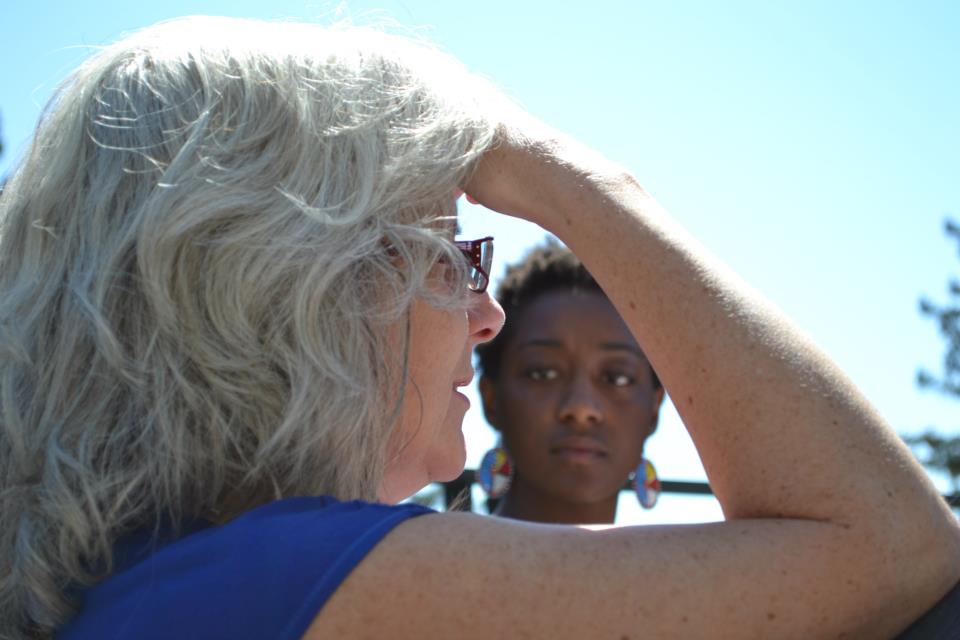
I thought about how Roe had been invited into this work – not with the question of “how do I engage you” but with the open hearted invitation of “what can we do together and I would LOVE you to come to Nova Scotia to do this work with me!”

Stillheart Roe and Kathy

I began to wonder how many conversations around youth engagement (or engagement generally) come from a place (unintentionally of course) of fear, regret, reproach or judgment.  Reproach and judgment because youth are not meeting some standard of engagement or community participation that may no longer even be relevant or of interest to youth.  Fear and regret that elders may have let youth down, let themselves down in the process, worried about what kind of legacy they are leaving youth and community.

And then I wondered, “What if a conversation with youth about how to engage them had a totally different starting point?”  Inspired by Mary Oliver, for instance, and her great question: “Tell me what it is you plan to do with your one wild and precious life!”  What if a question like that was the invitation to a conversation where we really listened to each other instead of suppositioned?  What if everything about the conversation said, “I care about you and what you care about,” if engagement came from the place of how do I support you in that which calls you from the soul, and what could we do together and learn together if we jumped into engagement from that point?

Just sensing into these two approaches, the energy shifts shape from one of burden and how do I get someone else, in this case youth, to do something they don’t seem to be particularly interested in doing to one of curiosity and eagerness as I anticipate listening in to what makes someone else come alive and imagining with them how they could do more of that!  And maybe I could do it with them!

Road Trip With My Dad

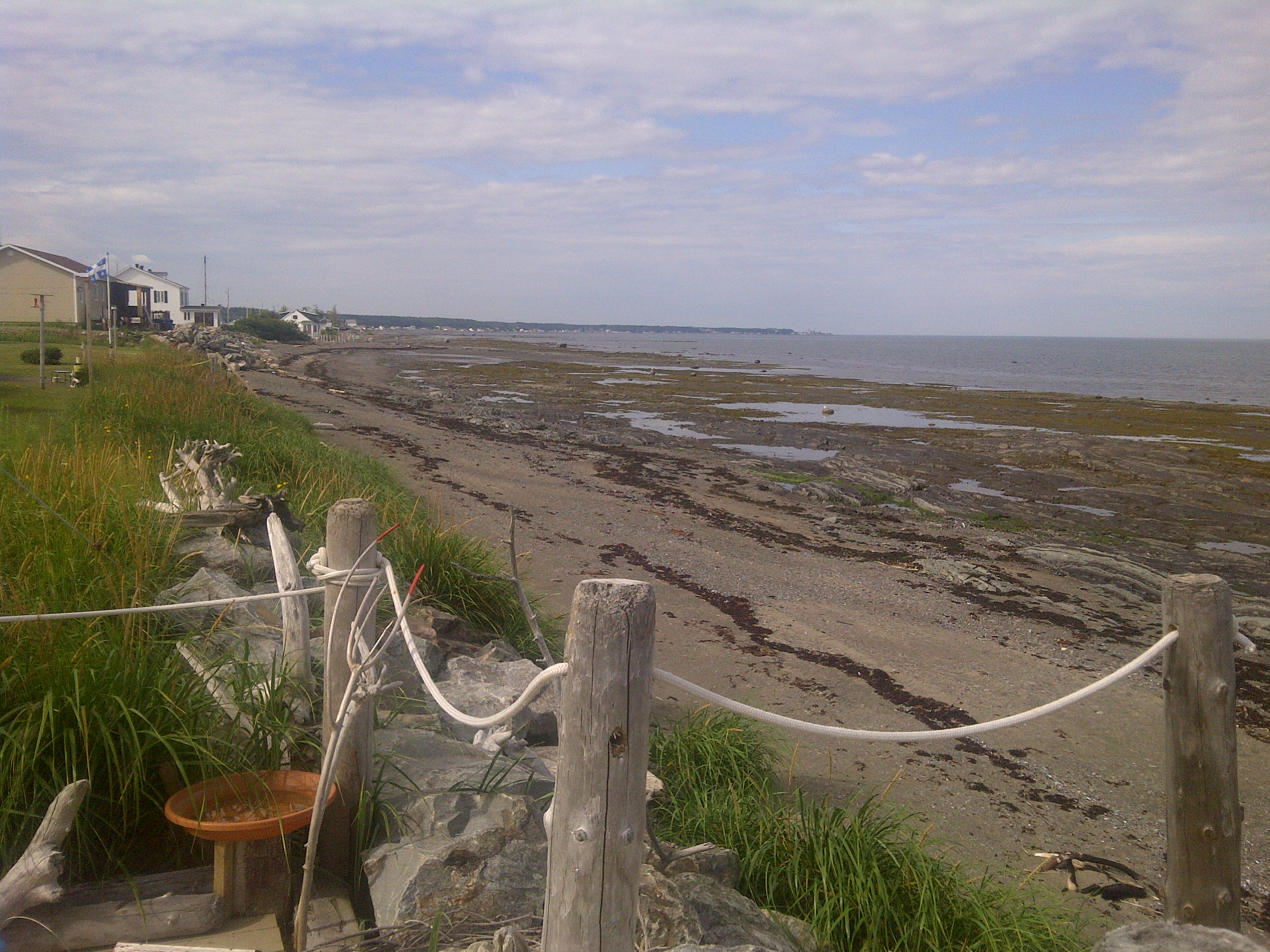
I’m sitting on the deck of my cousin’s home, on the Gaspe  coast of the St. Lawrence Seaway, near Rimouski, watching the relentless movement of the tide – in and out, taking in the smell of the salt sea air, feeling the call of memories and of stories past, present and future.

Gaspe Coast from Sainte-Luce Sainte-Luce-20130812-00493

I’m on a road trip with my dad – to his homeland in Quebec.  He felt the call of coming home and invited me along.  He grew up on the Gaspe coast, his family’s home one one side of the road, the seaway on the other side. Although I also grew up in a coastal community, it is not the same as being right on the sea, being shaped in some unknown way by the tides; and there is no doubt the sea is in my father’s blood.

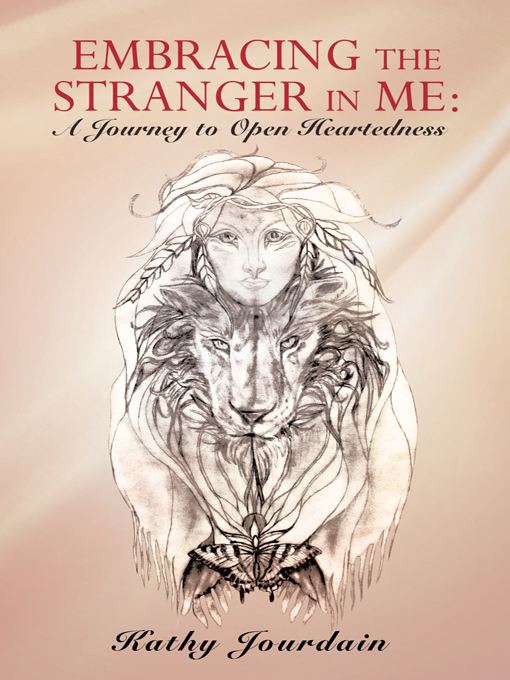
Having just completed my first memoir: Embracing the Stranger in Me: A Journey to Openheartedness, I am full on in the exploration of how stories shape our lives, what are the stories we focus on and the ones we give life to.  There is some story in my book about my father and his family, a little of what it was like for him to grow up in this place.  I am aware they are told from my perception and interpretation of what he has shared.  He – or members of his family -would probably reflect reflect them quite differently.

9781452575728_COVER.indd


Last night we were joined at the home of my cousin and her husband  by two more cousins (two of her siblings) and my aunt who is almost 90 years old and looks amazing for her age.  She is part of the reason we are here.  Because she called and asked my dad if he would come.  Another aunt, who will visit tomorrow, is another part of the reason.  My father is the last surviving member of his immediate family, his parents and his five siblings all living in spirit now.  My aunts had been married to his brothers.

For two of my cousins, it has been maybe 30 years since I’ve seen them.  For the other cousin, it has been since the death of another cousin – sometime in the last decade.  It surprised me to try to remember how long ago it was.  Time is fleeting in so many ways, it seems as if no time has passed.

I would not have taken this trip on my own.  It would not have even occurred to me.  For some reason Quebec seems far away for me – not geographically but maybe through all the stories I don’t know.  And, yet, being here, all the stories, known and not known, melt away as I find myself lovingly embraced by this part of my family I see so infrequently – and why would it be any different.  I am curious now about what are the stories that are here and now, what are the stories that will emerge late while I sit here by the St. Lawrence Seaway, taking in the salt sea air through all my senses, feeling the call of story in new ways.

Soul Encounter with Burnley (Rocky) Jones

Every now and then someone walks into a room, makes eye contact, a door to your heart opens and they walk right in. That’s exactly what happened to me the morning of June 19, 2013 when I met Rocky Jones.  It was a two way exchange, a soul encounter. I can count my in person exchanges with him on one hand, literally – three days of Art of Hosting training, two dinners – one with others and one in my home –  what was to be the beginning of a next phase of important and difficult work in the world and now is a sum total of something that cannot be readily explained in words.

Burnley (Rocky) Jones

Burnley (Rocky) Jones

Carolann Wright-Parks, a friend and colleague near and dear to my heart, had persuaded Rocky to attend the first half day of an Art of Hosting training for African Nova Scotian facilitators on behalf of the Ujamaa board, to show support.

Even then, given his health, Rocky knew his time was precious. He gave thought and care to how best to devote his time, telling us fishing had a strong call on him.  He came for the morning, participated in our opening circle, heard my good friend from MInnesota, Dave Ellis do a teach on World View (inspired by the work we are doing with Jerry Nagel of Meadowlark) and was inspired enough to clear his calendar for the next three days to participate.

His presence in my heart grew deeper roots the next morning when, as a group we were checking in to the day and this 71 year old man, a man who has seen and experienced much in his day, who shifted the shape of the world for so many in the province of NS and beyond, a legend in his own time, sat there in full humility marvelling at how much he does not yet know, how much he has to learn.  He knew, like so many of us when we encounter the wisdom of ancient futurism alive in the Art of Hosting that here was something that when we practice it could shift the shape of how we show up together and just possibly could shift the shape of our most entrenched problems.

And he knew about entrenched problems having encountered them since the time he was twelve, as he describes in this TedTalk on Breaking Down Social Barriers.  In our three days I watched him in his passion, curiosity and marvel as we shared frameworks for understanding he had never seen before and as he shared the history of African Nova Scotians making these frameworks come alive in his experience and the experience of the whole group.

I watched his incredulity at dinner one night in deep conversation with Roshanda Cummings a young woman from San Francisco who was on our hosting team about engaging youth, about how as a young Black woman, at times, she feels abandoned by her elders.  He listened deeply, asking questions, trying to understand her experience and what he could learn that could help him invite youth in a way that they could find meaning and be supported in their journey too.

When the Art of Hosting was over, I couldn’t wait for the next conversation we would be in, and the next, and the next – looking forward to learning from and with this man and to working with him. He reached out to me with a sense of urgency, wanting to find a time before I was on vacation and traveling again, thankfully, or it never would have happened.

At dinner in my home, we shared stories of journey, talked about the sense of soul connection.  He said to me, “When I walked into that room, you really stood out.” I paused for the briefest of moments and responded, “Well, I was the only white person in the room.”  We both laughed because we both knew that wasn’t what he meant.  Soul journeyers feeling the immediacy of connection.

He also said to me as we talked about a book he was in the process of writing with others, capturing the stories of his journey, “There isn’t enough time.”  As I imagined the work of the coming months, I told him, “There is always enough time.”

Turns out, he was right.  I have no doubt he was sensing his path.  And now he continues his work energetically in the spiritual realm.  And his work on the physical realm will be continued by many who have been deeply inspired by him, his authenticity, integrity, impact and ongoing sense of journey.

I grieve deeply for a man I met for a few brief seconds of life, who impacted me deeply.  I can only imagine the depth of grief of those who’ve known him longer and also the sense of celebration of a full life, a life worth living.  I celebrate knowing him and I will carry him in my heart and soul journey in my own continuing exploration of race and racism and of changing the conversations to ones of community, healing, belonging and acceptance.

The ancestors live on in us. Rocky lives on in many.


Generosity – Guest Post by Bob Wing

“To be generous means giving something that is valuable to you without expectation of reward or return. Many traditions measure generosity not by the size of the gift, but by what it cost the giver.” 

Give me your heart

For awhile I have been pondering the topic of generosity, wanting to share some reflections – and I might still do that.  However, in the meantime, I am delighted to share reflections from my good friend Bob Wing, Warrior of the Heart Sensei and Art of Hosting Steward.  I resonate with much of what he wrote in response to an email thread on this topic and delight in how he is sharing his reflections through story.

I asked him if he would be willing to guest blog here on Shape Shift and he agreed.  He is my very first guest blogger and this is what he wrote:

I have some experiences and thoughts I would like to share, though they raise more questions for me than answers. 

A true story about generosity:

I learned something of generosity years ago, in a liquor store. I was in the check out line to buy some good beer. I remember it as being Guinness Stout. There happened to be two men in front of me, also waiting. One of them, a Native American (most likely a Lakota), asked me what kind of beer I had and what it was like. Well, you can’t really just tell someone what Guinness is like, so with a great sense of generosity and a very good feeling about myself, I gave him one.

It surprised me how reluctant he was to accept my gift. It actually took some coaxing. Finally he would only accept it if I would receive one of his Coors beers in return. Compared to Guinness, I find Coors quite anemic and I didn’t really want it.  In that moment, however, I realized that genuine generosity lay in me letting him give me something in return … a trade …not a gift… and then he could leave without a feeling of obligation to me. My real generosity was in accepting his equality by allowing him to give me something in return. 

Another true story about generosity:

In the early 1980’s I knew of a small group of very respected Lakota medicine people who had been invited to tour places in Europe to bring their “medicine” and to lead healing ceremony for whomever wanted to come. Their travel had been paid by sponsors but by tradition they could not/would not receive any money for their work. Medicine, both physical and spiritual, is held to be a gift and not a business.

The problem arose when most everyone who came saw it as being “free” and failed to offer gifts in return. While the medicine people could not “charge”, they did expect (this also by tradition) that their generosity would be met with material generosity in return. A medicine person does, after all, also need to support his life and his family, so it is important there be a way to do that, or the medicine/generosity-based culture crumbles. In their traditional culture everyone understands this and so are as generous as they can be in return.

 What finally happened was that after continually not getting anything in return the “medicine stopped flowing”. They perceived not getting anything worthy in return as being neglected, devalued, and even insulted. They stopped doing anything real. I think it was a misunderstanding of cultures, not so much of Native American and European, as of business culture and gifting culture misunderstanding each other.

 Some ideas on generosity: 

Gift culture is based on openness to a return and business culture is based on demanding a return, though maybe they are not really so different in essence. In both, if the return is not at least of some equality, then each will soon stop functioning–the medicine will stop flowing. 

 However, the language and gesture of each seems to be so very different. Maybe the difference involves who is perceived as having responsibility for seeing to the equity. In a gift culture, the responsibility for equity of the return is usually with the receiver of the medicine, and in business culture the responsibility for the equity of a return is usually with the giver of the medicine.

 Also, I think that business culture tends to promote separateness and gift culture tends to support relatedness. In our culture, business culture seems most dominant, though I suspect that the basis for keeping a sense of relatedness, even in business, is actually an expression of gift culture. It may come from the sense most humans have of needing to be related to others. 

 Personal awareness of generosity:

I am aware that I am in love with gift culture and I suspect most of us are. I love being generous as I suspect most of us do. I love having the means to be generous in all ways, although I don’t always seem to have these means. It’s a quandary.

A big problem for me sometimes comes in my skillfulness to communicate my needs in a culture where people most often seem to act as though it is either “free” or it “costs”, maybe similar to the essence of the problem the Lakota Medicine people had. When I sense that I’m not in some way being gifted enough in return, my “medicine” stops flowing. I don’t like it when that happens. I search for good ways to travel between these two. I like the saying I’ve heard many times before and have really taken to heart, “I don’t work for money, but I do accept money for my work.”

And this, to me, is some of the crux of what we meet up with when the work we do is for the good of ourselves and others, to shift the shape of patterns that no longer serve and generate new patterns that serve us better.  How do we value this important work in the world and not feel embarrassed or awkward about being paid well for the work?  What is the spirit of generosity and reciprocity that creates expansion and openings for things to flow in the best of ways and continues to make what we offer widely available, recognizing various capacities to be financially generous and knowing that generosity shows up in other ways too?

Thank you, Bob Wing, for your willingness to have your reflections shared here.

Women, Leadership and Power

Will feminine principles rule the future?  John Gerzema and Michael D’Antonio posit this in their book, The Athena Doctrine: How Women (and Men Who Think Like Them) Will Rule the Future, and I like to think they are right.  More than like to think it, I am actively inviting it, through the work I do and the way I do it – collaboratively, with others doing good work in the world using the practices and patterns of the Art of Hosting Conversations That Matter.  This doesn’t mean I think masculine principles are bad, just that they are overused and a rebalancing of the energies could spark the next evolution of leadership and power in life, work, play and community.

We are living now in the space between narratives as my friend and frequent co-host Jerry Nagel likes to say.  The old story of power and control, described as masculine attributes, that many of us around the world are reportedly dissatisfied with is the story that has been operational for centuries now.  The new story of consensus building, collaboration and co-creation, described as feminine attributes, is what many are longing for, even when they do not have the words to articulate it.  People I encounter in the work I do and the places I travel want to show up and be seen as full human beings rather than as the distinct parts that are “acceptable” in different circumstances – logic and rationality at work, nurturing and caring in private. When we are invited as full human beings a new essence of aliveness and creativity also shows up.

The characteristics we are yearning for now are exactly the characteristics that have been dismissed and squelched as not being effective, as too soft, as the antithesis of leadership; the characteristics of feminine principles.

The principles of masculine and feminine are being confused with gender, feminine principles have been diminished and, by extension, women have been too.  Women wanting to be successful in business and politics in the past have had to become more like men in the drive for power and authority. Even Cheryl Sandberg in her book Lean In is really asking women to to step up to their male colleagues in the way of the old narrative.  I love that her book is sparking conversation in many places about masculine and feminine principles, and I love that she is successful as a powerful woman leader.

What does it take to shift to a new narrative about women, leadership and power? It is hard to shift to new narratives.  The grip of the old story is engrained in us in ways we do not even know.  Even as we step into doing things differently, the pull of the old narrative, embedded in culture which is designed to perpetuate itself, is strong.  It takes intentionality, vulnerability and the willingness to be in good inquiry and co-learning with each other.  It takes a re-valuing of the feminine in all that it has to offer and a new understanding of what it means to be powerful. It takes the willingness to let go of control to step into patterns and practices that invite the best of our thinking, leadership and accountability to show up, the spaces were emergence lives.

It takes men embracing principles of the feminine and it takes women seeing and stepping into the strength of these principles in ways that show how powerfully they can shift the shape of the narrative we are living into now.  It means bringing for the best of the masculine principles into this rebalancing dynamic and acting with curiosity, generosity and compassion.

This inquiry is one I am excited to be exploring at a one day forum in San Francisco on June 7, 2013, which is an invitation to be in a deep dialogue together with other women about women and power, the next evolution of leadership.  There we will be exploring questions like:

1) What is the new definition of success we need to create so women can truly thrive in their personal and professional lives?

2) How do we gain the confidence and courage we need to express ourselves more authentically as professional women?

3) How do we more fully step into our leadership to vision and co-create new, more powerful systems and patterns in the worlds we live and work in?

4) What are the feminine qualities, when we as women express them more fully, make us more powerful leaders?

5) What becomes possible when we as women elevate each other and what is required to support or grow this over time?

6) What is the desired impact we want to have in our organizations and in the world?

7) What are the prejudices and stereotypes women hold which, if they shifted, would create better opportunities for women to thrive?

I am curious to see what will emerge from the inquiry and how we might set in motion, or accelerate what is already in motion, supportive leadership practices that invite the best of who we are as human beings to show up, individually and collectively.