Hosting Lessons from the Field – Presence and the Four Fold Practice

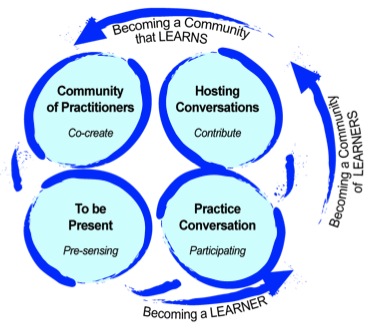
It is the last morning of our 3 day Art of Hosting training in St. Paul Minnesota in mid April 2012.  We have 40 participants plus our 6 person hosting team which includes 3 apprentices. The hosting team is starting our day by checking in. Day 2 was a good example of a groan zone kind of day.  The field felt a bit disconnected from itself.  There were little rumblings here and there that had been showing up since our opening circle on Day 1 that had our attention a bit and certainly our curiosity.  At the end of Day 2 during our check out as a hosting team, we noticed some of the dynamics that seemed to be in play, felt we didn’t have enough information to make informed determinations of what may or may not be in the field and let it go as we left for the day. On this last morning, the person hosting our check-in asks, “What are you anticipating in this day?”  The question gives me pause, although I’m not sure why — until I begin to answer it.  I start with, “Well, I’m anticipating a few good conversations with individuals – some of whom have already been identified.”  I hesitate.  What else am I anticipating in this day?  What do I want to anticipate?  Ah.  That is a good question.  My clarity begins to emerge. I continue, “I don’t think I want to anticipate anything else.  We know there are some dynamics in this field.  It is not fully clear what they are so I think I don’t want to anticipate anything.  What I do want to do, is be fully present and attentive, ready to tune into whatever emerges that needs tending, but without anticipating now what that might be.” This sentiment seems to resonate for all of us on the hosting team.  An invitation into being fully present, to not speculating, to not imagining how carefully we need to tend the field for certain things.  The first of the four fold practices – being present. The Four Fold Practice is a core pattern and practice in Art of Hosting and it has been receiving renewed attention lately in our teaches and our conversations. Self hosting. Not just being nice to self by going to the spa or eating dark chocolate.  Depth. Practice.  Discipline. The discipline of practice. Meeting oneself, sometimes in places one would prefer not to meet oneself. Being present is fundamental to good hosting.  This I knew.  What happens next for us as a hosting team is what has me reflecting still on the power of presence and what it means to hosting and, more than that, for me anyway, what it means in my life. As a team we decided not to try to figure out what may or may not be going on in the room, or who was holding the threads of what dynamics, but to let it go to sense into what was alive in the moment allowing us to more powerfully engage the next two folds in the practice – participating fully in those one-to-one conversations and contributing to the larger hosting process. Following our check in, I was coaching the proaction café team.  It was a large team, a bit chaotic to start, but everyone managed to find a role that worked for them with several teams of two hosting different sections.  I went off to find the members of the team to check in with them about their role and what, if anything, they needed from me. In entering the room, I began to encounter some of the people who seemed to be holding some of the threads of discontent and disconnect that had been popping up over the previous two days.  Spontaneously.  I didn’t seek them out.  I’m not even sure they sought me out.  We just bumped into each other. In this spontaneous connection in even just five to ten minutes, a depth of human to human connection happens on the level of story, being able to see and witness some extraordinary part of an individual’s journey.  What is even more surprising is that this spontaneous connection happens for many of our host team members. What we notice alive in our field now is that the threads of discontent and disconnect seem to dissipate and disappear.  They don’t go underground as often happens when not addressed, but they seem to disparate in the depth of human connection.  People feel seen, heard and acknowledged in their journeys in unanticipated and beautiful ways. Then, the proaction café weaves people, their stories and their gifts together in a beautiful way.  Nine projects/ideas expand in delightful ways.  The conversation hosts feel gifted.  The participants also feel gifted and honoured with holding and exploring other people’s dreams, realizing the power of contribution even when not directly connected to someone else’s project. One of the roles taken on in the proaction café is the deliberate and intentional holding of space – or the energetics in the room.  Two women stand on either side of the room, visibly and silently witnessing the room and hosting space.  When we debrief, they are asked to share what they have been doing and what their experience has been.  They describe the honour of it, of seeing the weave in the room, of deliberately fueling it with positive intention and love.  Participants describe their experience of it, what they feel corresponded to what they heard from the hosts of the energetic space.  It was one of the most deliberate explorations of what are we hosting really that I have been part of. When we do our closing, as often happens, we become aware of how powerful the three days have been for many who are there.  We are reminded of the power of the groan zone and how our assessment of where we are in our process influences our interpretation of whether we are successful or not.  On a day that ends in a groan zone it doesn’t always feel on track or successful.  Seeing the convergence in the next day reinforces the beauty and possibility of the groan zone. I’ve been through enough groan zones that I should know this but it is always a renewed awareness. As we close our hosting team circle at the end of the day, we bring curiousity about what has happened and a fresh wondering about the Four Fold Practice and the power of presence to shift the shape of the field and the possibility it can shake out some dynamics without needing to dive into them.  Is that what happened?  I don’t know with absolute certainty.  That’s my continued reflection.  Will full presence always be enough to dissipate shadow on its own?  Happy to experiment more to discover – rather than anticipate the answer to that. This experience has me reflecting on hosting self, specifically myself, my life and my relationships.  How often have I said about a situation, relationship or person, “I’m optimistic that…” or “I’m not optimistic that…” What is the anticipation that gets built into those kinds of statements?  What if I just met that situation, relationship, person, myself, in the moment of the experience and not as a precursor to what might or might not be but attentive to what, if anything, needs to be tended to in this moment?  How would this ongoing presence shift the shape of my experience now, shifting the shape of my relationships and my situation? I am deeply appreciative for the question, “What am I anticipating?”  It has made me aware of how much I do anticipate and how a lot of that does not serve.  The only journey I really need to pay attention to is mine.  Another person’s journey is not really my business and is certainly not my journey. My journey intersects with others, but they don’t define mine unless I let them.  I don’t define theirs unless they let that happen. Letting go of analysis and simply tuning in at the moment supports what wants to happen rather than fuels my own anticipation of what might or might not happen, possibly feeding something that didn’t need to be fed, creating something where it might not have existed except that my/our anticipation brings it into being.  Still ruminating on this one. Powerful lessons from the field on being present.
Hosting Lessons from the Field – Dancing with Design Flow in Brazil

How many of us have had the opportunity to enter into hosting a day or a training (Art of Hosting style) without any design for the day, completely sensing into what is needed in the moment and fluidly dancing with five other hosts with offerings to meet what was emerging in the field moment by moment?  How would you meet that invitation?  Excitement? Trepidation? Both and anything in between?

It is one thing to do this on your own or with one other person as Bob Wing and I did last summer in work we’d been invited into that turned into Hosting Ceremony.  It is a whole other thing to do it with a new hosting team  constellation of six of us on the third and last day of working together – in this case for the first Warrior of the Heart training completed in Brazil in January 2012.

Warrior of the Heart is the work of Toke Moeller and Bob Wing coming out of many opportunities they had to jam together combining Art of Hosting and Aikido practices and principles.  Playing together they imagined Warrior of the Heart training into being.  I’d participated in a couple of Warrior of the Heart trainings – on Bowen Island in August 2010 and then at Windhorse Farm in Nova Scotia just this last October, 2011 with my 9 year old son.  I’d also had the chance to work with Bob where Warrior of the Heart became a component of the Art of Hosting training we were delivering.

In September 2011, after the Art of Hosting training in Porto Alegre, Brazil that I’d been co-hosting, Thomas Ufer, Najara Thamiz and I sat down with Jose Bueno and crafted an invitation to Bob and Toke to bring Warrior of the Heart to Brazil for the first time to seed the field for more and build the ground for the amazing expansion of the Art of Hosting and social change movements happening there.

Working with a larger hosting team for a training the two of them were used to offering on their own invited Bob and Toke to some new learning edges. They invited the rest of us to go there right along with them.  There was already a huge reservoir of trust in our hosting field even before we began. We built on it during our preparation and hosting time together.  On our last day, it was Toke who invited us into the dance of hosting together without an agreed to advance plan.

I felt in me my own skepticism at the invitation which arrived after morning practice, before breakfast, where we had actually invoked this flow already.  I really wasn’t sure how it would work and whether we would all find our own place to play in this day – but I was willing to step into the challenge – because with this team there was nothing to lose and lots to gain.

As the six of us stood in a tight circle on the stone patio outside the training building, a staff was in the centre with the challenge of who would take it first and offer something to the group to begin our day.  Silence.  A deep collective breath or two.  I could feel the tremble in me.  Another breath and then I reached for the staff.

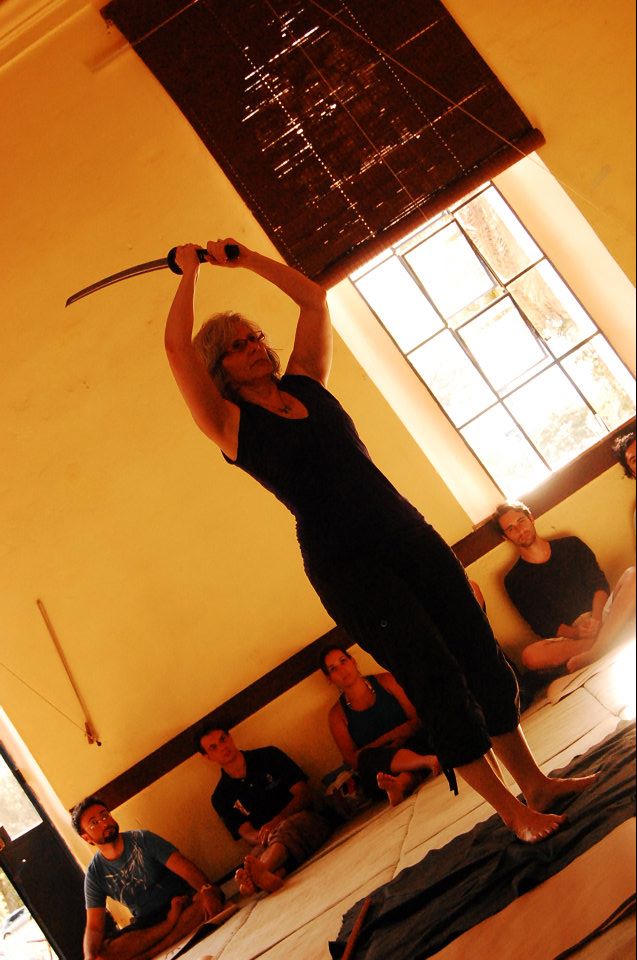
I had been preparing during our time together to do a teach with the sword – in this case the wooden representation of the sword – a bokken.  Bob had been coaching me.  Perhaps because I was preparing to step into the challenge of a teach on something I was still very much learning myself, I had taken Bob’s feedback and coaching in in a whole new way, embodying the teaching and the sword movements with more fluidity and confidence than I ever remembered feeling.  I had been preparing for a teach and this was apparently the moment it would be offered.

I started the teach – the four directions – and forgot how to do the step to turn from one direction to another.  Without being hard on myself, I asked Bob to step in and help — and he did because he had my back.  All six of us had each other’s backs and none of us needed to shine or take up too much space and yet we were all invited to offer our brilliance when we felt the call.

It was the beginning of a rich dance that included all six of us throughout the day.  The experience was playful and fun and ended with a touching and powerful ceremony.

Raising the Sword in the Warrior of the Heart (Brazil 2012) Closing Circle

The willingness to let go of control and design flowed into the Brazil Stewards Gathering that followed the Warrior of the Heart – in its own way and to its own degree because, of course, the team and the circumstances were different.  But the fluidity of the dance was just as hesitant and joyful in its own way.

I’ve been reflecting on what makes this kind of dance possible?  One is definitely trust in the individuals and the collective of the team – knowing that each individual is there to serve the good of the whole and with no need to shine on an individual basis – although, as I mentioned above, of course each person does shine because of the gifts they have to offer in service of the whole.

A sense of knowing when what I have to offer as an individual is exactly what is needed now.  This is a complete dance with the subtle energies, with intuitive capacity.  The courage to offer it when it is called.  A certain level of trust or confidence in my own skills and abilities.  A willingness to let other people shine in their mastery or even in their apprenticeship.

It takes a certain level of maturity in each individual, the team and even in the field.

Would I want to completely free flow it every time?  I don’t think so.  Every situation requires us to be tuned into what is wanting and needing to happen.  Different situations will call out different things. And many situations invite a free flowing of design and offerings to different degrees.  I and we are already practiced with working with emergence.   Practicing to this degree honed my skill and my sensing capacity and invited me into new levels of mastery.  It is embodied in a new way.  It will always be with me – and with each of us.

Having had the opportunity to host immediately after this experience, I know it’s in me in a new way and for that I am grateful.  Looking forward to the next opportunity to dance in the ultimate emergent design – and to all the other variations of that that will show up along the way.  Thanks Toke for the invitation and to Thomas, Narjara, Jose and Bob for being willing to dance the beautiful dance that shifted the shape of my hosting experience to new depth.

Prototyping Collaborative Leadership at Capital Health – Citizen Engagement and Accountability

Citizen Engagement and Accountability Portfolio

In May 2009, the creation of a portfolio within Capital Health with the title of “Citizen Engagement & Accountability” presented a rare opportunity to create something that had no precedent.  The portfolio was launched in response to the strategic stream of Citizen Engagement that came out of the Strategic Quest work in 2007.

Lea Bryden was tasked with bringing together three functional areas under this new portfolio: Marketing and Communications, Community Health Boards and Patient Representatives.  In looking across the country, they found themselves virtually alone as there were no models to inform the portfolio development.

In January 2010, Kathy Jourdain and Tony Case, through Shape Shift Strategies Inc., were contracted to assist in shifting the shape of this portfolio.  The intent was to truly create a new portfolio with collective purpose, principles and streams of work and not just perpetuate the three existing functional areas under a new name.  Some of the functional work would be the same and new work would emerge through the process but all of it would be informed by the collective purpose.

This work was given context and framing by the following pre-existing pieces of work:

  • Our Promise
  • Declaration of Health
  • My Leadership: Being, Caring, Doing
  • Citizen Engagement Strategic Stream
  • 2013 Milestones

In addition to wanting to honour CEO Chris Power’s intention in asking the question: “What kind of future could we create if the vision of Our Promise and belief in our Declaration of Health showed up at each of our touch points in the course of our day?”, Lea also wanted to uncover the unique gifts and contribution of each member of the portfolio and understand how they came together as a collective.  And, it was  very much a mechanism to create a cultural shift to even greater transparency and accountability.

This process invited a design team to co-design the process.  There was initially a very specific invitation to a member of each of the three functional areas. As the process unfolded participation in the design process was completely open and transparent and those with the greatest interest and passion continued to participate in the process.  Some people showed up in the beginning because they thought they should and then kept showing up because they saw how their contribution directly influenced the design of each session.

This work took place over a period of four or five months to establish collective purpose, principles, priorities, and strategies.   It took into account other work that was underway in the organization, incorporating things like the budget planning process or the response to Capital Health’s community engagement recommendations right into the process so the portfolio could learn how and when to respond as a portfolio to other moving parts of the organization.

We knew we were making headway when we hit the groan zone.  The collective purpose and principles were articulated and we began to hear, “Oh good.  We have what we need.  Can we be done?  Can we get back to our regular work now?”  This was a signal to push back.  Lea did this by asking a simple question, “Where are we seeing evidence of our collective intention at work?”  The responses were amazing, informative and represented a turning point.

A philosophy of our work as consultants was to transfer collaborative leadership skills into the portfolio so it could flourish once our involvement came to an end.  The portfolio created a transition team to continue to guide the work and this team is also working collaboratively.

A key contributor to the success of this initiative was Lea’s willingness to foster collaborative leadership and her openness to growing her own awareness and skills in the process.

Like all significant culture shift initiatives, there are certainly bumps along the way.  But there is lasting change in the way this portfolio views itself, understands its work and engages with the public.

Prototyping Collaborative Leadership at Capital Health – Infusion

In March 2007 Capital District Health Authority (CDHA) in Halifax, Nova Scotia took on a planning process called Strategic Quest.  A significant component of Strategic Quest included public participation in an unprecedented way, shifting the shape of awareness and thinking at Capital Health.  The results were revealing and the impact continues to reverberate throughout the organization today, strongly influencing ongoing public participation in a number of areas and inviting collaborative leadership as a strategy to accomplish many of its goals.

One initiative I was involved with where Collaborative Leadership was an essential part of the process was Infusion: a gathering in November 2008 of 70 leaders from across North America, in our local community and within Capital Health, convened to inform what bold and unique leadership development within Capital Health could look like.

The planning process for Infusion, championed by Lea Bryden and led by Shape Shift Strategies, invited and modeled collaboration, shared leadership and shared responsibility.  A diverse group of people from across Capital Health were invited into the planning process.  Many identified the planning process itself as a leadership development opportunity as they experienced collaborative leadership in new ways, stretching beyond their original assumptions about how and what they could each contribute to this unusual event.

Achieving clarity of purpose was the first task.  It required a significant investment of time – several meetings.  It was a difficult task because there were multiple overlapping components all alive and unfolding as we were in this planning process.  We stayed in the conversation until sharp clarity was achieved and then rest of the planning process unfolded rapidly because it was guided by this clarity of purpose.  We also actively worked with Theory U in the planning process and for the event itself.

The planning process always had a forward momentum, even when people missed meetings.  As they came back in, they found their place in the process and continued to contribute constructively.  They could step into and out of the flow of the process without having to back track and rehash decisions made when they were not present.

The two day Infusion event drew on the talents of everyone on the planning team.  Invited guests: leaders from a vast array of backgrounds, many of whom were leadership consultants, were asked to bring their knowledge and expertise in a participatory way.  It was at times a challenging field to hold.  The team was able to hold its ground as we went through the fire of chaos, adjusting design in the moment and holding space for some anger and frustration that unexpectedly arose within the group because of the collaborative leadership we had been growing throughout the planning process.

Infusion did not end in a nice tidy wrapped up bundle and Lea Bryden, myself and the team were good to leave it that way while taking away the gems that guided the development of My Leadership – a truly unique leadership development initiative inside of Capital Health with a bold vision and goals that has since had 500 leaders complete and won a number of regional and national awards.


A 1500 Day Collaborative Journey

In November 2006, the Council of the College of Registered Nurses of Nova Scotia (CRNNS) embarked on a 1500 day collaborative journey, the likes of which they could hardly imagine was possible at the time.  What was clear was that the College had a vision and a mandate to grow inter-professional collaborative practice (IPCP) from pockets here and there across the province to a more widespread practice as one of the responses to a health care system in need of shifting the way services were delivered.

They knew this was not a mandate that could be achieved alone and they weren’t quite sure how to invite other professions into the conversation.  They contacted an Art of Hosting colleague of mine who invited me into the process and we worked with a team from the College to begin to clarify the work.

Early on we identified that this would likely be a long term process that would use Theory U to define the journey and Art of Hosting as the operating system. Before the journey could even begin, others needed to be invited into the conversation so that other people and organizations could identify what contribution and what level of support or commitment they were willing and able to offer.

The College hosted its first assembly in November 2006 to announce its mandate, speak what they were hearing in the system and being called to do, invite a broad array of health care professionals into conversations using processes like Appreciative Inquiry, World Café and circle which many participants experienced for the first time ever that day.

Out of this assembly a core team of about twenty-five people and financial support from a broad range of health organizations self identified to commit to a multi-year process that included two Art of Hosting retreats (one a sensing retreat and one a presencing retreat) to train the core team, deepen their understanding of the purpose and principles of the work and identify a strategy to move this mandate forward.  We called on Art of Hosting colleagues doing similar work in Ohio and in England to come and also support this initiative, bringing with them a wealth of experience and weaving in the stories from other places that increased the anticipation of successfully shifting the shape of collaborative health care in Nova Scotia.

The collaborators included: Annapolis Valley Health, Capital Health, College of Licensed Practical Nurses of Nova Scotia, College of Physicians and Surgeons of Nova Scotia, Dalhousie University, IWK Health Centre, Nova Scotia Association of Health Organizations (now Health Association of Nova Scotia), Nova Scotia Department of Health, Pharmacy Association of Nova Scotia, Registered Nurses Professional Development Centre and the Pictou County Health Authority.  The team included people from many of these organizations and was itself inter-disciplinary.

In between the two retreats, the core team embarked on a series of sensing strategies to broaden their own understanding of the health care system in Nova Scotia, identifying challenges and opportunities without assuming they already knew all the answers.  One purpose in this was to also engage a more stakeholders and learn from them what would capture their support, interest and imagination.  Seven group interviews and thirty five individual interviews were conducted, designed to elicit their private voice more than their public voice.  It is in the private voice that deep despair and incredible hope both reside.

The information that came back from these interviews was powerful.  So powerful it was used to invite back a large assembly of stakeholders in May of 2008 to hear the results and, most importantly, to hear the voices of the system spoken back into the room.  In response, somebody said, “What we are seeing is a crisis of the soul.”

We asked people: “What would you do that you’ve never done or dreamed of doing to change the future of healthcare?” They responded:

  • Change the way we deliver health care
  • Change the focus of health care
  • Change education of practitioners
  • Change what we say to communities
  • Change governance of health care
  • Change relationships and how we work together

We asked, “What should the purpose of the health care system be?”  To which they responded:

To create and maintain holistic, accessible support and care so that Nova Scotians may live well in a place they call home.


To facilitate and empower the individual and the community to create and maintain

optimum health as defined by the individual.


The purpose of the healthcare system is evidence based, person-focused, preventative, holistic, and uses a collaborative approach to optimize the health, safety, wellbeing and environment of people within their communities.

People made commitments that day and the College made a commitment to check back in later with their last assembly to acknowledge and celebrate progress.  That day happened in June 2010.

Six champion collaborative practice teams currently providing services in Nova Scotia were invited to present at the Assembly, modeling the way and illuminating the steps to successful collaborative care in Nova Scotia.

Have all the ideas identified in May of 2008 been implemented?  No.  But in 2010, there was far more collaborative care in Nova Scotia than there was in 2006 when the College began its quest and invited in collaborators, retaining its willingness to be a champion of this work and, at the same time, “letting it go” so that it could be co-created throughout the whole journey with those who stepped forward to share the leadership and responsibility of this work in Nova Scotia.  Other initiatives focusing on Collaborative Care also emerged during this time helping to expand awareness and the field of practice and this does not lessen the impact of the Inter-Disciplinary Collaborative Practice initiative in generating impactful responses to a system in need of change.

Some things have fundamentally changed.  Some things are still to come.