Slowing Down to Go Fast

Our world moves so fast we all want it done now, or yesterday – whatever “it” is. The paradox is, we don’t have time to go fast anymore. But it’s not just about slowing down. It’s slowing down, adding in intentionality, purposefulness and patterns of movement – often non-linear and iterative – to take us to places we’ve never been before but that we’ve dreamed and know have to be possible. We want to get to this new place but we keep repeating the patterns that have never gotten us there before – Einstein’s definition of insanity.

Add into the mix, the complexity of today’s challenges generally means it is not a straight path from A to B and even if it is, your destination is probably somewhere else.

What does slowing down mean?  One is taking the time to acquire new lenses with which to view the challenges and complexity we face.  Another is learning how to use conversational methodologies well – tuned into purpose and intention as a guiding principle for how to design, enter and engage the questions of most relevance to what’s needed now – in growing learning, tackling innovation or bridging organizational divides.  It is not simply a learning and development opportunity.  It can be a formidable strategy to grow an organization, engage a challenge, conceive of innovative processes and/or products that serve the mission or mandate of your organization – as you already know.

These things are all possible using the principles and practices alive in Art of Hosting practices and frameworks.  Art of Hosting is not just a training.  Seasoned practitioners use it in consulting work all over the world – in every sector, for small and large initiatives, to launch new organizations and teams and to shift whole systems.  It is not just theory.  It is today’s complex challenges made real.  And it takes time.

For the training work we do, we often get asked about three days.  When money is no issue the larger question that looms is, “Is it worth three days of my time?”  Well, that depends.  On how aware you are of the value of slowing down to go fast – slowing down to allow insight to percolate, new perspectives to digest into new approaches and new strategies to emerge in animated and reflective conversation with other bright lights called to gather together in three days.  Because there are an amazing number of bright lights who show up for any training – of all ages, backgrounds and perspectives.

The beauty of being in 3 days or more with the same group of people is it invites the pattern of divergence-groan zone/emergence-convergence to show up.  There are many times when I’ve been asked at the end of day 2 of a three day training how is it going?  If I write that story, it is a very different story of what emerges because even subtle things shift and change in one more overnight or one more conversation evoked through a powerful question.  There is something in a three day pattern that lets us sense more fully into what our questions are, explore them in the company of others also asking powerful questions, seeing not just synergy but emergence – where we all gain something that no one person brought into the room, and we begin to imagine, often with extensive detail, how we will use what we’ve learned when we go back to work.

Not everything needs to slow down of course.  Not everything needs three days.  Some need less.  Many need more. But we refuse to take the time – we believe we don’t have the time, other things are more pressing, we will get too far behind – lots of limiting beliefs we carry individually and collectively.   But what about the things that do need three days and maybe longer? Percolation does.  New perspectives often do.  Imagining – really imagining the new – does.  Shifting paradigms does.

When we give ourselves permission to slow down we also invite ourselves to be surprised by what emerges and how fast things move with new clarity.  It is a wise investment of time and necessary for those of us imagining how to shift the shape of the worlds we touch.

“Until recently”…. a Very Simple Strategy

“Until recently, my office was really cluttered.  Now, I’m in the process of organizing it.”

“Until recently, even though I liked you and wanted to be in touch, I was a little afraid of you.  Now, I promise to stay in touch because I’m no longer afraid of the questions you’ll ask.”

“Until recently, I didn’t know how to approach difficult conversations.  Now, I’m learning strategy and gaining courage.”

“Until recently, I was just walking through the experience of my life because I was afraid of my emotional response.  Now, I’m living into it. And, it’s not as scary as I imagined it to be.”

“Until recently, I was struggling.  Now, I’m feeling more flow and a smoother road ahead.”

It is a simple little strategy that, until recently, I hadn’t heard about.  But, now that my friend Robert Newman from Columbus Ohio shared it with me when I saw him in June, I’ve been using it and I’ve been sharing it with my coaching clients.

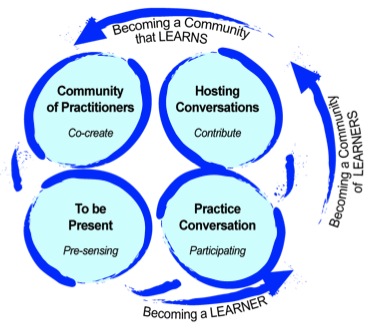
One of the aims of coaching is to become aware of old patterns that no longer serve and awaken new patterns that serve us better, generating greater self awareness, one of the goals of hosting self in the Four Fold Practice.  It is really easy to get stuck in the story of what was instead of engaging the story  or the future we want to invite, the one that shifts the shape of our world and our interaction in it intentionally in the direction we envision, the way we want to show up for ourselves and in relation to other people.

It invites a gentle noticing: “until recently this is the way it was” – and it invites an intentionality: “now, this is what I choose. ” There is no harshness, no self judgment but a delightful invitation to choice.  To choose a better feeling story and invite ever increasing better feeling results.  It is like a mantra and a habit that can be remembered mid sentence in an old pattern:” I don’t keep in touch very…” pause, notice… “until recently, I wasn’t very good at staying in touch. Now, I’d like to set up a regular pattern of calls”.

It invites lightness into whatever it is we want to shift and grows the potential we will create the shift we want.  Try it.  Recently, I have discovered it is a very simple yet effective strategy.

Explaining Art of Hosting for Beginner’s Wanting to Know What It Is

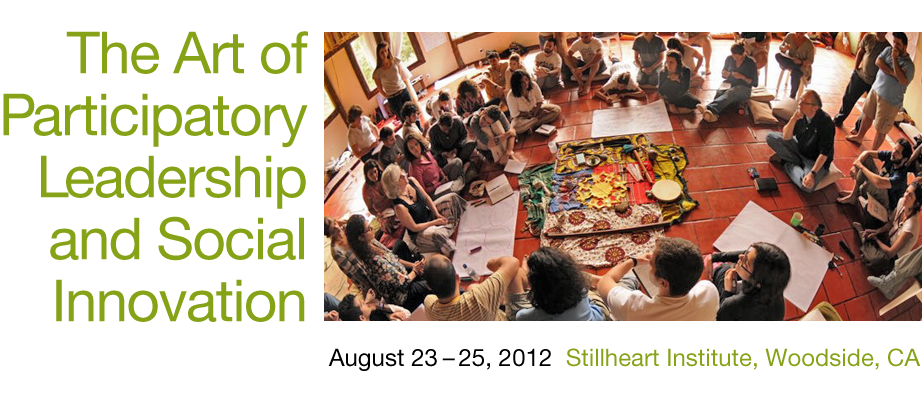
Every place we go has its own tone, texture and timing.  It is part of what makes Art of Hosting – or in the case of California in August 2012, the Art of Participatory Leadership and Social Innovation – so hard to define. “We” being whatever configuration of hosting and calling team has coalesced around an identified need or opportunity.  Every training is different because every place is different, every group that responds to the call is unique.

People who are just coming across Art of Hosting want to know, what is it?  One way to think of it is, at its core, a set of patterns and practices that help us be successful in complex circumstances.  Developing skill in using these patterns and practices is particularly helpful now at a time when long term strategic planning doesn’t work anymore (if it ever did) because we don’t know and can’t predict what ten, five or even two years down the road will look like.  One thing many of us have a growing awareness of is that what has worked in the past – strategies, practices, principles – doesn’t seem to work anymore – if it ever did.

The world is providing us with increasing complexity – in the environments in which we operate, our communities and in our organizations, especially as things seem to move faster and faster.  Social innovation is a response to this increasing complexity.  Rigid protocols have limited application in complexity.  Complexity calls for a different set of leadership skills – skills that tune in and are responsive to emergent circumstances.  Complex systems share behaviours that cannot be explained by their parts.  This requires a different set of frameworks to see and understand it.  In the Art of Participatory Leadership we draw on world view, chaordic path, divergence/convergence, the 2 loops of systems change, theory U and other frameworks as lenses through which to think about complexity and social innovation.  Social innovation looks for an alignment of circumstances that makes action possible – the relationship among elements.

One of the names we use for this type of experiential learning is the Art of Participatory Leadership because it also calls forth a new set of leadership skills required to deal with complexity and social innovation, quite different from how we think about traditional leadership.  Participatory leadership focuses on participation and engagement strategies, knowing from experience there is wisdom and knowledge that exists within a group, a team, an organization, a system.  When we make it visible in a group, it moves into the realm of collective wisdom, knowledge and understanding leading to a different kind of action and ultimately different results.

Participatory leadership  connects well in high pressure situations. Some of its core characteristics are curiosity or non-judgement, staying in the space of not knowing, generosity or openness, a belief that conversations matter and that good conversation leads to wise action.

It is not a quick fix or a magic bullet for problems that have existed and have been evolving over long periods of time.  However, there are often very immediate results for individuals as they examine and reflect on their own leadership practices.  This is also why we encourage teams to participate so they have a new common language and are more able to hold each other accountable to create a path of behaviour change and organization practices that will be sustainable.

A core element of the Art of Participatory Leadership is for each of us to deepen our own capacity to effect transformation – in ourselves and in a complex world.

Where have these practices and patterns been used? In community, private sector, academia, healthcare, and educational settings as well as social change efforts around the world.  The stories are only just beginning to be documented because many of us have been deep in the work rather than the writing about the work.  Stories are alive in Nova Scotia, Ohio, Minnesota, Europe and Brazil and many, many more places.

Art of Hosting is also a global self-organizing community of practitioners who use these integrated participative change processes, methods, maps, and planning tools (like circle practice, appreciative inquiry, world cafe and open space technology) to engage groups and teams in meaningful conversation, deliberate collaboration, and group-supported action for the common good.

The hosting and calling team for this first Art of Participatory Leadership and Social Innovation in California: myself, Jerry Nagel, Ann Badillo, Sherri CannonDana Pearlman and Mia Pond will weave stories of where this work is alive in the world into these three days of co-created emergent design and process – a little taste of what we do in the world and what is possible.

Navigating the Groan Zone is an Art

For a such a simple little concept, the divergence-emergence-convergence model we use in the Art of Hosting sure packs a punch.  It is a simple teach that can be done in 10 minutes – or longer – if time, space and the opportunity to engage others in the conversation allows.  It sheds light on design process, the groan zone and people’s experience.  Navigating the groan zone is an art form that often arises out of our ability to host ourselves well.  Stories from a recent Art of Hosting training a bit later in this post.  First a bit about the model.
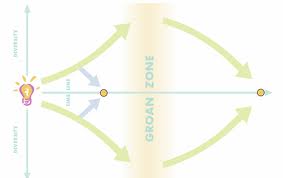
Divergence-Emergence-Convergence – a simple model with an interesting challenge

The divergent phase of this model is akin to brainstorming.  We want as many ideas as possible to emerge so we can later select the best ones to develop further.  It has much broader application than brainstorming though.  It is about expansion.  It is where ideas are generated, information is collected,  issues or challenges are sensed into to gain more insight or shift perspective or simply where we holding open the space for possibilities to enter in.  It is not a time for evaluation.  We don’t need to know what we will do with the information.  We don’t even need to know whether the information is ultimately useful while we are in the divergent phase of the learning, the work, the project.

As we begin to feel overloaded, overwhelmed or uncomfortable, or we begin to question “the process”, or the leaders or hosts of the process, or we are just tired and grumbly, we are desiring understanding and often looking for convergence.  What does it all mean?  What should we do now?  When can we be done?  All questions that indicate we are near or in the groan zone.

In an effort to avoid discomfort, end discussion, or just get to the end now, we are often tempted to circumnavigate the groan zone by picking an idea, or a solution prematurely – any reasonably good one will do – and developing it into “the answer”.

Some things happen when we do this.  One is that we may miss the truly important things.  By prematurely closing a conversation, the essence or pattern of it often comes back.  We think we made a decision but the decision is questioned and we end up in a new round of conversation about things we thought were settled, growing frustration and dissatisfaction later on.  Staying with the discomfort just a bit longer might emerge a different idea or opportunity or a new understanding of where are at and why. What if we became curious about where we are instead of wanting to shut it down?  What might then emerge?  What if we ask the question, what else is going on here?  What is underneath the conversation, the unrest?

Navigating the groan zone is an art of discernment in many ways.  It is also a skill we can develop.  I recently had someone send me a note, asking me how a training was going.  The note arrived exactly in the groan zone at the end of day 2.  I thought about replying and knew it was just impossible to explain succinctly where we were in our process – unsettled, a bit disconnected as a group, unclear about what all was bubbling.  Sure enough, the next day things flowed together, the group became more cohesive and new possibilities emerged.  I had a new story to share about the groan zone and the importance of staying in it in our processes, not prematurely attempting to assess the success or failure of a conversation, a training or a process. We don’t just need to stay tuned to the groan zone, we need to be alert for convergence and good timing of it.

A couple of stories about the groan zone from recent hosting experiences.  These two stories come from the first AoH training for Rio de Janeiro in Brazil at the end of April 2012.  Two of my co-hosts (on a team of nine) were Jerry Nagel from the US and Maria Barretto from Brazil.

The first story is from the hosting/calling team.  We met, as is normal practice, the day before for our check-in and design process for the training that was in front of us.  In the couple of weeks just before the training, it filled so rapidly most of us had no idea we had reached our capacity of about 50 people in the lovely retreat centre we were at near Petropolis.  Even in this last night before we were to begin, people were sending emails saying they wanted to attend.  In the normal flux of what happens leading up to a training, some people were appearing, some were saying they couldn’t come and we were left trying to figure out what to do.  We had five people  on a waiting list.  There were two possibilities: begin the list for the next Rio AoH or refer them to an AoH that was to happen in Sao Paulo a few weeks later.  We circled around a decision several times, even as we tried to move on, but never landed.  We were clearly in the groan zone.  Maria was the first one to suggest this conversation was not about numbers, there was something deeper that maybe we needed to become curious about and pay attention to.

After two hours we agreed as a team that we would just say yes.  Full invitational energy.  You want to come?  If you can still come we will figure out how to make room.  Calls went out to the five people, three of whom showed up the next morning, two of whom had a 7 hour drive to make it happen.  What was our conversation about?  Letting go.  Inviting.  Trusting.  When we entered full invitation, we passed through the groan zone as a hosting team.  Something shifted for us. Beyond the decision itself. Into the collective space of being a team.

The second story – this time from the full group.  Day 3 of a 4 day training.  The morning is all about hosting self – embodiment, art, silence.  Not everyone is comfortable with meeting self.  We decide not do a collective harvest of the experience but to leave it with individuals.  The afternoon is Pro-Action Cafe – one of the best I’ve ever seen as my Brazilian friends take it to new levels, engaging the participants while the conversation/project hosts are reflecting on what they have learned so far.  “What does it feel like to host other people’s dreams?” is the question they ask, a question that touches me heart.

After the proaction cafe, we enter a debriefing space.  It’s been a long day.  First comments are quite positive and excited.  Then there is a shift. The comments and questions that are now coming into the space do not, in my perspective and through translation, seem to reflect the proaction cafe experience.  So, I become curious.  As I pay attention, I begin to wonder, what is the level of discomfort from the morning experience that seems to be bubbling up now?

The day before, Maria taught the divergence-convergence model, speaking about the groan zone.  In this moment, as I listen I know we are in the groan zone.  I listen for an intervention point and take the talking stick – a paint brush from the centre that many who speak are holding as if it is a microphone.  I step into the centre of the circle and begin to walk it.  I say, “Friends, yesterday Maria talked about the groan zone.  Today, now, we are in it.”

Someone says, “So we should be celebrating.”

I chuckle.  “Yes,” I respond, “We should be celebrating.” I pause, “We need to be careful that we do not assume that our individual experience is the experience of the group.  The things that really resonate with me might be the things you are most challenged by and vice versa.  This is an invitation for us to each own our own experience and to become curious.”

From here, I am not really sure where we want or need to go next.  I invite the hosting team into a transparent conversation about how we want to proceed.  There is one more thing we had been planning but we are now into the time for that process.  Things take on a life of their own and we enter into a fishbowl experience.  I’m still not sure how that happens, but we flow with what is emerging in the space.  As a host team we have a little conversation about what will serve best now.  Participants enter the fishbowl and offer their experience and their questions.  One person asks, “Why don’t you, as experts, just tell us what to do now?”  Good question.  We invite it to sit in the room with us til a bit later.

After hearing from more people one clarity emerges for me.  I  want to be sure we honour the stepping in of volunteers to host processes they had never hosted before and I feared itt was being lost in the ripples showing up in this groan zone.  The response to the question of why we didn’t just provide the answers for people?  “Looking for someone to provide the answers is a typical reaction when we are in the groan zone.  Learning to co-sense and co-learn into what is needed next is the learning edge we are all on.  An answer too soon might not be what we need at all.”  People are nodding.

As we have heard the feedback and sensed the room, I suggest maybe we need to wrap up.  One of the desires in the room is to end for the day and dance – beautiful Brazilian circle dance.  Jerry states, with a beautiful level of intensity, “I didn’t come all this way to just stop and dance now.  There is more learning to be offered.”  People around the room nod.  This is another thread very present in our space.  Maria finally suggests we wrap up for dinner and, for those who want to, we will reconvene after dinner to hear stories of where the methodologies have been used and the impact of them.  This is ultimately the path we choose.  Pretty much everyone shows up for the evening of storytelling.  There is a hunger in the room.  It is a good call.

In the middle of the groan zone we modeled how we can hold the intensity of it, offer up various points of view, and maintain integrity and depth of relationship in our field.  We feel the relief in the room and we know the tension we have been holding in this moment.  Many people later thanked us for modeling what we speak about, that it was a powerful moment for them.

The next morning, we know we need to converge well.  We invite triad conversations as a check in.  People are asked to reflect on their greatest learning and how they are going to take their learnings home.  It is a powerful convergence moment as people reflect on their experience and how to apply it.

Convergence is not necessarily something that happens half way through the process as is depicted in the diagram.  More likely it will happen 2/3 or 3/4 of the way through.  And, when we have navigated the groan zone well, it happens swiftly.

In a lot of our planning processes, I will often say they are front end loaded. If we take the time to sense into what is needed, and the time to be in conversations that take time, with the curiosity about why, we create the conditions for “magic” to happen. I’m not sure I’ve ever been in a process where “magic” happens when we haven’t had to navigate the groan zone with attunement, patience and awareness.  There are ingredients that lend themselves to magic and navigating the groan zone with presence, patience and attunement are some of them.  It is sometimes the most challenging space we hold, but the rewards are bountiful when we do it well.  And whether we do it well or not, the learning is rich.

Hosting Lessons from the Field – Presence and the Four Fold Practice

It is the last morning of our 3 day Art of Hosting training in St. Paul Minnesota in mid April 2012.  We have 40 participants plus our 6 person hosting team which includes 3 apprentices. The hosting team is starting our day by checking in. Day 2 was a good example of a groan zone kind of day.  The field felt a bit disconnected from itself.  There were little rumblings here and there that had been showing up since our opening circle on Day 1 that had our attention a bit and certainly our curiosity.  At the end of Day 2 during our check out as a hosting team, we noticed some of the dynamics that seemed to be in play, felt we didn’t have enough information to make informed determinations of what may or may not be in the field and let it go as we left for the day. On this last morning, the person hosting our check-in asks, “What are you anticipating in this day?”  The question gives me pause, although I’m not sure why — until I begin to answer it.  I start with, “Well, I’m anticipating a few good conversations with individuals – some of whom have already been identified.”  I hesitate.  What else am I anticipating in this day?  What do I want to anticipate?  Ah.  That is a good question.  My clarity begins to emerge. I continue, “I don’t think I want to anticipate anything else.  We know there are some dynamics in this field.  It is not fully clear what they are so I think I don’t want to anticipate anything.  What I do want to do, is be fully present and attentive, ready to tune into whatever emerges that needs tending, but without anticipating now what that might be.” This sentiment seems to resonate for all of us on the hosting team.  An invitation into being fully present, to not speculating, to not imagining how carefully we need to tend the field for certain things.  The first of the four fold practices – being present. The Four Fold Practice is a core pattern and practice in Art of Hosting and it has been receiving renewed attention lately in our teaches and our conversations. Self hosting. Not just being nice to self by going to the spa or eating dark chocolate.  Depth. Practice.  Discipline. The discipline of practice. Meeting oneself, sometimes in places one would prefer not to meet oneself. Being present is fundamental to good hosting.  This I knew.  What happens next for us as a hosting team is what has me reflecting still on the power of presence and what it means to hosting and, more than that, for me anyway, what it means in my life. As a team we decided not to try to figure out what may or may not be going on in the room, or who was holding the threads of what dynamics, but to let it go to sense into what was alive in the moment allowing us to more powerfully engage the next two folds in the practice – participating fully in those one-to-one conversations and contributing to the larger hosting process. Following our check in, I was coaching the proaction café team.  It was a large team, a bit chaotic to start, but everyone managed to find a role that worked for them with several teams of two hosting different sections.  I went off to find the members of the team to check in with them about their role and what, if anything, they needed from me. In entering the room, I began to encounter some of the people who seemed to be holding some of the threads of discontent and disconnect that had been popping up over the previous two days.  Spontaneously.  I didn’t seek them out.  I’m not even sure they sought me out.  We just bumped into each other. In this spontaneous connection in even just five to ten minutes, a depth of human to human connection happens on the level of story, being able to see and witness some extraordinary part of an individual’s journey.  What is even more surprising is that this spontaneous connection happens for many of our host team members. What we notice alive in our field now is that the threads of discontent and disconnect seem to dissipate and disappear.  They don’t go underground as often happens when not addressed, but they seem to disparate in the depth of human connection.  People feel seen, heard and acknowledged in their journeys in unanticipated and beautiful ways. Then, the proaction café weaves people, their stories and their gifts together in a beautiful way.  Nine projects/ideas expand in delightful ways.  The conversation hosts feel gifted.  The participants also feel gifted and honoured with holding and exploring other people’s dreams, realizing the power of contribution even when not directly connected to someone else’s project. One of the roles taken on in the proaction café is the deliberate and intentional holding of space – or the energetics in the room.  Two women stand on either side of the room, visibly and silently witnessing the room and hosting space.  When we debrief, they are asked to share what they have been doing and what their experience has been.  They describe the honour of it, of seeing the weave in the room, of deliberately fueling it with positive intention and love.  Participants describe their experience of it, what they feel corresponded to what they heard from the hosts of the energetic space.  It was one of the most deliberate explorations of what are we hosting really that I have been part of. When we do our closing, as often happens, we become aware of how powerful the three days have been for many who are there.  We are reminded of the power of the groan zone and how our assessment of where we are in our process influences our interpretation of whether we are successful or not.  On a day that ends in a groan zone it doesn’t always feel on track or successful.  Seeing the convergence in the next day reinforces the beauty and possibility of the groan zone. I’ve been through enough groan zones that I should know this but it is always a renewed awareness. As we close our hosting team circle at the end of the day, we bring curiousity about what has happened and a fresh wondering about the Four Fold Practice and the power of presence to shift the shape of the field and the possibility it can shake out some dynamics without needing to dive into them.  Is that what happened?  I don’t know with absolute certainty.  That’s my continued reflection.  Will full presence always be enough to dissipate shadow on its own?  Happy to experiment more to discover – rather than anticipate the answer to that. This experience has me reflecting on hosting self, specifically myself, my life and my relationships.  How often have I said about a situation, relationship or person, “I’m optimistic that…” or “I’m not optimistic that…” What is the anticipation that gets built into those kinds of statements?  What if I just met that situation, relationship, person, myself, in the moment of the experience and not as a precursor to what might or might not be but attentive to what, if anything, needs to be tended to in this moment?  How would this ongoing presence shift the shape of my experience now, shifting the shape of my relationships and my situation? I am deeply appreciative for the question, “What am I anticipating?”  It has made me aware of how much I do anticipate and how a lot of that does not serve.  The only journey I really need to pay attention to is mine.  Another person’s journey is not really my business and is certainly not my journey. My journey intersects with others, but they don’t define mine unless I let them.  I don’t define theirs unless they let that happen. Letting go of analysis and simply tuning in at the moment supports what wants to happen rather than fuels my own anticipation of what might or might not happen, possibly feeding something that didn’t need to be fed, creating something where it might not have existed except that my/our anticipation brings it into being.  Still ruminating on this one. Powerful lessons from the field on being present.

Deep Sensing Interviews

Deep sensing interviews are a powerful tool.  In the times I’ve used them I’ve seen them help deepen relationships, deepen a field of inquiry, shift the shape of  a team, organization or system.

Deep sensing interviews are one of the tools highlighted in the Sensing phase of Theory U,  where we begin to see how we see the world.  Once we become aware of our seeing, then we have the opportunity to focus our attention in more intentional ways.

The beauty of a deep sensing interview, when it is designed well, is that it takes the interviewee on a tangential or divergent journey to where you want to go which is usually the current situation you are wanting to inquire into.  When we take the direct route to where we want to go, we often get the first off-the-top of the head responses which also often are the responses aligned with role or positon in the team, organization or system.  It can be a good, helpful reflection and, often so much more is possible.

Deep sensing interviews take people out of their heads and invite them to embody the conversation or enquiry which takes them to a different place, allowing them to see their own experience and their own questions in new light.  They also help to build trust which is advantageous if you are embarking on any initiative requiring trust, openness and alignment.

It was through the four year Collaborative Care initiative, championed by the College of Registered Nurse of NS that I was first introduced to deep sensing interviews.  Phil Cass, who was on the hosting team with us, spoke about the impact in Columbus, Ohio. In health care work there designed to shift the system, they discovered, through sensing interviews, that the people interviewed seemed to have a public voice and a private voice.  The public voice was the one that came from their role or position and provided ideas or suggestions from that official voice. It was often also the voice looking to someone else to “fix” the problems.  The private voice was the one that tapped into both despair and hope, the embodiment of the conversation, the knowing that if change is really going to happen, it is going to happen through people and relationships first, then systems and that they just might have a role to play.

Phil’s experience with deep sensing interviews inspired us to use them too, but not without some trepidation at the start.  The structure of these interviews is a bit different and they take time – a good hour and sometimes more – which feels like a lot of time to ask of someone – especially someone busy, especially someone “high up” in a system or organization, especially since it doesn’t dive right into the information you’re after but takes the time to build the field of inquiry.  Now, however, having seen the impact and quality of response, it is an intentional strategy to draw upon when, of course,  it serves the purpose of the work underway.

There are four key phases to a deep sensing interview.  They are:

  • what was your path to here
  • why here, why now
  • what is here – issues and challenges that have led to this inquiry
  • imagining the future

Path to Here

I will tell people before we begin that this interview will start in a very different place, because I want to get to know them, because I want us to see connections across a journey.  The questions will be about where they grew up, what it was like to grow up there, what they wanted to be when they grew up, what did they do after high school, how they found their way there, what excited them, what they were passionate about.  These are not diversionary questions.  They are questions that help people reconnect with themselves, their dreams, their essence.

Why Here, Why Now?

What is their job now?  How did they get to this job? What did they aspire to when they began this job? What keeps them going on the difficult days or in the challenging times?  Why here, why now?

What’s Here Now?

This series of questions is intended to get at the issues and challenges – in the team, organization or system – that sparked the inquiry or the work. Why are we here?  What is the need?  What is their role in this? What could it be?  What are the barriers? What else gets in the way?  What conversations are not happening?  What are the costs – financial, human, other? What is the trajectory if nothing changes – how much worse could it get?  What would that cost?

Imagining the Future

Imagining the future – these are the questions to inspire what’s possible.  What one conversation, that’s not happening now, that if it did happen, could change everything?  Who would be in that conversation? What/who are your systems of influence?  What are we not seeing, that if we could see it, would allow us shift the shape of our experience?  What would an ideal future look like?  What would it take to move us in that direction?

The questions floated here are not the “right” questions, or the “exact” questions.  To be powerful, the questions need to be crafted to the purpose and intention of the work. Testing them improves them.  Leading people through a deep sensing interview invites them into a mindful reflection where just the asking of the questions begins to open up new possibilities.

Sometimes in the interview it is tempting to assume someone has already answered a question.  I will often say to someone, you may have already answered this, but I’m going to ask it anyway.  It is amazing what more turns up when you ask the question – something completely different sometimes, often a new level of reflection and depth.

I have used deep sensing interviews in systems work, in organizational work and with teams – particularly teams that are experiencing challenges in the moment.  Looking for themes and patterns across the interviews is a powerful tool for building momentum in the work.  We have, at times, reflected back the “voices” with direct quotes.  At other times, especially for teams, the themes and patterns have been mind mapped.  It is extraordinary how people begin to see things they could not see before, how illuminating themes and patterns provides a base for shifting to more of what’s working.  How people begin to recognize that their themes and patterns are collective – my story is also your story.  What a surprise it is to individuals when they begin to see this.

Deep sensing interviews.  A powerful tool when well crafted and clearly intended.

Hosting Lessons from the Field – Dancing with Design Flow in Brazil

How many of us have had the opportunity to enter into hosting a day or a training (Art of Hosting style) without any design for the day, completely sensing into what is needed in the moment and fluidly dancing with five other hosts with offerings to meet what was emerging in the field moment by moment?  How would you meet that invitation?  Excitement? Trepidation? Both and anything in between?

It is one thing to do this on your own or with one other person as Bob Wing and I did last summer in work we’d been invited into that turned into Hosting Ceremony.  It is a whole other thing to do it with a new hosting team  constellation of six of us on the third and last day of working together – in this case for the first Warrior of the Heart training completed in Brazil in January 2012.

Warrior of the Heart is the work of Toke Moeller and Bob Wing coming out of many opportunities they had to jam together combining Art of Hosting and Aikido practices and principles.  Playing together they imagined Warrior of the Heart training into being.  I’d participated in a couple of Warrior of the Heart trainings – on Bowen Island in August 2010 and then at Windhorse Farm in Nova Scotia just this last October, 2011 with my 9 year old son.  I’d also had the chance to work with Bob where Warrior of the Heart became a component of the Art of Hosting training we were delivering.

In September 2011, after the Art of Hosting training in Porto Alegre, Brazil that I’d been co-hosting, Thomas Ufer, Najara Thamiz and I sat down with Jose Bueno and crafted an invitation to Bob and Toke to bring Warrior of the Heart to Brazil for the first time to seed the field for more and build the ground for the amazing expansion of the Art of Hosting and social change movements happening there.

Working with a larger hosting team for a training the two of them were used to offering on their own invited Bob and Toke to some new learning edges. They invited the rest of us to go there right along with them.  There was already a huge reservoir of trust in our hosting field even before we began. We built on it during our preparation and hosting time together.  On our last day, it was Toke who invited us into the dance of hosting together without an agreed to advance plan.

I felt in me my own skepticism at the invitation which arrived after morning practice, before breakfast, where we had actually invoked this flow already.  I really wasn’t sure how it would work and whether we would all find our own place to play in this day – but I was willing to step into the challenge – because with this team there was nothing to lose and lots to gain.

As the six of us stood in a tight circle on the stone patio outside the training building, a staff was in the centre with the challenge of who would take it first and offer something to the group to begin our day.  Silence.  A deep collective breath or two.  I could feel the tremble in me.  Another breath and then I reached for the staff.

I had been preparing during our time together to do a teach with the sword – in this case the wooden representation of the sword – a bokken.  Bob had been coaching me.  Perhaps because I was preparing to step into the challenge of a teach on something I was still very much learning myself, I had taken Bob’s feedback and coaching in in a whole new way, embodying the teaching and the sword movements with more fluidity and confidence than I ever remembered feeling.  I had been preparing for a teach and this was apparently the moment it would be offered.

I started the teach – the four directions – and forgot how to do the step to turn from one direction to another.  Without being hard on myself, I asked Bob to step in and help — and he did because he had my back.  All six of us had each other’s backs and none of us needed to shine or take up too much space and yet we were all invited to offer our brilliance when we felt the call.

It was the beginning of a rich dance that included all six of us throughout the day.  The experience was playful and fun and ended with a touching and powerful ceremony.

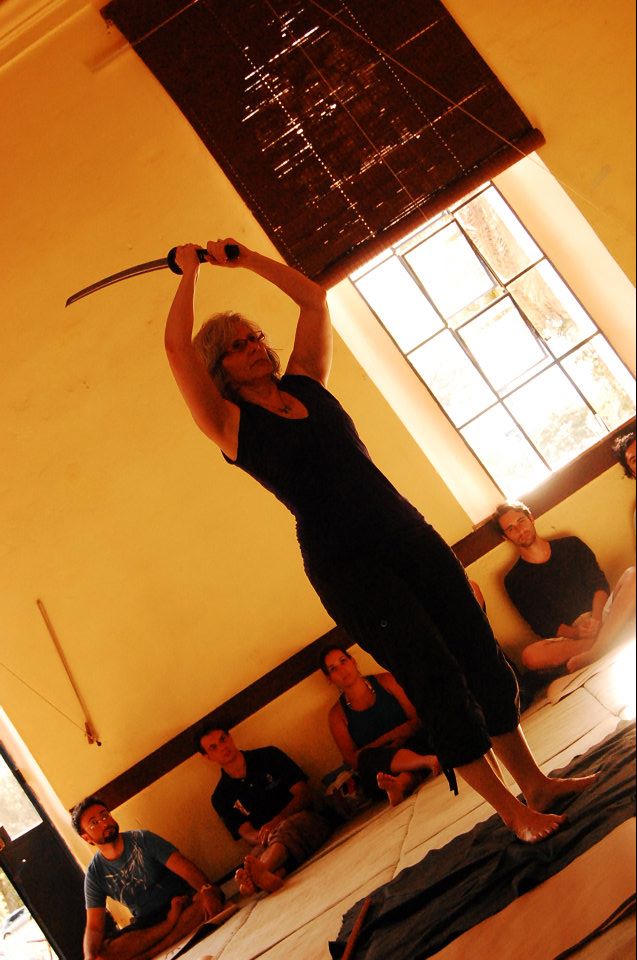
Raising the Sword in the Warrior of the Heart (Brazil 2012) Closing Circle

The willingness to let go of control and design flowed into the Brazil Stewards Gathering that followed the Warrior of the Heart – in its own way and to its own degree because, of course, the team and the circumstances were different.  But the fluidity of the dance was just as hesitant and joyful in its own way.

I’ve been reflecting on what makes this kind of dance possible?  One is definitely trust in the individuals and the collective of the team – knowing that each individual is there to serve the good of the whole and with no need to shine on an individual basis – although, as I mentioned above, of course each person does shine because of the gifts they have to offer in service of the whole.

A sense of knowing when what I have to offer as an individual is exactly what is needed now.  This is a complete dance with the subtle energies, with intuitive capacity.  The courage to offer it when it is called.  A certain level of trust or confidence in my own skills and abilities.  A willingness to let other people shine in their mastery or even in their apprenticeship.

It takes a certain level of maturity in each individual, the team and even in the field.

Would I want to completely free flow it every time?  I don’t think so.  Every situation requires us to be tuned into what is wanting and needing to happen.  Different situations will call out different things. And many situations invite a free flowing of design and offerings to different degrees.  I and we are already practiced with working with emergence.   Practicing to this degree honed my skill and my sensing capacity and invited me into new levels of mastery.  It is embodied in a new way.  It will always be with me – and with each of us.

Having had the opportunity to host immediately after this experience, I know it’s in me in a new way and for that I am grateful.  Looking forward to the next opportunity to dance in the ultimate emergent design – and to all the other variations of that that will show up along the way.  Thanks Toke for the invitation and to Thomas, Narjara, Jose and Bob for being willing to dance the beautiful dance that shifted the shape of my hosting experience to new depth.

Interrelationship of Circle-Triangle-Square

Many people are so frustrated working within hierarchy and bureaucracy that when they are introduced to beautiful engagement processes like World Cafe, Circle Practice and Open Space, a new love affair begins.  These methodologies are powerful in re-igniting passion, hearing every voice, creating mindful and thoughtful conversational spaces that take individuals and groups into new territory.

The love affair becomes a bit jaded when people begin to say, “Conversation is great, but what about doing something?  Where is the action in these methods?  Where does decision making rest?”  As if creating meaningful and relevant conversational space and decision making or action are mutually exclusive.  In many cases though, people haven’t figured out how to make them work well together.  It is not either/or.  It is and. What is the leadership and understanding necessary to find the balance that invites both broad based engagement and effective decision making leading to wise action and movement on initiatives, especially social change initiatives inside organizations and systems?  What does it take to truly shift the shape of the world we live and work in?

Recent conversation with with Toke Moeller and Bob Wing in Brazil has sparked my curiosity and reflection on the relationship between the circle, triangle and square that we often reference in the Art of Hosting.

The circle represents the social technologies that engage people in deeper, more inclusive ways, tapping into human longing for connection and meaning.  Circle is an ancient and universal symbol of unity, wholeness, infinity, the goddess, and feminine power. It represents the sacred.

The triangle represents  hierarchy and structure within which so much work happens and decision making takes place. When the triangle points upwards, it symbolizes fire, male power and the masculine archetype.  The energy of doing and of action.

The square represents the physical world in contrast to the sacred.  In relationship with the circle and triangle, the square represents new forms of governance, stewardship or strategic thinking partnerships.

Power of Circle-Triangle-Square Interrelationships

Much of the intention behind or underneath circle or engagement strategies is to share leadership and responsibility more broadly.  We are not always clear on what that means. Sharing it doesn’t mean foregoing it as sometimes happens as people begin to experiment and play with engagement strategies.  A point is often reached where things feel stalled because we are not always clear where decision making fits or how to do it well.

Sometimes change processes fail because leaders are not clear on how decisions will be made in conjunction with engagement methodologies. They then “take back” decision making which seems to disempower the move toward shared leadership and shared responsibility.

Yet, very little gets done without decisions being made.  Clarity around decision making allows for stronger relationships and more powerful work processes.  Understanding the need for and how the circle and the triangle work together creates the space for more intentionality in processes and relationships.

There is not just one form of decision making that should always be used.  Sometimes consensus decision making is the most appropriate decision mechanism.  Other times decision making will be vested in an individual or a team that sits elsewhere in the organizational structure.  The lack of clarity around who makes what decisions when and how information flows is more likely to lead to problems more than the type of decision making structure.  The degree of trust inside of the relationships also has an impact.  In organizations or systems where the trust is high, decisions are trusted and respected no matter who makes them.  In organizations or systems where the trust is low, of course decisions are questioned and sometimes disrespected.  Quality of relationship can be improved through the circle, thus supporting the triangle better.  Clear decision making processes improve quality of relationship.

The circle and triangle  are nested inside of the square.  If the square is equated to stewarding or governance, the role of the square is about holding space and perspective from a strategic, bigger picture point of view.  Not so active in the decision making structures or in the conversational space but bringing the awareness of deeper patterns that relate to or underly any given process, initiative or movement, providing insight and perspective that then feeds back into the engagement (circle) and decision making (triangle) processes.

The danger lies not in any of these specific shapes. It is in becoming enamoured with any one of them to the exclusion of the others or disenchanted with one to the point of not wanting to engage it at all.  As I consider the work in front of me now, I will bring this deeper curiousity about the interrelationship between the circle, triangle and square into my process and coaching considerations, particularly as it relates to new leadership competencies required in a rapidly changing world.

Hosting Lessons from the Field – Inviting Innovators and Pioneers in Health Care

It is just the beginning of 2012 and already the year has been rich in hosting lessons from the field, diving deep into new levels of awareness around hosting subtleties. It began in Utah early in the month, hosting Healthier Health Care Systems Now with Tenneson Woolf, Steve Ryman and Marc Parnes.

Marc Parnes

Marc, who is a physician, gynaecologist and host from Columbus Ohio, started us off on day 2 with a story intended to set the tone and challenge of the day.  He told of what was to be a routine surgery he was doing on a woman.  When he opened her up and looked inside, what he saw not only surprised him, it alarmed him.  Things that were not supposed to be stuck together were.  He could not see the path for the surgery.  He was not able to see his way.  He did not know how to proceed with the surgery as he stared at this jumble of internal organs.

All eyes were on him as he then he stood up in our circle.  We could feel the anxiety of that moment.  Standing there, Marc planted his feet shoulder width apart, just like he did on the day of the surgery, to ground himself.    As he closed his eyes, he described doing exactly this as he stood beside the woman on his operating table.  Then, with his eyes closed, he reached into the woman and began to feel his way around, searching with his hands for the openings he could not see with his eyes.

When he finished, he knew what to do.  He opened his eyes.  He could now calmly begin the surgery, having expanded his vision of what was possible by “seeing” with other senses.  The surgery was successful.

There was a collective sigh of relief in our circle.

We began to reflect on what Marc’s story had to do with innovation in health care, what it had to do with hosting.

After coming through the first day, we checked in as a host team and invited the voices of others who showed up to participate in the design process.  We tracked our day around purpose and intention.  We felt good about the design and flow of the day and we felt we had challenged people beautifully in our opening circle on day 1 by asking them to speak to the pioneer and innovator inside of them that had responded to the invitation, but not to speak too deeply to their work, promising that would come later.  We sensed that though the day had been good, something was missing.  With reflection, we realized we were still on the ground of old territory and familiar conversation, not the new conversations we had invited people into.

The invitation was to be in a different conversation about health care.  The challenge for this group was to move into what would be a new conversation for each of them. This amazing group of individuals carry in them irrepressible dreams for healthcare systems that thrive; for simplicity that doesn’t deny the complexity, yet responds well to it.  They continue to have high hopes for healthier healthcare despite having been in many, many conversations about shifting the systems within which they work and play.  Those who responded to the HHS call were already innovators and pioneers in health care.   Maybe the new conversation was not a collective conversation about a new global vision about health care but was about individual systems of influence and what was at the edges of their own learning that might be new territory.

Our challenge, as a hosting team, we realized, was in making sure we really did travel to new territory – not an easy challenge given the experience of the people who came.

We continually scanned what we knew that could invite people into new territory. We brought play into our process – a beautifully renewed learning edge.  Collaborative play, allowing us to see and experience our learning beyond the cognitive or intellect.  Then, through reflection, seeing our patterns in work and relationship in whole new ways.  Allowing inspiration to enter in.

At the end of day two, despite traveling much ground in the day, there was still a sense of restlessness in our hosting team that took awhile to fully sense into. Something edgy.  Something still not quite arrived at.

Checking in as a host team and, like the day before, with others interested in our design process, we recognized that we were happy with our design and the flow of the two days. We briefly wondered if we should be satisfied with where we were and consider how to enter and close our last day well. Yet there was something we still had not quite arrived at.  Something about the new conversation we hadn’t quite dug into.

We reflected on what we knew from our Art of Hosting experiences that would push the edges of where we were.  If we were looking for a groan zone or acupuncture point in our process, normally we would look to a point in day two.  But this timing did not show up in day two.  Were we willing to push our own learning and hosting to bring in something even  more edgy in the morning of day three?

We knew we would not get to where we wanted to go through another conversational or intellectual process.  We decided to invite this group of physicians, health care administrators and others into a guided visualization process, to invite them to explore their own future journey in healthier health care now. Following the visualization, we invited them into drawing or illustrating some representation of their experience in the visualization process, followed by a conversation with a partner to really dive into this experience in depth.

The experience was intense and provocative. It shifted the shape of some individuals.  It shifted the shape of our gathering.  It broke the pattern of the old and invited a new pattern. The World Cafe that followed was amazing.  It was sparky. Ideas flowed quickly.  There was a new quality that had entered into our space.

Once we saw it, experienced it, we could name it.  We had shifted from conversations that came from the head to conversations that now came from a deeper place.  The conversations were now embodied. People began to look at their own path and their own systems of influence rather than at points of the system too far beyond their own systems of influence to have any real impact.  We were in new territory.   We observed that embodiment shifted the conversation to deeper and more meaningful places.

As a hosting team we agreed to continue to push the edges of this group, knowing we still had a whole day ahead of us, even though if we had planned a visualization process, we would likely have planned it for the end of day two.  But sensing where we were, knowing what we were aiming for, keeping our essential calling questions close, we pursued our purpose and intention.  We continued to host potential right up to the moment of preparing to close our circle.

It isn’t over until it’s over.  We know that.  I have often heard it said in a hosting team.  And this time we lived it fully with a trust in each other, in what we were sensing and our willingness to flow with what was there.  Even as I write this, it is hard to describe the exact edge we were on or the truth of our experience.  But I’ve been reflecting on it a lot.  These reflections flowed into the last couple of weeks in Brazil, during Warrior of the Heart and a local Art of Hosting stewarding gathering, where we danced with flow to the most amazing degree – letting go of design to sense into what was alive and needed in any given moment.  More reflections on that later.

For now, the richness of the host team learning in Utah stays with me, embodied in my own experience in the best of ways.  I feel myself growing my capacity in hosting in the most delightful of ways, brought out by those I have the privilege to host with.  This year has started off so rich in learning, it makes me deeply curious for what the rest of 2012 will bring.

Innovators and Pioneers in Systems Change

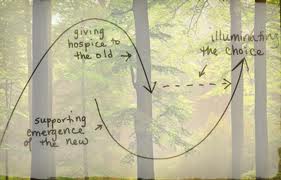
In Utah for Healthier Health Care Systems Now (January 11-13, 2012), we used the 2 Loops Model of Systems Change as one of the framing references for why we were gathered. It is a tool and a framing to understand the work we are individually and collectively in that shifts the shape of health care.  The two loops model looks like this:


The first loop represents the old system, the one we often name as the dying system.  The second loop represents the new system, the one we keep claiming we want, the one we think cannot emerge by fiddling with the old, the one we believe is needed to bring our current systems out of crisis.

The problem is, when we begin to think about the complexity of something like health care, where there are so many jurisdictions, so many players, so many interlocking systems,  trying to imagine what this new system or systems could be becomes paralyzing.  The conversation often becomes philosophical and theoretical.  It largely comes from an intellectual and cognitive place focused on all the things that need to shift that are outside our circle of influence.

Some of the frustration in being innovators inside of systems is that the systems begin to push back on the work in small and large ways, leading to the exhaustion, frustration and disillusionment so many leaders in health care experience.  This is all part of the old narrative.  Of course this showed up in our conversations in Utah to greater and lesser degrees depending on the questions, depending on who was in the conversation at any given time.  Any time we were in that conversation, thinking about the new system, it didn’t feel like a new conversation.

So, how could we be in conversation about Healthier Health Care Systems Now without  focusing on the second loop or the new system?  Well, by remembering who we are – pioneers and innovators in health systems – working under the first loop – in the in-between spaces – championing the new or being championed.  We began to focus in on and explore new questions: Where are the edges of my work?  What is the new territory I could begin to walk when I go home?  How can I draw on the resources in the room to expand my thinking, even turn it upside down and on its head – like the person who relies on gift economy in her practice, for her livelihood?  What more becomes possible in generative spaces with other innovators?  This was a different conversation, in tone, texture and energy.  This one did not come from the head. It was embodied in a whole new way – the beginnings of a new narrative of health.

The awareness of the old narrative and of the stuck places infiltrated us in the best of ways at the end of the first day of our three day gathering.   Someone suggested what we needed to do was create a vision of the new.  Ordinarily I might agree.  In this case though, that didn’t feel right.  It felt like it would take us further off track given that our roomful of people were geographically stretched from coast to coast across two countries with countless “systems”?

So, without taking our eye off the intention of shifting the narrative of health, we refocused on innovating and pioneering and guerrilla tactics of  hosting, collaborating and co-creating, engaging those around us in this journey that is health.  We didn’t leave with a specified vision of the new system.  We left heartened in our respective journeys, knowing the way to the future is through new processes, deeper conversations and finding our way with as many of our friends and colleagues as we can attract, engage and embolden along the way.

As we continue to shine the light on the experiments already underway, the successes, the challenges and the “failures”, and tap into the individual and collective resilience that is fighting to emerge, we can remember it is a journey that will shift and change as we go.  We remember life actually wants to help and it wants to heal. If we focus on how to expand our individual systems of influence and share those stories with our friends, our collective system of influence automatically begins to expand.  What seems like isolated work informs pockets of work elsewhere and we grow an energetic field that is part of the new, part of the second loop and is fueled by everyone stepping into innovative, courageous and pioneering ideas and projects.

I still can’t see what that second loop is for health care – other than it is about health and it is healthier.  I’m not sure anyone who showed up for this conversation can see the second loop either.  But I am absolutely sure that the innovators and pioneers are already prototyping what’s possible, what’s new, and in this work more and more of the new and the new narrative will show up.  I am reinvigorated by what’s possible, by the people who continue to explore these questions, who challenge the status quo, despite possible personal risks in doing so and know that there are better and more healthy ways to engage health care.

I and my hosting mates are committed to convening more of these conversations with people compelled to be in them to grow the field.  We envision large gatherings of people convening in new ways, continuing to innovate our way into the new system(s) so that maybe one day we will wake up and see in front of our eyes what we once thought impossible – a new generative system of health resilient enough and healthy enough to be sustainable in unexpected and beautiful ways.   If we take our eyes off the urgent need for something that feels impossible and put it in the places where possibility thrives… well, what more is there to imagine or say?

Steve Ryman, Tenneson Woolf, Kathy Jourdain, Marc Parnes


2 loops of systems change