Unknown's avatar

About Kathy Jourdain

Kathy Jourdain is a co-founder of Worldview IntelligenceTM consulting, curriculum development and program offerings as well as a steward and practitioner of the Art of Hosting Conversations That Matter. This has her traveling internationally working mostly in Canada, Brazil, Europe and the United States. In 2009, she launched Shape Shift Strategies Inc. for her consulting practice. She is an author and keynote speaker. Her first book, Embracing the Stranger in Me: A Journey to Openheartedness has been hailed as an inspirational, deeply authentic sharing of the journey that has contributed to who she is today. She is contributing author to Gift of the Hit where she shares the story of her own soul journey with her mother, dementia and death.

Exceptional is not an Extension of Good

“There is a fundamental discontinuity between good and great,” was one of the assertions Ray Ivany, President and Vice-Chancellor of Acadia University, made during a talk at a recent Knightsbridge Robertson Surrette event.  He was invited to speak on the topic of being the best and his talk was an insightful blend of the human dynamics and structural components necessary for exceptional performance.

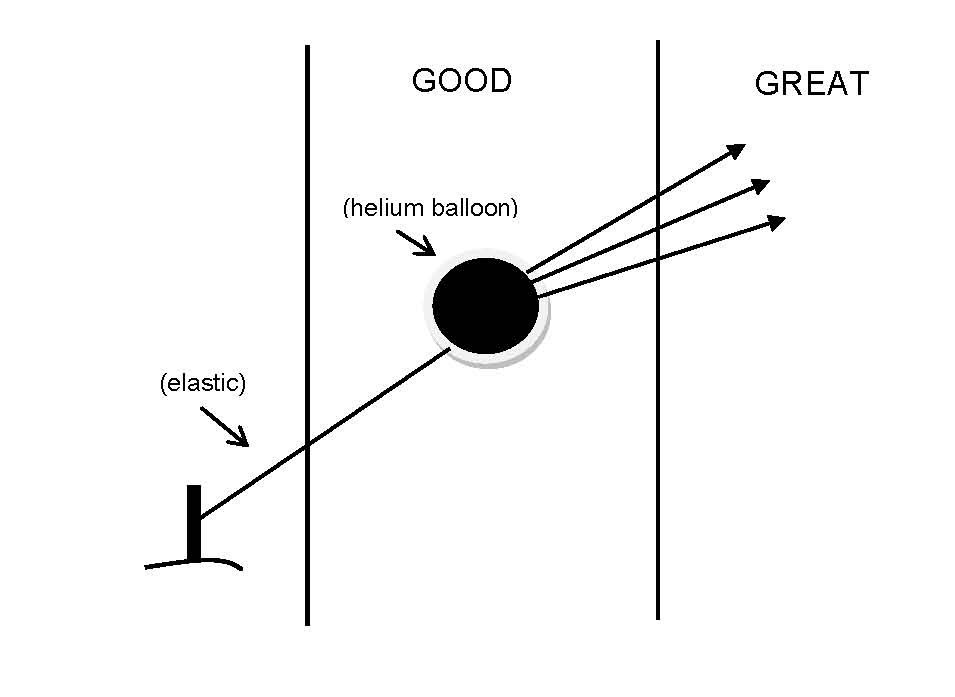
“Exceptional is not an extension of good but it’s in a completely different place,” he said as he shared the following diagram with us.  Imagine that organizational effort is represented by a helium balloon that is attached to a stake in the ground by an elastic tether.  It manages to rise to the expectations of good performance without too much effort.  And, with some effort and exertion, it can stretch into the category of great.  However, it takes sustained effort to keep it there and as soon as the pressure is taken off, the elastic tether immediately yanks that balloon back into the category of good.

Great is not on the same continuum as Good

In order to allow it to stay in the zone of great, you actually need to sever the tether that holds it in place.   If you believe that great is discontinuous from good, the organizational and human strategies needed to move to and stay in great or exceptional performance are fundamentally different.

In looking at this diagram, it occurred to me that not only is good the enemy of great, it is probably the enemy of itself as well.  As soon as we think we are onto something good, we want to institutionalize it by creating standards and policies to maintain it.  This standardization means we often prevent the organization from conceptualizing the strategies that lead to great.  On the other side, the more we insist on standardization without the ability to continually adapt, the greater the likelihood we actually unintentionally shift our organization from good to mediocre by insisting on standards that often lose their meaning and relevance over time.

From this place of mediocrity, leaders still try to aim their people for excellence without any hope of getting there and the people are often frustrated in their efforts to shift organizational thinking and performance and no one really understands why.

We only shift the shape of our organizations from good to great, and stay there, when we build in the systems and the capacity to take different risks – one of those risks being failure.

Looking at this diagram and the capacities necessary to shift into a whole new category of performance reminded me of the Chaordic Path where one of the key questions is: “what is the minimum amount of elegant structure required to enable us to act in purposeful ways that lead to wise action and meaningful results?”  This is also the amount of structure that allows an organization to stay nimble and responsive to its environment, creating the conditions for chaos to emerge into its own sense of order and cultivating the adaptive and collaborative leadership that is also a strategy for exceptional performance.

Ray’s comments were entirely consistent with many of the steams of thought that show up in the Art of Hosting community and body of knowledge, providing a beautiful avenue of reflection for me.  The next entry will focus on some of the human dynamics elements that comprised the other main thread of this thought provoking talk.

Corridor of the Dying or Something Else?

It is such a small leap for me I don’t know why it never occurred to me before.

I went to visit my mother this weekend.  She has had dementia for more years than we know and she has been in long term care for almost three.  Awhile ago I wrote about only understanding her journey from a soul perspective.  This is becoming more true for me as she gets nearer to her transition.

During this visit, I sat on her bed with her, maintaining physical touch the whole time I was there.  When she looked at me and we held eye contact, she smiled and even laughed.  So did I.  Sometimes with my tears also flowing.  The rest of the time, I watched her lift her head to look very intently at things I could not see all around her room.  It is clear to me that spirit in gathering although less clear to me when she will finally decide to let go of her physical body, but likely soon.   We, her family, are becoming more ready as we walk this path her.

To get to the dementia ward in what everyone in the town calls “the Home”, you enter the front door of the building, walk a short corridor past the administration offices and enter through an electronically locked door into the main residential part of the building.  You then have to walk down a long corridor to get to the dementia ward, behind yet another locked door.

As you enter the residential part of the building, you come upon people – old people and in some cases, really old people – sitting in wheel chairs or chairs – just sitting there for the most part, most nodding off.  Those are the ones well enough to be sitting up.  As you go down the corridor, bedrooms are on either side and in most of them someone is lying on a bed, oblivious to the rest of the world.  Sleeping, snoring, unaware. And, as good as this place is – and I do believe it is one of the best, it smells of old people waiting to die, sometimes less so, sometimes more so.  It is a hard corridor to walk with regularity, know the shape of these people’s lives have shifted so dramatically.

I have always thought of these people as waiting to die.  We all know the only way people come out of long term care is in a coffin.  This is where some of our population go to die – when their loved ones can no longer take care of them and, believe me, that is not an easy decision.

For some reason, with this visit with my mom, I had a little revelation and I don’t know why it never occurred to me before, but I’m glad it has now because it expands my awareness of what else just might be going on in these corridors.

My spiritual journey over the last dozen years or so has shown me pathways to altered consciousness, to spirit journeying, to spirit guides, angels and other entities.  I am aware that it is possible to “travel” in dream states – sleeping and waking – and that much good and healing work can happen in these states of altered awareness and consciousness.

As I sat with my mother and observed her looking at that which she could see and I couldn’t, I all of a sudden became aware that her physical body might be old and weak and her brain injured, as they say at the Home, but her spirit or soul is strong.  I began to wonder just where, how far and how often she may have been journeying while her physical body slept and that thought took me to all those sleeping bodies throughout the whole facility and a curiosity about where some of those souls might be journeying to while their physical bodies sleep.  I’m sure some of them may well be wrestling with their own demons, so to speak, but whose to say that most of them aren’t off doing much needed soul work in ordinary and non-ordinary reality.

Then I could feel a bubble of light surrounding this Home. The notion that these beautiful souls might be making contributions to the world that most of us cannot see or understand made my own spirit more joyful.  And now I hold my mother’s journey with an added degree of lightness and joy which I have no doubt she feels.  She is journeying well and will continue to do so, I have no doubt.  She is a great teacher for me.  And I love her and she know that.

Play is an Attitude

I am becoming more and more serious about play – as an attitude as much or more than as an activity.   These days I’m reflecting a lot on the Law of Attraction, abundance, energy, flow and what blocks flow.  I have been soaking up Abraham-Hicks and their teachings on the Law of Attraction.

Things like worry, stress, fear, negativity, seriousness of character all get in the way of attracting what you want in your life – anything that constricts the essence of who you are slows down the manifestation of what you want.   Anything that gives relief – laughter, joy, love, delight, hope, fun, playfulness – all fuel a vibration that attracts to you what you want to manifest, contributing to expansiveness.

There was a time, a long time ago, that I used to have fun and be fun to be around.  Wherever I was, there inevitably was laughter.  And somehow, when I was distracted by the seriousness of life, running a business, being in relationship, raising children, my natural joie d’vivre slipped away until all that was left was this grave seriousness, worry, fear and strain.  My world and my energy became more and more constricted and flow was blocked off.

One day, I noticed.  I looked up and looked around and I noticed I was all seriousness, intensity and negativity and lacked any sense of joyfulness or play in my life.  Couldn’t even really remember the last time I had laughed out loud or had any sense of fun. How had that happened?  Little bit by little bit the shape of my life had unintentionally and, in some ways, unwillingly, shifted. I was deep in my own shadow.

That day, that observance, marked the beginning of a long road back to joy.  I was blown away by habitual patterns, belief systems that locked me into seriousness and the impact of the voice of my inner judge.  I learned about the voracity of my inner judge by working through the book Soul Without Shame, learning how to identify and disempower it.  While it still shows up, it has less impact for much less time.  I have learned about understanding my emotions as a guide to my experience and as an inner guidance system.

Over the last few years I have been picking away at of the things that have constricted my energy and constricted flow in my life.  I have been opening up to a greater sense of expansiveness and to taking risks and this has been accelerating.

And, I have been learning about play and playfulness.  When I’m leading workshops, playfulness hasn’t been my strong suit.  I rely on other team members to bring that element.  I bring depth and intensity of connection to group process and I do it well.  What is being reawakened in  me is the idea that play doesn’t have to be an action, it is an attitude that opens up or shifts energy in individuals and in groups and particularly in me.  I have been observing how it galvanizes attention and curiosity in the best possible ways even in a room full of strangers.

I have witnessed the impact of play as an attitude in social settings, at home and in the work I do. It is infusing the relationships I have, and even chance encounters.  Play as an attitude brings with it a greater capacity to risk putting myself out there more, risk being wrong, risk trying things that might not work, risk showcasing the imperfection of being human.  It means the willingness to try without needing specific results to show up as proof of success.  Everything then becomes a learning situation which, oddly enough, then contributes to breeding success – and in beautifully fun ways rather than with a seriousness that brings everything down.

Play as an attitude encompasses joy, delight and expansiveness.  It opens up channels for Law of Attraction to work in  favourable ways, bringing wanted things into being.

Now, I smile more even when I’m alone.  I’m enjoying the expansiveness in my own vibrational frequency.  I am more energetic, eager and focused.  All because I am understanding play as an attitude.  I can still be really serious about my work, the integrity of all my relationships and the responsibilities I hold.  But when I infuse them with an attitude of play I bring alive two of my favourite rules – Rule 6a and 6b:

6a: Don’t take yourself so f—–g seriously!

6b: Don’t take other people so f—–g seriously!

These are two rules I have had to be reminded of often for a long time and now they are becoming integrated into my being along with the delightful attitude of play.  What things can you bring an attitude of play to that would enable you to shift the shape of your experience?

More Reflections on Funerals and Family Stories

Family funerals mark the passage of time.  People gather to pay their respects who may not otherwise be showing up in the same place together, from near and far, some literally seem to come out of the woodwork.  We can see threads of connection not always evident and ghosts of what might have been.  Receptions following funerals are places rich with stories, not just about the person who has passed on but about families and friends and the weave of lives over lifetimes.

While earlier this week, immediately after my uncle’s funeral, I wrote a reflection about one of his sons whose path in life has been forever changed because of an aneurism he had decades ago when he was in his mid-twenties – there are also other reflections that stood out that mark the passage of time.

The family funeral before this one was for my other uncle – both uncles are my mother’s brothers.  My mother was at the last funeral.  She was missed this time around and she was the topic of some conversation, partly because of the post I wrote about her for her birthday which has circulated to many people in this small town and partly because so many people know and love and miss her.

The last funeral was before I knew the story of my adoption – although many who attended the funeral would have known.  It wasn’t like people were deliberately avoiding the topic, it just wasn’t on anyone’s radar and in some ways just not important.  But now that I know the story, I can talk about it and, in so doing, it invites other stories.  Stories of being adopted. Stories of giving children up for adoption.  Stories of connecting family threads in more coherent ways, filling in gaps with beautiful and rich stories of love.

One of my mother’s cousins, who I only seem to see at funerals, who knew the story of my family when I came into it shared just how much joy I brought to my parents as I came into their lives.  She shared the story of her adoption and how that came to be – one she always knew.

And, she shared the story of what happened the day my grandfather died back in 1973.  She as at my grandparents’ home with her three year old daughter.  My grandfather, recently retired, was filling in for someone’s vacation, out on  the sea, captaining a ship.  The sea was in his blood.  When he was at home, he had a favourite chair, downstairs in the rec room.

On this day, this little three year old started to go down the stairs and suddenly began to cry.  She said to her mom and my grandmother, “There’s a ghost down there.”  She proceeded down the stairs, went over to my grandfather’s chair and put her head down on the seat.  It was perhaps right at the moment that he was transitioning.  Her mother reflected that at three years of age, this little girl would have had no known reference points for ghosts or death.  The story gives me goosebumps even as I write it.

Then there is my cousin and his family – my uncle’s oldest son who is a couple of years older than me and who I don’t know as an adult.  I just remember him, his two brothers, me and my brother as children who for a time when we were young celebrated holidays together with family dinners at each others houses.  We sat at the children’s’ table.  Tumultuous family stories intervened and after awhile, we didn’t celebrate those occasions together very much.  There was much I didn’t understand then and now, so far into the future, I still don’t really understand the things that led to hurt feelings and isolation in our family constellation that never seemed to be repaired.

What I am aware of now, is that my cousin, and me too, has lived a very full life.  He has a beautiful wife and two amazing grown children.  I am struck by the realness of this person I only remember as a child in the distant past.  Of his warmth and caring.  Of a connection I didn’t realize was there.  Now I find myself curious about him, his family and his life’s path. I am curious about who he is and I feel some sadness in not knowing him and some hope about knowing him in the future.  He lives in Alberta and I plan to visit my sister in Alberta this summer.  I have pledged to myself to connect with my cousin when I am out there.  For some reason, connecting these threads in our family constellation seems important and has my attention in a new way.

My mother is the only member of her immediate family left.  My father is also the only member of his immediate family left.  It makes me very aware of the shifting shape of life and our roles in life and in our families and the stories, told and untold that have shaped our lives, our communications and our connections over the course of our lifetimes.

Funerals, Families and A Family Story

I attended my uncle’s funeral today.  He was 80 years old, lived a full life and had dementia and other health issues in recent years.  His dying was not unexpected although death always brings some grief and sorrow.

My sorrow today, however, was not for my uncle.  It was for my cousin who came into the church with his family, dressed in orange prison overalls, shackles on his hands and feet, followed by two guards.  The sight was so jarring and so unexpected, tears sprang to my eyes as my heart broke open for him.

You might wonder what a man must have done to be brought to his father’s funeral in prison gear.  I suspect it has more to do with him being a flight risk than a danger to the public, although, to be honest, I don’t know why he is in jail this time.  His family has struggled with his path for some time and, understandably, don’t want to talk about it too much and they shouldn’t have to.   He has been in trouble with the law on and off for the last twenty five years, not because he grew up on “the wrong side of the tracks” or because he had a terrible childhood or because he had a bad streak in him.

He is in trouble with the law because the part of his cognitive ability that helps him discern right from wrong, appropriate from inappropriate, ethical from in-ethical, was destroyed in his mid twenties when he suffered a brain aneurism that instantaneously changed the course of his life forever.  It was a wonder he survived, many don’t, and survival came at a very high cost.

My sorrow is for a young man who lost any chance of living out his dreams or of living a normal life because he simply doesn’t know that walking out of store without paying for merchandise is wrong.  My sorrow is for a person who, one day, had a whole life of promise ahead of him and the next was thrown into unimaginable complexity and chaos in a world that had no answers and no systems to truly support him.  While I don’t know all the ins and outs of his story, I do know his family searched high and low and tried everything they could think of and then some to find a way to help him navigate his life, including having him live with them.  He has been in and out of rehabilitation centres and programs as well as jail.  Is it really true that the only place we have to house a person who’s had this kind of traumatic brain injury is in our jail system?  That breaks my heart.

And, my heart breaks open for my cousin and the path he unexpectedly finds himself on.  There is so much about him that is still quintessentially my cousin – he looks like himself, although he is now prematurely aged and hunched over.  He has a wicked sense of humour.  He knows all the people in his life.  He just doesn’t know how to respond to events in his life.  When his brother, someone he was very close to who kept a loving eye on him, died unexpectedly at a young age a few years after his aneurism, he went to see a neighbour and said, “I don’t know what I’m supposed to feel.”  And not from the perspective of the grief curve, but from the loss of this integral brain function.

Well, I know what I feel.  I feel my heart breaking open for my cousin, his family, the wife and children he will never have, his unlived dreams and potential and the loss to all of us of a caring, responsible, delightful, contributing young man. I still think of him as young even though he is now in his late forties.  My heart breaks open for this good person who has walked an unexpected path due to circumstances truly beyond his control that no one could have anticipated and which are, apparently, unfixable.

To see him makes me deeply grateful for the ability to intentionally shift the shape of my own path with levels of awareness no longer available to my cousin and leaves me feeling very humble.  While I’ve thought about my cousin on and off over the years and have seen him at family funerals, seeing him walk into the church today in this way will stay forever etched in my memory and my heart will be forever open with love for this human being who is part of my family and a living example of the mystery of how our individual and inextricably linked soul journeys show up in this lifetime.  Maybe if I can hold him in a field of love, even if he doesn’t know it, it will offer some ease and levity to the dark and difficult path that is his to walk.  And, really, he is still just a young man.

Ode to My Mother on Her 79th Birthday and Mother’s Day

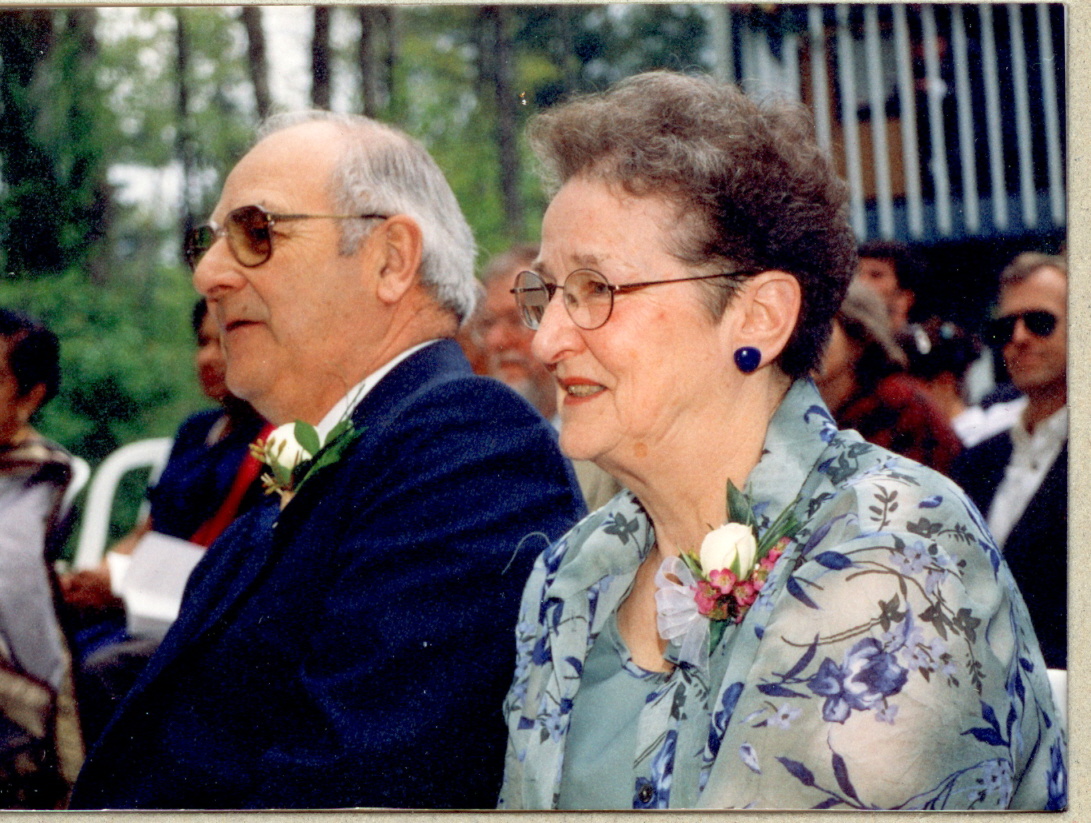
My mom and dad in 2000

As another Mother’s Day and my mother’s 79th birthday rolls around I am inspired to write a little dedication to my mother: Mary Patricia Ann Ritcey Jourdain.  This beautiful woman now lives in long term care because of dementia.  I write in appreciation and gratitude for all she means to me because of what she has made possible in the shifting shape of my life.

When I was a baby, my mother took me in.  I didn’t know this until recent years and not until after dementia had already significantly  impacted her, but she loved me like her own – because to her I was her own, even if she wasn’t the one who actually gave birth to me.

She loves me so fiercely she was afraid to tell me this little bit about my life story.  And I certainly felt like I belonged, even in those teenage years when I wished I was adopted so I could escape the craziness of our family dynamics to some idealized dream family – which I didn’t actually think existed but now that I know they do, I know it’s also not an idealized dream family but real people with their own crazy family dynamics and stories.  It’s good my mother wrapped me in her warm embrace and shepherded me into life.

My mother had the gift of gab.  She could talk to anyone about anything, no matter who they were.  And in the summers when we brought guests aboard the Bluefin, my dad’s pride and joy, my mother had a storehouse of knowledge about just about every home you could see from the water and every island we cruised by.  She didn’t like being on the water so much, but she loved being the social director.

When I was younger, I didn’t really appreciate her gift of gab.  I may, I hesitate to say, have even been a bit embarrassed by it.  But as I grew older and found myself in situations where the ability to make small talk would have come in handy, I grew to appreciate what I now understand as a gift and wished I had the same capacity.

My mother only learned to cook when she married my father.  I definitely heard the stories about not even being able to boil water.  She became a pretty decent cook, except for when she wasn’t paying attention – Harlequin Romances were usually the culprit and sometimes it was Another World.  There was more than one burned dinner in our household when I was growing up.  Somehow that motivated me to learn how to cook and my mother gave me free reign to cook and bake as much as I wanted.  To this day, I love cooking and baking.  I find it relaxing to cook for a large crew of people.

She was, thankfully, an adamant voice when I considered whether I should actually go to University because I didn’t really know what I wanted to do.  I went and I never looked back.

Over the years, as I got married and had children, my mother showed up more than once when I called.  When I was nine months pregnant with my second child and my husband and I both came down with flu and couldn’t take care of our toddler, she came, tended us, made chicken soup and watched our son.

When I was traveling and needed a hand with the kids, she showed up.  When I moved – both with and without my husband, she was there.  Never any questions or judgment when I got married or when I divorced.  Just always there.

She had a way of unobtrusively lending a hand.  She never got in the way, she just started helping out.  This is a gift I really appreciated as I saw other people clumsily get in the way even when trying not to while my mother just began to do what needed doing, gracefully and easily.

She was amazingly resourceful, resilient and always cheerful.  She loved the few years she worked as a waitress or host in several different places during the summer months.  She could regale friends and strangers with her stories as if they happened yesterday.

She doesn’t tell her stories anymore.  Even before she went into long term care on July 2, 2008 she was losing her capacity to string thoughts and sentences together.

The hardest thing we ever did as a family was sign the admittance papers that turned Harbourview Haven into her home, what will be her last place of residence.  At first, we could take her out for little trips.  We even brought her to my home for Christmas Dinner that first year.  But it wasn’t long before taking her out was just too difficult for her.

She went from walking to sitting in a wheelchair, using the wheelchair to motor around the dementia ward to moving less and less.

My mother, who never let me sleep in, now refuses to get out of bed a lot of mornings – making up for lost time maybe.  She never complains – and almost never did – although she’s been known to suggest that maybe some people should be thrown out the window!  Sometimes I think dementia removed a filter,  allowing her inside voice to become an outside voice, maybe giving her freedom to say things she would have been horrified to say pre-dementia.

I have written before about my mother’s situation and only being able to understand it through the perspective of soul journey.  I feel that even more so now.  What I know is that even though she doesn’t talk much and her thoughts seem all jumbled and incoherent, she brightens up when she sees people she has known and loves.  It takes a bit longer these days but it still happens.  She still knows what she wants and is adamant about it.  She’s on a bit of a hunger strike at the moment – not likely a conscious one – but she is refusing to eat.  I have no doubt she wants to be acknowledged for her choices.  She does accept the milkshakes they give her full of the nutrients she needs to sustain her physical body.

For her birthday and Mother’s Day, I can’t really offer her the kinds of gifts that would have excited and delighted her in the past.  Opening presents, which use to be a much anticipated delight, has no meaning for her now.  When I see things that I know my mother would have liked, I also recognize that as a memory and an honouring of my mother more than as a gift to buy.

My mother’s world has shrunk dramatically and she has too.  She has lost much of her vibrancy and joy in life and her ability to comfort others.  But she’s still a human being.  She’s in her journey, in her way, in her soul’s calling and I would only be fooling myself if I didn’t recognize that she is in a transition from he vitality of a full life to what’s behind the veil.  The rest of her will catch up when the timing is right.

She is still a person.  She is still loved.  She is still my mother even though our relationship has shifted yet again into a next phase – as has been happening over the whole course of my lifetime.  Even when the rest of her passes beyond the veil, she’ll still be my mother and she’ll still be loved – remembered for this most amazing journey she stepped into 79 years ago.  Who knew where it would lead but thank goodness she was here for me because who knows where I would be if it weren’t for her.
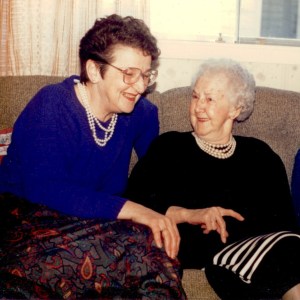
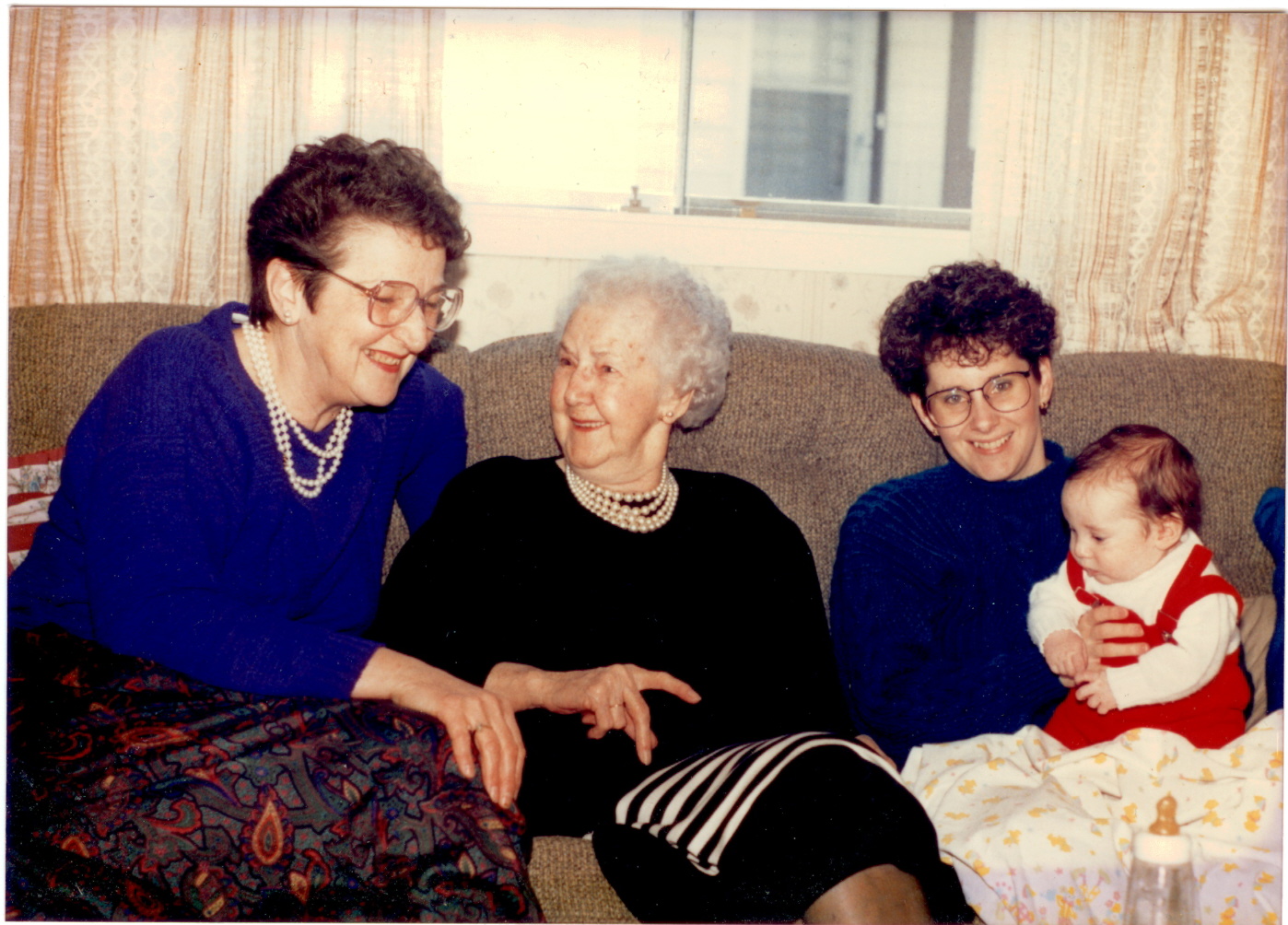
My Mother and Grandmother - 1991
Victimhood, Survivorship – Two Sides of the Same Hook

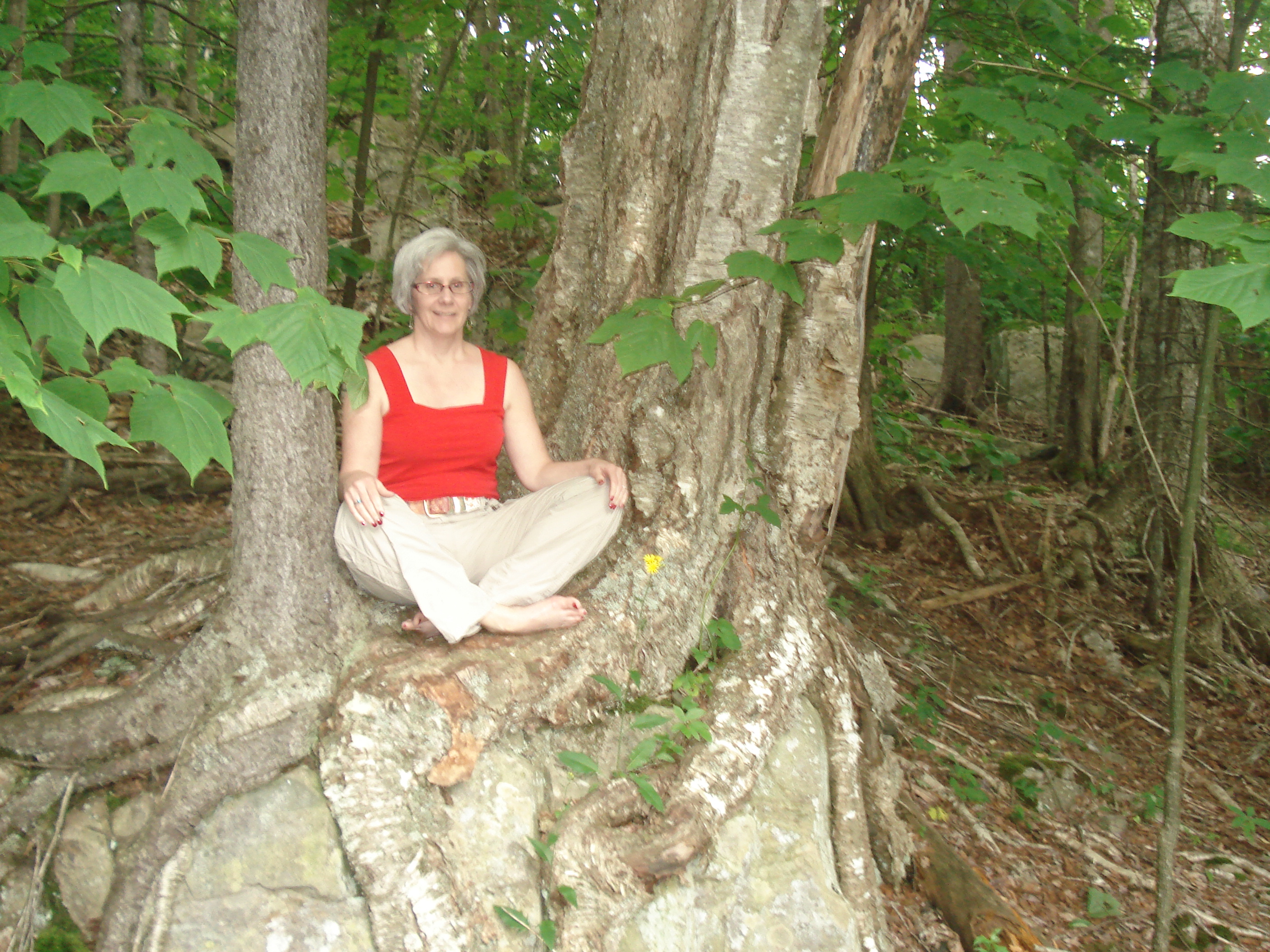
Me In My Meditation Tree

This morning, on my run, I had a revelation.  I wasn’t particularly looking for a revelation – it just showed up.  The power of it could have knocked me over – except it fully formed when I was sitting in my meditation tree in my back yard after my run – and it definitely brought tears flowing as I felt release from a long held story.  The revelation? The story of survivorship is inextricably tethered to the story of victimhood.

I haven’t thought much about being a survivor over the last year as I have mostly felt joy in this new phase of my life.  On my run, I was feeling joy and inspiration, alive and vibrant, connecting to nature in the unseen ways that nature is also alive and vibrant.  Feeling really good.  Reflecting on events of the last week and a half that had me off my ground and my centre and then the three conversations/events that brought me back to my centre and a feeling of being myself.

One of my friends offered me, very bluntly, an acknowledgement of the victim threads buried in the story I wrote to her.  It highlighted it so brilliantly at first I was startled and then I laughed to see the truth of it.  And seeing the truth of it released it.

As I reflected on this experience this morning I realized I have lived into a story of survivorship probably most of my life, even before I was old enough to be consciously aware that that’s what I did.  I survived the story of my birth (a story for another time), growing up in a small town (only half a joke), two divorces, an ectopic pregnancy, job loss under crazy and difficult circumstances, starting a company, merging businesses, separating businesses, difficult and challenging personal and work relationships.   After all, the other choice was to be a victim.  And God forbid that I would ever be a victim.  I will always rise up and overcome whatever challenge shows up on my path.  I am a survivor.  I am strong.  I am resilient.  And this is all good.

Except, of course, for my little revelation this morning.  In order for the survivor story to be alive and well in me, the victim story is also alive and well but buried deep.  Victim and survivor are contrasting sides the same story – two sides of the same hook.  If it is only a choice between these two things, then of course, I want to be a survivor.  But if the survivor story is alive and well in me, even if I have lost conscious awareness of it, then in order to be a survivor, I must attract circumstances and challenges to myself so I can continue to live into the story of being a survivor.

The core of the revelation: without those challenges I am neither victim or survivor.  There are not just two choices.  There are a myriad of choices.  I can live into my life, path and purpose with freedom, joy, love, eagerness and enthusiasm.  I can still attract growth and contrast to my life, but they don’t need to be challenges.  They can be offerings from which I can choose the path that path serves the joyful, delightful core that is calling me.  I can accept, allow, receive.  How much more powerful is that than choosing only between victim and survivor but to release that hook and choose a completely different story and unfolding of my life as this new phase is just getting started.

Deeply grateful to friends, to nudges along the path and the beautiful shifting shape of my life, relationships and work that has only just begun.  Hungry for more.  Ready for more.

Becoming an AoH Practitioner

One of the things that stands out from my Envision Halifax days when a team of us co-designed and co-delivered a nine month leadership program, meeting with the group once a month for either a retreat or a learning day, is how often people talked about getting their Envision “fix” – essentially being able to step out of the craziness of their workplaces into a deep breath of a different kind of space, where we often began with check-in circles and always entered into a conscious, intentional practice field of learning focused on self-leadership, team learning and community reflection and engagement.

The desire and need for this “fix” is directly related to how challenging people find it to bring their learning about new ways of interacting with people, creating the conditions for different conversations that lead to different results back into their work environments – and it is also what I hear from people who have just stepped out of their first Art of Hosting training ground.  “It is okay to do this here, but back at work, well, that’s another story.”

At the risk of stating the obvious, becoming a practitioner of anything takes…. well… practice.  And, I am aware of how risky it feels to try out new group processes or new ways of inviting conversation at work.  How many times we hear things like, “I could never use a talking piece at work.”  “I could never get our group to agree to use World Cafe.”  “People I work with would find this language strange and it may turn them off of even trying something new.”  Yes, all true AND there are always ways to begin practice.

People feel their credibility and reputation are most at risk trying something new with the people they work with all the time.   So one of the simplest possibilities is to look for other places to practice – with another team or department, in a volunteer capacity, with someone else who also wants to practice.

When we just begin to know the many and varied practices that are available through the Art of Hosting field and have little experience with them, we have less confidence in and knowledge of how the processes work and how people can be well and fully engaged in them.  Our own lack of confidence and fear can influence how the process unfolds.  For example, if the group has never participated in an Open Space before, it  may take a few minutes for them to warm up to inviting their own conversations when we open the space for their questions.  With experience, we know to be easy in that pause.  Without experience, it ignites our fears and then we want to jump in to make it happen, often over facilitating the space or the process, sometimes resulting in less than hoped for outcomes.  As grow our own experience and confidence in the impact of the process, we relax more which invites more flow and synchronicity into the space.

As for language, if it will be a barrier, don’t use it.  Rather than talking about circle practice, you could just say, “I would like to make sure we hear from every voice.  Maybe we could just go around the table and as each person speaks, the rest of us could just listen well to what they have to say.” Or, of course, whatever language suits you best.

Begin your practice in little ways.  Take little risks.  Change how you listen and see what difference shows up.  Use more questions, powerful questions, that invite people to respond differently.  Bring more curiousity to the conversations you have in the work you do.

Find places to practice the skills you want to develop more.  Find people to practice with.  Look for like minded people inside your organization with whom you can have conversations of discovery and potentially opportunities for practice.  Think of how you can intentionally shift the shape of your world.

Look for places outside of work to practice.  Take yourself back to another Art of Hosting training to deepen your understanding and skills and grow your courage.  Share success stories, small and large, so you and others can see the impact of making even small shifts.  Maybe you have an opportunity to be part of a calling team for an Art of Hosting in your organization or community.  You could look for an opportunity to apprentice in an Art of Hosting training with experienced practitioners and stewards so you learn to pay attention to and look for the nuances that can influence design, hosting and results.

Grow your confidence through practice and your practice will grow.  Don’t be discouraged easily.  Keep your eyes and ears open for opportunity, openings and invitations.  If you look for them, you will be delightfully surprised at how often they show up.

Join a community of practice.  If there isn’t one in your area, start one – even if it is just with a few people.  Join the on-line conversations and communities.  Observe and contribute when and as you are ready.

Whenever and however you can practice, do so.  Grow your courage through small victories and those victories will also grow.  You didn’t show up at an Art of Hosting training because you are risk averse.  You came because something called you.  My guess is, this work will continue to call you and you will continue to respond.  And there is a global field of practice that responds with you.  Be intentional, thoughtful and mindful and practice well.  Before you know it, you will recognize the Art of Hosting practitioner that is you.

One AoH Training Does Not a Practitioner Make

From the last few Art of Hosting trainings I have co-hosted there are two things that I am increasingly aware of: what it means to be a practitioner of the Art of Hosting and the value and contribution of stewarding to the field and the learning and growth of all.

People come to Art of Hosting trainings hungry for any number of things: to learn more about the methodologies and practices, to connect into a sense of community, to find refuge from the craziness of the worlds they live and work in, to deepen their own self leadership, to find new ways to be in the world, to discover mates they can work and play with in the world, because they have been part of a process somewhere that has drawn from Art of Hosting and they want to learn more and many more reasons I’m sure.  And they go away refreshed, curious, hungry for more and a bit hesitant around how they can bring this back to their life and work.

Two things I am aware of: to really be a practitioner of an Art requires practice and one Art of Hosting training does not a practitioner make.

The Art of Hosting field is incredibly rich and diverse and linked to so many other fields: World Cafe, Circle Practice, Open Space Technology, the Chaordic Field, Theory U, Appreciative Inquiry and more.  When we call a three for four day training, the breadth and scope of the days is shaped by the intended purpose and the people who show up – responsive to the collective need of the group, no matter whether it is a public or client offering.  There is no such thing as a set agenda.  It is a fluid process that the host team and the participants all contribute to.  It also means that the host team is having to pick and choose among the vast array of possible offerings that could flow into the training.  It is not possible to do them all.

All of these things – the hosting team, the purpose, the participants, the choices made within a training ground – contribute to the look, feel and shape of each training, while some underlying things always remain – paying attention to the field, holding space for co-creation and emergence, recognizing the interplay between the dynamics in the field and the learning needs of the group, between self hosting and collective hosting.  No two offerings are ever exactly the same, even if the same hosting team is in place – because the hosting team is also in its own learning individually and collectively and because of the responsiveness to each new training ground.

One Art of Hosting training offers a slice of the Art of Hosting field, even if it is a large slice.  Another Art of Hosting training will show different nuances, different strengths, different emphases and be just as relevant and meaningful as a reflection of the field.  If we leave an AoH training believing this is the way it is – and the only way – we will have missed something fundamentally important – that a key underlying principle is responsiveness to need, co-creation which influences the flow of any training or practice ground, paying attention to what’s in the space and what’s wanting to happen.

It really does take a number of trainings to have a more fulsome understanding and experience of AoH and what’s possible and really understand how AoH contributes to the shifting shape of the world.  We become practitioners when we practice and learn from what we practice.  The next post will explore some ways that practice shows up and how to ask for and offer support in the practice and a future post will look at the questions and observations that have been occurring to me about the role and importance of stewarding.

“Soft Skills” – A Real Misnomer!

Ask anyone.  The hardest thing we ever do is relate to other people, especially as leaders in our organizations or communities, but also in our personal relationships.  Ask anyone what the most difficult component of their job is: relationships, interpersonal dynamics, people.  Ask project managers why most projects fail: inadequate communication and team members moving in different directions or having differing priorities.  Ask teams their greatest challenge: getting work done – because of interpersonal dynamics that get in the way.  Because people challenges interfere in getting the job done, slowing us down.

Empathy, leadership, communication, sociability, ability to laugh, optimism, common sense, responsibility,  integrity and motivation are some of the skills identified as soft. Somehow soft has become interchangeable with expendable so when budgets become tight the first thing to go is soft skills.

Soft skills are not about being nicey nice.  They are about creating the conditions for relationships to grow, enabling individuals and teams to engage in difficult and necessary conversations, not so we can all live in some kind of utopia but in service of getting work done, achieving results, having impact, shifting systems, seeing possibility, opening to emergence.  We do our best work with people we like, people we care about and people we love.  We have our greatest resilience in systems that care. We reach our highest potential in supportive environments that encourage growth.  We take our greatest risks when we know someone will help us up and dust us off when we fall so we can all be ready for what’s next.

There is nothing soft about soft skills.  They require discipline, practice and self awareness.  They require risk and letting go of control, trusting others to step up and in when we create the space for them to do so and they require discernment about what is the right amount of leadership, coaching and support required to allow teams and individuals the highest possibility of growth and contribution.

One of the reasons I gravitate to the Art of Hosting Body of Knowledge is because of the emphasis on creating the field or conditions from which wise action, results and impact will flow, flowing out of a well tended relational field.

We will not shift the shape of the world only through projects.  We will shift it by paying attention to the quality of the relational field and our relationships.  The greater the quality of the relational field, the greater the power to engage in actions with such purposefulness that the shape of the world cannot help but shift.