The Voice of the Judge

There is no more powerful limiting mechanism in our lives than the voice of the judge.  I don’t mean that other person – parent, spouse, child, teacher, boss, friend, co-worker,random stranger on the street or in the shopping mall.  It’s the internal voice of judgment or internal critic that often runs rampant inside of us that we barely notice, if at all, because it is so clever and really good at disguising itself – for self preservation really.

I first became intimately acquainted with my inner judge in 2008-09 during coaching work with Sarita Chawla.  She recommended I read Soul Without Shame by Byron Brown in addition to the work we were doing together. I will forever recognize this as a pivotal point in the shifting shape of my journey.  I wrote about the voice of the judge back then in an article.  I am reviving that article here now in an updated version because it is the season of amplification.  My inner critic is activated – obvious to me because of how I feel – and I am reminding myself of strategies I already know that help to deactivate it and release its grip on me.

When I first became aware of the force of the internal judge, I had been working with the concepts of self-leadership and hosting oneself for almost as long as I could remember – still do, of course.  I worked with coaches, read books, did courses, took part in and led deep group work.  I am generally a positive, optimistic person holding deep appreciation and gratitude for much of what transpires in my life and who shows up.  I have transformed negative self talk into more appreciative forms of self talk and into periods of quiet in my mind.  I meditate and practice other forms of reflection and mindfulness.

So, imagine my surprise when I discovered a voice of self judgment and self criticism that was booming loud and clear in my unconsciousness, stronger than any external voice of judgment or criticism could possibly be.  This voice constantly set the bar for my performance at the best that I had ever achieved.  The bar moved if I did better.  When I didn’t match my most excellent performance, even when I did extremely good work, this voice told me that I had failed, that I did not measure up and that I never would on a consistent basis.  Strong performance was interpreted as mediocre.  Criticisms from others, whether justified or not, was reinforced by this inner critic.

When I felt most down on myself or just down in general, this voice played a significant role – and still can in moments I feel most overwhelmed or vulnerable – until I expose it.  I didn’t actually hear it as a voice until I began to listen for it but I felt it strongly in many forms: sadness, unhappiness, melancholy, anger, listlessness, lack of motivation and many other emotional manifestations.

While I had been aware of this voice (or at least the emotions it manifested in) to some extent, I also prided myself on my journey of self-transformation and change.  Been there, got that medal, surely I must be done now, can I just get on with my life and success?  I realize now it was the voice of self judgment that said, “You’ve been doing this long enough, how come you’re not done?”

Part of the reason I had been pretty oblivious to this voice was because, in my quest to be calm and serene and professional, I skirted over my own emotional reactions.  I barely recognized I had them except in the odd instances where they overtook me.  Oh, was that an emotion that wasn’t calm and serene?  Oops.  Nope. Couldn’t have been.  It must have been something else.

Then, a friend told me I deal with my emotions intellectually.  So, I thought about that.  And I thought my friend just might be right.  Emotions don’t reside in our intellect.  They reside in our bodies.  We feel them and sense them.  We use metaphors to describe them.  We say things like, “That packed a punch!”  If we stop to notice, we will notice where it feels like we got punched.  And if we stay with that, we will begin to notice the impact.  And if we stay with it longer, we will notice the uncomfortableness and want to move onto something else.  This is where I am learning to stop.  I have learned to stay with it longer, until I can begin to discern the wisdom that is held there and that can only emerge when we give it an escape hatch to surface to the light.

It is in these moments that my voice of self judgment has come booming out at me in all of its voraciousness.  With all good intentions, all it wants to do is protect me – from failure, from being unlovable.  But its methods only serve to reinforce for me my failures, even to the extent of turning successes into failures, thus creating in my mind my own unlovability and unwantability.  I have also become aware through the Law of Attraction and the teachings of Abraham that this voice of the judge interferes with flow, abundance and allowing the full vibrancy of life.

I learned to journal in this voice.  I am astounded by the punch it does pack.  Periodically I sit and check inside of me to sense into what I’m experiencing and feeling and what the impact is.  I journal what I am sensing until I feel done.  Then I check in again to see what I am experiencing, sensing and feeling, and then journal again. And then again, if that seems required.  I am committed to going the next layer deep and the next until I feel the light flood back into my soul and I feel a lightness of spirit and of body. This is what I want to amplify in my life now.

Exposing my voice of self-judgment transmutes it into a gift of understanding and insight after which joy can once again arise and take more of the space that is its, and my own, rightful due.  Now, instead of seeing my journey as one that should be concluded and being hard on myself because it is not, I see my journey and myself with a gentleness I could not access before as it was hidden underneath the protective layer of the voice of judgment.  I have always known, intellectually, that learning and growth is a life long journey.  Now I know it and accept it with a graciousness that only comes from the light.  It is a good reminder in this season of amplification.
Healthier Health Care Systems Now!

Most of us know the intractable challenges of health care, no matter where we live. Many of us are battle tested, battle weary and battle scarred.  Yet, we continue to have high hopes for healthier healthcare.  We have irrepressible dreams for healthcare systems that thrive and are committed to wellness.  Just because some of us have been in this conversation for awhile, doesn’t mean the shift won’t happen, no matter how discouraging it gets at times.  Really how do we nudge the big machine of the system when it seems to be hunkering down that much more? What is the staying power we need to do this work in the midst of chaos and serious push back?

What do we do when we are asked to be different but the “system” wants us to do all the same things?  We are being asked to transform but please don’t look any different than you do right now?  These are tough scenarios, impossible push backs from a system that is seeking its own next evolution and afraid to go there at the same time.

Just because we can’t see the way, doesn’t mean it doesn’t exist.  But what does it take to stay the path of pioneering, shift and change?

My good friends and colleagues Tenneson Woolf, Steve Ryman, Dr. Marc Parnes and I have put out a call to current day pioneers in health care systems change to gather in Salt Lake City, Utah from January 11-13th to unearth the deeper questions that sustain us and propel us forward on this mission for healthier health care systems now.

The more we are in conversation as a hosting team, with those planning to attend and those who wish they could be there but for various reasons find it impossible, the more inspired I become about how THIS conversation can and will be different and more than all the ones I’ve been in over the last 5 or 6 years.

I am particularly inspired about what connection can be made between this event and a global conversation on health care.  As we come out of a retreat together, what is it that we could collectively offer, or even teach, others about what we are leaning?  We see a Community of Practice emerging from this.  What does the CoP do together over a period of time that none of us can do alone?  What is the conversation that needs to happen in health care right now – today – that cracks it open in a new way?  What is the unifying force and what happens if it gets unleashed directionally?  How do we use the amazing technology platforms available to do this in whole new ways?

Other thought provoking questions that have been arising through the many conversations:

  • “The system doesn’t work that way” is not a good enough answer anymore.  How do we create systems that make sense to any of us?
  • Systems are more complex that we can manage – how about simpler systems?
  • What’s at the edges that if we could see it and understand it, might help us open up the middle?
  • What happens when we tell our stories of inspiration, especially the ones that are in danger of getting lost?  Can we revitalize these real world stories and our own capacity to be in the journey for the long run?

I am inspired by the Occupy movement, even as it struggles to understand what is next – like health care, like community change, like financial systems….  Charles Eisenstein writes about Occupy in this post on Where next for Occupy.  One of the things he says is, “We want to change the psychic and interpersonal substructure of the system we live in.”  Is this what we mean when we talk about health and wellness systems instead of illness systems?  What would happen if we could change the psychic and interpersonal substructure of health care?  What does that even mean?  I’m not sure but would love to be in that conversation.

Our hosting team has also been inspired by our friend Peggy Holman’s work on Journalism that Matters.  What if this gathering on health care that matters produces a similar set of principles; something like:

  • Health care professionals are stretched, refreshed and inspired to pursue innovations
  • New and often unlikely partnerships
  • Breakthrough initiatives
  • A community of health care innovators
  • A growing culture of innovative health care

We are not in this because it is easy.  We are in it because it matters.  Because we have tried many things, seen success with some and know there is what appears to be a long ways still to go.  Because “the system doesn’t work that way” is not a good enough answer anymore even if we haven’t quite seen the path forward.  Because we know we need to be in this together.

Because we feel in our very beings it is actually possible to create healthier healthcare and we know that it must happen more systemically. We are gathering with people who want to see and do leadership differently for the future of healthcare. With people who are hungry for new conversations. Who feel a responsibility for imagining and contributing what hasn’t been imagined before. With people who know that the way to take on big stuff is to turn to each other. Muck it up. Get curious. Stay focused.

I grow hungrier every day for this conversation now.  Wondering how much bolder I need to become…. we need to become… in a age that needs boldness and daring like never before.  What a good way to kick off a new year – and a prescient one at that!

Tis the Season of Joy — And Sorrow

The holiday season is an amplifier.  It is often a time of great celebration and joy as family members and friends gather together in gift giving and meal sharing.  It is also a time of great sorrow for many as reconstituted families find new patterns of gathering and as many of us feel the absence of loved ones who are elsewhere, may have departed, are sick or dying or in long term care facilities or simply no longer a part of our lives.  And it can be overwhelming and stressful as we strive for perfection in a season that often already demands a lot of us and where expectations run high – the ones we have of ourselves and of others.

It is impossible to live life and not have our fair share of  joy, sadness and stress.  Simple little delights often bring the joy.  A particular Christmas song.  Lights.  Tree trimming. Christmas celebrations.  Buying someone that perfect little something – or creating it.  Traditions that are meaningful.  Conversations that are as delicious as the traditional holiday fixings.  Lovely memories.

The things that make the heart sing are a beautiful thing.  The things that make the spirit sad are harder to acknowledge.  Absences seem to be one of the most significant contributors to sadness at this particular time of year.  The absence of loved ones.  It is an experience I know.  We all do.

One example in my life: my mother is in long term care with dementia.  She’s been there now for three and a half years. Since May, seven months ago, we have been told she could leave us any day.  Some small part of her still inhabits her physical body while most of her is having a different kind of experience that is beyond my knowing at the moment.

She has been absent from our family Christmas celebrations the last two years physically and to varying degrees cognitively for longer than that.  A week or so ago, I was in a shopping mall.  Something in a store caught my eye. I was hit with a wave of missing my mother – really for the first time.  This woman loved Christmas and loved opening presents so much it happened so fast it was over almost before it began – until we found ways to slow the process down.  My mom was always like a kid at Christmas when it came to presents – until she forgot what to do with a present, forgot what it was or even how to open it.

We all have these kinds of stories.

Some of us have stories of being in relationships that are not fulfilling, meaningful or relevant anymore.  Some of us are no longer in relationships and carry sadness or regret as a result. Some of us are in relationships with loved ones who live far away from us.  This is a season that brings nostalgia about better times and brings heightened awareness of what is not working.  It shines a light on the imperfections of our lives and relationships.  It brings loneliness even as we are surrounded by people and festivities.

In a season that is “supposed” to be joyful, we don’t always know how to handle the emotions and times that are not.  When we try to suppress them, we just drive them underground for awhile.  They will resurface when an opening shows.  There is nothing wrong with surrendering into our sadness long enough to acknowledge it.  If it continues to overwhelm us deeply maybe we will need help to come out of it, but for most of us, surrendering into and acknowledging our own emotional turmoil, allows release.

There is nothing wrong with tears.  Truly, there isn’t.  Although many of us believe there is.  We apologize for our tears.  Like we are somehow weak and maybe imperfect because we cry – especially when we cry in front of other people.  But tears are releasing and healing and an indicator of our experience.  How much more beautiful it could be if we stopped apologizing for tears and let ourselves be in our experience and even have it witnessed by other people.  In the event it makes others uncomfortable, other people’s uncomfortablenss with our tears is not our responsibility.  And for most people who witness, it is also freeing for them.

As we allow ourselves to move through our own experience, we create more space for joy and delight to show up faster in our experience.  Staying in our sadness will not fill the absences, will not bring back people no longer here or bring people to us who are far away.  And most of those absent, would not want us to be lost in our sadness but would want us to celebrate the joy and vibrancy of life.  Even if they wouldn’t, our soul is inviting us to celebrate the vibrancy of life.

Another thing that detracts from the vibrancy of life is the stress of trying to make the perfect holiday – on top of so many other things that need tending – children, parents, work, life and death.  Very little of this stops just because it also happens to be Christmas and we now also need to shop, bake, decorate, wrap gifts, go to Christmas concerts and Christmas parties.

Some things could be left undone or done a little short of perfection.  How many cookies do you really need to bake?  How many presents do you really need to buy?  What if you boiled it down to the one or two essential elements that seem the most dear to you?  For me, it is gingerbread houses.  I make the house parts.  I thought about buying them one Christmas but realized how much a part of me is in this tradition – because I love to bake and love the delight of the gingerbread house process from start to finish.  Most of the rest of it I can let go – especially in my experience of reconstituted families.  When and how things happen is a matter for conversation and joint decision making that usually extends beyond my immediate family.

Tis the season of amplification.  What is joyful is more so, what is sad is more so, what is stressful is more so.  Tis also the season of reflection and remembering.  And maybe most important of all, let it be the season of self-care – because, in that, we shift and grow our capacity to embrace the joy, delight and imperfections of being human that are completely available to us in the season of amplification.

Shaping Questions for Powerful Check-in and Check-out Processes

Check-in and check-out processes are not just frivolous time wasters in our meetings.  If they feel that way, something is probably  missing.

Wicked questions help shape powerful processes. The shaping of questions in a thoughtful, purposeful and intentional manner increases the likelihood of them being powerful. This is the second post on powerful questions, the first one contained  general thoughts about shaping powerful questions.  This post focuses on check-in and check-out – processes, so fundamental to the work we engage in and setting context for what we do.

The greater clarity we have about the purpose and intention of the overall work and the process we are choosing to use, the greater the likelihood of crafting a question that does exactly the work we intend it to do.  Check-in and check-out processes are used very intentionally and in all kinds of settings.

People who come to an Art of Hosting training are often introduced to check-in and check-out for the first time. There are many forms of check-in and check-out.   If we’ve done our work well, these processes will have been experienced in a variety of ways – through the use of words, body, music and using varying lengths of time from a couple of hours or more to a 10-15 minute process.

Many people leave a training seeing the possibility of bringing a check-in process to their team or meetings but wondering exactly how to do that well.  Using the same question all the time eventually wears out its appeal so it becomes important to hold attention and keep things meaningful and relevant to bring new questions at least periodically.  It keeps things fresh.  Which brings it all back to purpose and intention.

The Use of Check-In  in Trainings

In an Art of Hosting training, we use a check-in process as we arrive and settle in together.  Usually this is planned as a  longer process, wanting to dive  deep together as we set the context and container for the whole three or four days we are gathered.  We intend to begin well as we arrive, meet each other and understand individual and collective intention for this training.

Not only do we use good questions for this initial check-in, many of us also engage in the fundamentals of good circle practice so we set our container well and with depth.  A little teach on circle, the use and power of a talking piece and the agreements of circle set the stage well for the work we want to do with each other.  Our greatest and best resources on good circle practice come from our friends Christina Baldwin and Ann Linnea at Peer Spirit.  When we do this well, it is common for unexpected and beautiful things to arrive in our centre from the hearts, minds and souls of participants.

Often times check-ins on other mornings are simply to bring us into the space together.  Sometimes we don’t even use words but invite a physical movement or embodiment check-in.  Sometimes it is music.  It is whatever fits well with the overall theme and flow of the day and brings us fully into the space.

Check-ins also do not need to be done with the full circle.  Sometimes we use dyad or triad interviews or conversations to allow the time for people to go deeper in small groups.  Sometimes we might invite people into a walk with each other.

The Use of Check-Out in Trainings

Just like we use check-in to bring people into the space, we use check-out to bring some closure or convergence to a day or a multi-day process.  Doing a check-out doesn’t necessarily mean bringing everything to a nice tidy close but it could.  Check-out provides an opportunity for good reflection.  Where are we at, individually and collectively?  What is alive and present in the room?  Is there anything in particular we need to be paying attention to as we revisit our design for what’s next?  What is resonating for people?  Are we in a groan zone?  Are we eager and excited for what’s next?  Was there cool learning that took place that we want to provide people the opportunity to reflect on more deeply?

In a check-out we may want to presume in a certain direction, plant a seed – “What is shifting for you as a result of your experiences in this day?” “What spark are you carrying forward?”  Or we may want to take a little pulse – “What’s alive for you now?” “What one thing has your attention?”

And, like the check-in process, sometimes we are not wanting to use words.  Sometimes we use dance, embodiment, other physical movement, a series of claps or other imaginative ways to close our conversation or our day.

A good thing to remember, please don’t confuse depth with length of time of a process.  I’ve been part of many processes where there was not a lot of time available, but depth was achieved because of the care that went into thinking about purpose and intention and crafting a wicked question to guide the process.

What About the “Real World”?

This is one of my favourite questions – how to practically apply what’s been learned about check-in and check-out to “real world” situations, like my two hour staff meeting, my three hour partners meeting, my team that only wants to get right down to business, with a group of high powered individuals, senior leadership in an organization or in government?  Especially for folx who say, “that dance check-out was really nice but I could never do that with my group.”  And, of course, you wouldn’t want to go back to your organization and use some of those things that seem a bit too out on the edge.  But when you first try to use these processes, sometimes the very notion of a check-in or a talking piece is “out on the edge”.

Look for openings and invitations and step into practice in the places where greatest opportunities exist to try even some little new thing.  Sometimes bringing a check-in and check-out process to your meetings or your team is the simplest way to begin to practice on an ongoing basis and it can be done without great fanfare.

The Use of Check-In  in Ongoing Practice

It can be a relatively simple thing to begin a check-in process with your team.  “We spend a lot of time in meetings.  It would be great if we all felt these meetings were a relevant and meaningful use of our time and I’m not sure we all feel that way right now.  I would love to hear us each speak to this question: If we used our meetings really well, what would it look like and what is the difference it would make to us as a team and our work?” 

“The purpose of our meeting is….  Before we dive into the agenda, it would be great to hear a bit of what you are observing in your world that relates to our topic this morning.” Or, pay attention to what is the best question that can refocus your team or your meeting on what is important and link people’s passion or interest with the topic at hand.  It is amazing how a few minutes doing that can shift the entire feel of a meeting as people pay more attention.

Work the question you want to start with.  Will it generate the kind of thoughtfulness you are hoping for?  If not, how can it be nuanced – or sometimes completely thrown out in favour of a better question – to do the work you intend it to do?

How much time do you have for your check-in?  With a long time frame of meeting – a day or more, you have more time to begin well.  With a shorter meeting – as little as an hour or two – you can still begin well, just be conscious of the nature of the question you are asking.  The better you begin, the better the quality of the meeting, usually with better results in a shorter time frame.

The Use of Check-Out  in Ongoing Practice

Short and sweet often works for check-outs, particularly when you are in a short meeting. Once you get used to using check-in and check-out, meetings somehow don’t feel complete until you do a short round of check out.  Simple questions targeted at what you are looking for at the end of the meeting.  Curious about what is sitting with people now?  Ask.  Curious about what people are taking away?  Ask.  Curiosus about what is percolating?  Ask.  Noticing that things or people feel a bit unsettled.  Invite.  Not everything needs to be wrapped up with a nice tidy bow.  If you invite the rumblings that you sense, thank people for sharing.  “Thank you.  Good to know where we all are.  And not unexpected, given what we discussed/where we are in our process.  Thanks for sharing.  It is appreciated and important.”

Bringing in a Talking Piece

While I’m sure there could be an entire post on using a talking piece, there are some simple ways to bring one into your meeting.  For groups that are not familiar with this process and for whom it doesn’t feel quite right to do the full blown teach just yet, I will often say something like, “I want to hear from everyone in the room and to do that offer out this item (something I have with me, something in the room, something symbolic for the group, sometimes a bracelet I take off my arm, a pen in my hand, whatever is readily available) as a little talking piece.  This is just so we make sure we hear everyone’s voice.  The beauty of it is that when we have it, it is our turn to talk. When we pause, it is truly a pause and not an invitation for someone else to jump in.  It means we can think about whether we are truly finished or if we have a bit more to say.  When we don’t have the talking piece, that is our invitation to listen and listen well.  Because you know when you get the talking piece you can take a minute to think about what you want to say.  I find it changes the quality of the listening and changing the quality of the listening changes the quality of the conversation.”

I know from my own experience, that when the talking piece is not used often their are people who choose to stay quiet even when you invite all voices and then it is harder to re-invite their voice.  And it is amazing at how appreciative people become around using a talking piece.

Conference Calls

Yes we can, and do, use check-in, check-out and virtual talking pieces in our conference calls.  And, yes, it works well there too – shifting attention and quality of our experience.

The main points are the same across these different categories: purpose and intention, a question related to purpose and intention that you’ve worked a bit to make it wicked and powerful because you’ve sat with it to sense into whether it will do the work you want it to do.

Where are your openings and invitations?  The more you find them and accept them, the more you will find yourself in a practice that no longer feels risky but now feels fundamental for powerful process. The more the shape of your world will have shifted and before long you may find yourself not just an experimenter but a practitioner.

Shaping Powerful Questions

One of the most asked questions at, and after, any Art of Hosting training is about the questions.  Developing powerful questions is a crucial element to creating the conversational space we are seeking.  People are hungry for greater understanding of how to create questions, especially after they’ve tried a check-in, check-out or cafe experience that didn’t quite have the intended result or impact.

Sometimes powerful questions appear, almost like magic.  We know they are powerful because we feel them.  But usually they are developed and shaped with great care – and often co-created with others.  It is not unusual for a whole planning meeting (and sometimes more) to focus just on question development for a process – which may seem a bit crazy until you’ve had the experience of well formulated questions in comparison to sessions where questions have not been shaped with the same care.

This post contains general thoughts on the shaping of powerful questions.  Later posts will focus on specific processes where questions are used, like check-in and check-out, World Cafe, Open Space, Appreciative Inquiry, Dyad and Triad Conversations and Deep Sensing Interviews.

Three Dimensions of Questions

In an Art of Hosting training in South Dakota this past July, was the first time I heard the three dimensions of powerful questions, coming from World Cafe work and community of practice.  The three dimensions are: scope or scale of the questions, assumptions in the questions and construction of the questions.

What is the scope of the question you want to ask?  If the scope is too big it may shut down conversation (how do we create world peace?) but you might want your question inspirational enough to allow people to gaze higher than they might otherwise (how have you created peaceful moments for yourself/your team/work/family? How could you do that more often or in a different setting?)

People tend to rise to the assumptions made in the questions so it is good to both notice the assumptions being made in the question and also to be intentional about them so the work is more appreciative and aspirational in service of purpose and intention and the greater work being tended to.

In considering how we construct questions, there is a continuum that flows from less powerful to more powerful.  The less powerful questions are ones that can be answered with a yes or no.  Moving along the continuum, more powerful questions begin with when or who.  The next level are questions that begin with how or what and even more powerful questions sometimes begin with why. I say sometimes, because sometimes the why questions also entrench people in their point of view if asked in such a way they invoke defensiveness.  Ask why questions in ways they evoke curiosity and then you’re onto something.

There is a timeliness we generate when we put the word “now” in our question.  “What you noticing now?”  “What has your attention now?”

Purpose and Intention

A key factor in question development is what is the purpose and intention – of your gathering, your meeting, the particular process the question is intended to shape or provide context for, the question itself?  What is the work you want the question to do and then what is the simplist way to ask the question? Purpose and intention is so central to question development that we go back to it again and again.

Language and Shaping

I like to use as much present and active language as possible.  Instead of asking, “What did you learn from that experience?” you might ask, “What are you learning from that experience?”  There is a supposition built into the question – that the learning is active and ongoing. If that fits the purpose and intention of the space you are wanting to create that’s great.  If not, a question targeted to the learning and conversation you want to encourage would be better.

If you are wanting to move in a certain direction, then create questions that presume in the direction you want to go.  “What is the shift you imagine will happen once you leave here and begin to apply what you’ve learned?” This question presume you want a shift and that you will put something into practice post the training.  For some it will inspire their imagination. When it doesn’t inspire someone, they will usually say so without detrimentally affecting the responses of others who are feeling inspired.

It is also okay to take a pulse of what’s happening in a group or process without assuming a direction.  This is particularly helpful when you want to sense into where a group is at, what you need to pay attention to or what might be simmering under the surface.  It is good to have people in a group name their experience sometimes without trying to shift into a particular direction.  The information that surfaces is then helpful in shaping design or process informed by what is present in the room or group, tracking always toward the purpose or intention of why you are in this conversation or work.  Sometimes diversions are necessary to ensure we get to where we ultimately want to go. You could ask a question like “What’s sitting with you now?”, “What question’s are percolating?”  Sometimes I might even ask, “What tension is arising in you at the moment?” but only if I am really sensing tension in the room, wanting to surface what’s there but not create it if it isn’t there to begin with.

Nuances in Question Development

Slight nuances in a question can lead to very different conversations. This is why we often sit with the questions we have drafted and imagine the kinds of responses a question might evoke, noticing how changing the question slightly could generate a different conversation.  Some examples: “What are you noticing in your environment right now?” compared to “What are you noticing in your environment that relates to this project?”  or “How have you been since we last gathered?” compared to ” How has the last gathering impacted you and your work?”  The first version of these questions is far more open ended while the second version is more targeted to purpose and intention.

Co-Creating Questions

It is hard to create really powerful questions all by yourself.  It is much more fun and generative to co-create with others what the questions could be.  Then when a nuance is discovered that makes the question more powerful, the whole group feels it, not just one person.  Collectively we know we’ve gone to a new level of depth.  When we co-create the questions we can start in the ball park of what we want to do and, through the conversation, discover what those nuances are that increase the the capacity of the conversations we are inviting to be meaningful and relevant to the participants we have engaged and the purpose for which we have engaged them.

Powerful questions can shift the shape of an individual and their pattern of thought, a team and its dynamics, an organization and its usual ways of thinking about things.  Imagining they can even shift the shape of the world….

Why Don’t Those Occupiers Just Go Home?

The Occupy Movement seems to have hit a perplexing moment – yet another one, that is.  Officials in many cities across North America are trying to figure out how to make the occupiers go home.  Fall is settling in to many places and what many assumed was a passing fad hasn’t yet faded away with the cooler temperatures or fiercer weather.  If they didn’t have any demands like typical protestors and no proposed solutions to the problems that others could then shoot down, then why haven’t they just packed up and gone home?

So now, many officials are trying to figure out how to get them to disburse while opinions of the movement and the occupiers vary dramatically within the media and within communities in each of the cities.  Some people think they are an eyesore filled with people, mostly young, who don’t have jobs and are only looking for a handout.  People who have this perception seem to just want them to go home and find a job like everyone else.  Public officials are certainly playing off of the perceived dangers pointing to drugs, alcohol and even some deaths in some cities as reasons to disband the occupiers.

Other people see them as vibrant communities that people flow in and out of, people with and without jobs, people on traditional career trajectories and those on alternative career trajectories, who are standing up for democracy and “voting” by their very presence in public spaces.  My own bias or world view is that there is something more going on here, something deeper, something fundamental to understanding the shifting shape of the world.

Occupiers have been gathering long enough that minimum structures and process have emerged.  These tent villages include library and food tents as central points of focus.   They have been working with consensus decision making and ways of being heard in large crowds where any kind of speaker system has been denied.  The movements have stayed largely peaceful even in the face of being provoked at times.  They are communities that are taking care of each other in some beautiful and perfectly imperfect ways.

They are example of translocal communities that are learning from and with each other and supporting each other.  They exist in individual cities and they are part of a field of attraction that makes them more than any single city.  That the movement spread so quickly and virally from one place to the next points to its magnetic attraction and the sense that there is something more going on here.

Maybe the occupiers haven’t presented demands or proposed solutions because they know we don’t know what the solutions to our problems are and they won’t be solved by a few people locked away in a room brainstorming or strategizing our future.  The greatest likelihood of deep, systemic solutions appearing is the collective curiosity and discovery of what is possible through intentional dialog the likes of which we may have not seen before – like the 1000 table, 10,000 person cafe conversations that took place in Tel Aviv earlier this year – the first of its kind but surely not the last.

Our culture is such that any one person or group presenting solutions feeds into our predominant public and social structure of debate – giving people something to latch onto to elucidate all the reasons those solutions won’t work and dividing us into camps of right and wrong, good and bad, smart and stupid.  What happens when we invite ourselves to see past the dichotomies to hold the paradoxes and allow all possibilities to exist in the same moment?  The very idea is perplexing in a world that has become beautifully complex and yet where some still want to boil it all down into nifty little compartments of thought and action.  We don’t live in that world anymore.  We haven’t for some time.

Our systems – financial, health care, education, transportation, environment, to name a few – are in deep trouble.  For the most part, they no longer support themselves.  They are out of integrity.  Most of them would be financially bankrupt if we let them be.  Officials can try to make the occupiers go home – in fact, as I’m writing this I got a test message saying police in Halifax are forcibly trying to remove the Halifax Occupiers from Victoria Park right now, in the pouring rain.  But taking them out of public spaces does not change the condition of these systems or the condition of the globe in this moment.  It might allow some to pretend that we can go back to business as usual, but we have long since passed that point.

So, if we opt out of the ways we have always done things, where does that take us?  To the field out beyond right and wrong (to badly paraphrase Rumi)?  If enough of us were able to let go of everything we think we know and allow ourselves to surrender into the edges of our learning and experience, maybe collectively we will begin to imagine what’s next and lean into creating the conditions for that emergence – emergence meaning we all left with something no one brought.

The deliciousness of possibility has me salivating with eternal hope.  The inquiries I am in around stewarding what wants to emerge along with the deeper underlying patterns inherent in the work I am called to do make me deeply curious about the Occupy movement, the staying power of it and how it will influence the shifting shape of the world and the regeneration of its people.

What Time Is It In The World?

What time is it in the world?  This question has never seemed more relevant to me than right now.  It is a question I first heard in Art of Hosting work, often to context the times we are in, moving from a global perspective to much more specific contexts.  In the work and conversations I’ve been in over the last decade, there has been a sense of preparing for a time to come.  Now, in this time in the world, we are no longer preparing.  We are full on in it.  The shape of the world is shifting rapidly and it is a good time to be awake.

No longer are we waiting for someone else to fix the problems in the world. Like the Hopi prophecy says: we are the ones we’ve been waiting for.  Ordinary citizens are peacefully showing up by the thousands in public spaces in cities around the world to say, Enough! The Occupy movement has been rolling out across North America since September 17, 2011 beginning with Occupy Wall Street, inspired, whether they know it or not by events in Europe over the spring and summer where people also showed up in the streets of Greece, Spain, and London to name a few places.  It is a movement that started with little fanfare and almost no news coverage.  It is going strong, gaining momentum over the last three weeks or so and still not much coverage in the main stream media.  Thank goodness for social media! People don’t quite know what to make of it because it is not typical of demonstrations and protests where demands are made and violence is more the norm.

As Charles Eisenstein said in his post: Occupy Wall Street: No Demand is Big Enough  “Occupy Wall Street is the first manifestation in a long time of “people power” in America. For too long, democracy has, for most people, meant meaningless choices in a box. The Wall Street occupation is stepping out of the box.”  With many of our financial and government systems on the brink of collapse, the stakes are high – the highest they’ve been in my lifetime.

Tom Atlee, in his post Dawning Realizations, has noticed that “although Occupy Wall Street LOOKS like a protest and a demonstration (and occasionally turns into one), it is actually something more, something else: It is a passionate community of inquiry acting itself out as an archetypal improvisational street theater performance embodying, in one hand, people’s longings for the world as it could be and, in the other, their intense frustrations with the world as it is. These longings and frustrations reside in the whole society, not just in the occupiers.”

The Occupy movement has all the hallmarks Open Space Technology  – whoever shows are the right people, when it starts is the right time, when it’s over it’s over and whatever happened was the only thing that could have happened.  People are exercising the law of two feet just in showing up.

This is not the first time I’ve heard an Open Space reference made to recent public gatherings.  It was said about the gatherings in Greece and many others in Europe –  a giant open space with quiet conversations happening all over the square that no one individual or group called or planned.  It just began to happen.  And in Israel, a 10,000 person Cafe process was hosted in the streets of Tel Aviv and elsewhere.  Never before even imagined.

These references point me to another observation I’ve been making about What Time Is It In The World?  This observation percolates out of my recent time in Brazil where I was part of an  Art of Hosting training in Porto Alegre and also got to visit friends in Sao Paulo.  The first Art of Hosting training in Brazil was about five years ago.  Since that time a small but mighty group of friends have been building, holding and supporting the AoH field in that country.  In the last year, the field has experienced incredible growth.  After lovely, deep conversations with friends throughout the couple of weeks I was there, I came to the understanding of  a subtle but powerful distinction.  This beautiful group of early adopters and stewards is no longer holding the field – the field is now holding itself.  While these people are still important the field has grown beyond them – just like the field of shift in the world seems to have grown beyond any one individual, organization or community.

And, of course, it is not particular to the Art of Hosting field, which is what makes it even more powerful.  It comes from many fields and many different communities – like World Cafe, Open Space, Circle Practice, the Presencing Institute, Pioneers of Change, Society for Organizational Learning, Berkana, ALIA and many more; the quiet revolution Paul Hawken references in Blessed Unrest.

Sometimes it seems strange to go about my daily life, engaged in ordinary and profound conversations, dropping my son at school, navigating my parents health questions and concerns, taking care of the mundane ordinariness of life while at the same time being aware of the deep shift happening in the world right now wondering what will be different and how it will be different. Without being able to see the path, knowing with absolute certainty that things are different, they are changing and life will never be the same again, feeling in my heart that the things we have been longing for, in my awareness for the past decade or so, just might come to be.

What time is it in the world?  Are you paying attention?  Are you awake?  It is a beautiful and amazing time to be awake in the world right now.


Community of Practice – What’s it All About?

One of the biggest questions arising out of Art of Hosting trainings and related work I’ve been part of these days is, what’s next?  How do we actually practice and sustain what we have just learned?  How do we grow our skill, courage and capacity as practitioners?  How do we create fertile conditions in our organizations or our communities to shift the shape of our future, the way we work and even the work we do?

In March 2011, I co-hosted the Art of Collaborative Leadership in Nova Scotia with good friend and colleague, Jerry Nagel from the Meadowlark Institute in Minnesota.  He shared a model he and Chris Corrigan have been using in Minnesota as a means of thinking about and being in a Community of Practice (CoP).  I refer to it often now as it reminds me and the groups I work with of key elements that contribute to learning, growth and shifting the way we work and are with each other.

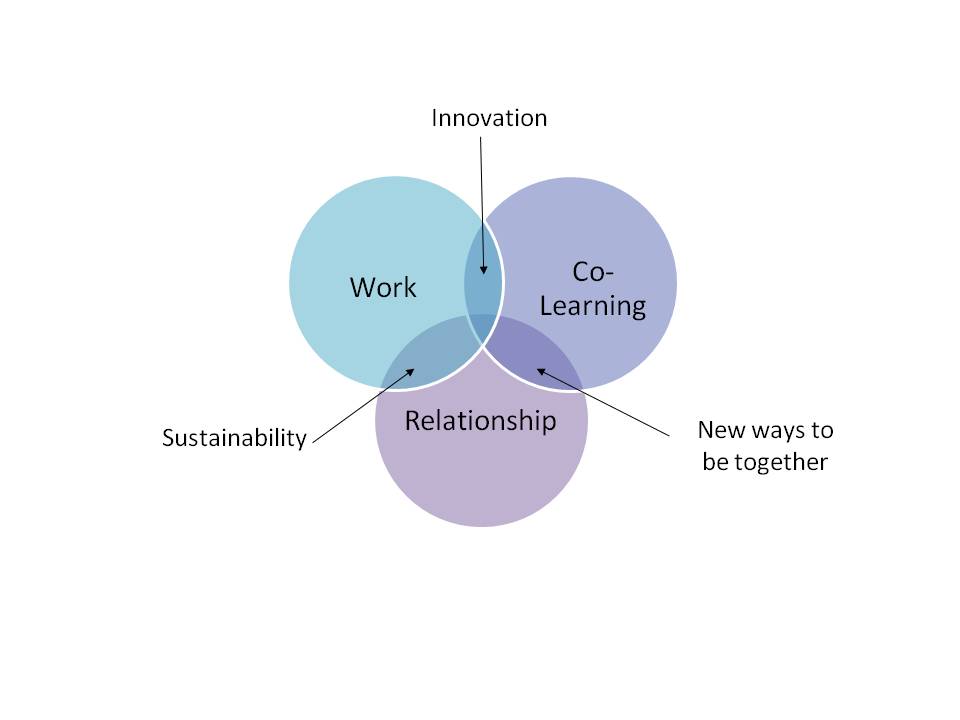
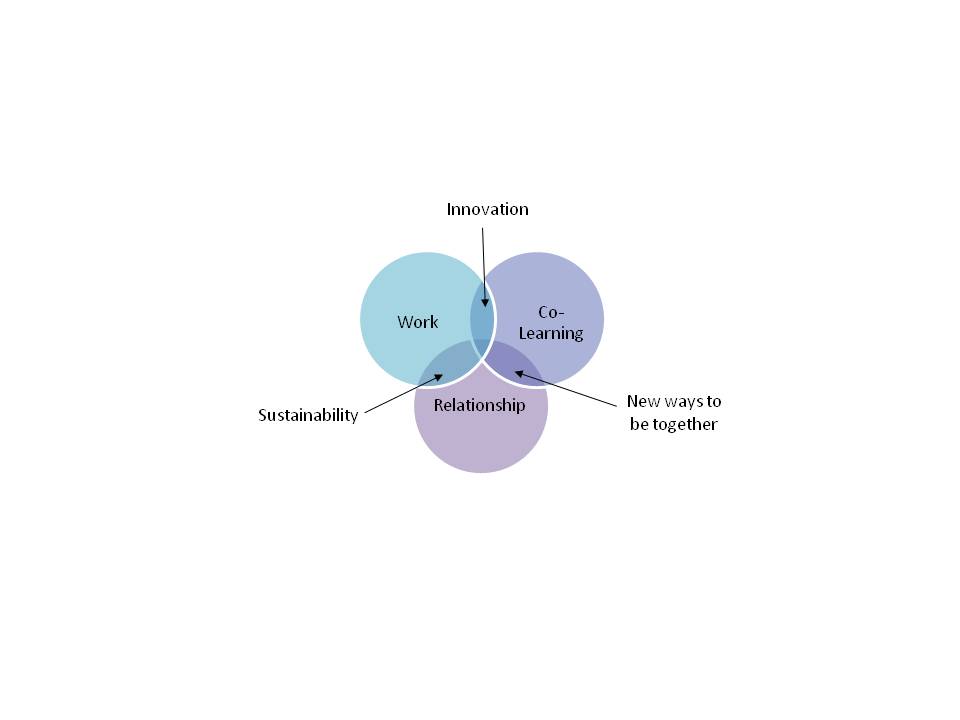
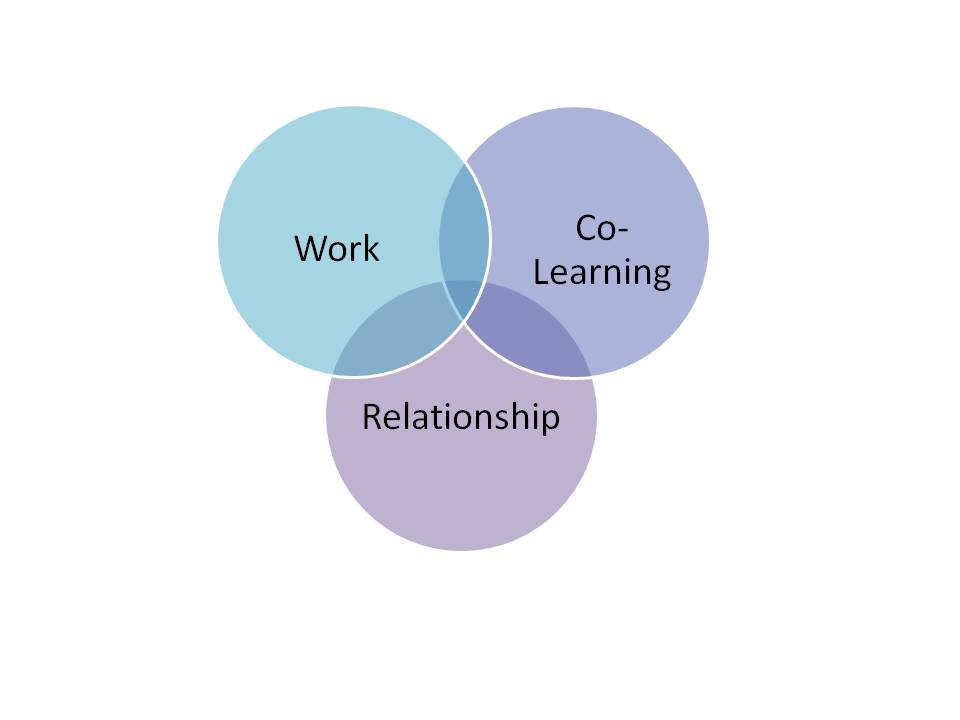
Work alone can be drudgery.  Learning alone can be a great intellectual pursuit and might lead to some shift within you as an individual but does little to generate collective learning.  Building good relationships is a good skill to have but in and of itself, you might as well be in a social club.  It is where and how work, learning and relationship intersect that creates the potential for a rich and relevant community of practice.


The intersection of work and co-learning is where innovation happens as people think about the context of their collective or co-learning in relation to work.  Ideas are generated and possibilities emerge.  Without relationship though, there is often no traction or sustainability to the innovative ideas that emerge – they simply dissipate into thin air because there is no impetus to work with them on an ongoing basis.

It is at the intersection of work and relationship that sustainability happens.  And not just any relationship will do.  The relationship needs to be of good quality, filled with respect, trust and deep caring for each other – the quality of field that enables divergent points of view to be expressed, where passion for the conversation, the work, the future and friends is welcomed.  Friendships we will fight for and support.  We don’t necessarily start there but how beautiful when we tend to the relational field with such care and intentionality that so much more can spark without risk of offending anyone, without having to tiptoe around the conversations that are most necessary in our learning, relationship and work.  These are friends with whom we will venture into unexpected places, uncertainty, emergent fields and creative explorations as well as nurture and cultivate the innovations that most spark our  passion and curioisty.  When these people call us because they need something, we respond.   Sometimes we drop everything else and respond.

Powerful friendship, kinship or mates is fostered in the place between relationship and co-learning because part of what we are learning is how to be together in new ways that break old patterns that have defined relationships, at work, home or in other places where we make contributions and commitments – patterns like hierarchy and culture,  old ways of moving work along,old ways of meeting and of thinking about meeting agendas, conferences or programming.

One of the key reasons we want to shift our relationships, aside from the experience of feeling better, working more effectively and enjoying showing up at work and projects is to focus them on achieving something meaningful and relevant in the world – maybe systemic change, maybe some smaller initiative. Otherwise, nothing happens.   We are at such a pivotal time in our human evolution on this planet, a Community of Practice will be most meaningful when we bring our relationships and collective learning  to bear on the shift we are wanting to create rather than putting up with the shift that just shows up.

Having now been in several conversations about community of practice, most recently with emerging leaders in Halifax – none of whom are following conventional career paths,  this model becomes extremely helpful in focusing on the purpose of a community of practice, especially as conversations tend to veer to one component or the other.  The power in the model is that it reminds us that each of these elements is fundamentally important to shifting patterns of work, organizations and communities, as well as individual patterns of relationship.

Communities of Practice could and will be many things – defined by the people who gather in them.  There is some core that attracts people into them – it could be creating an active practice ground in a community or organization for new skills, a safe haven in an environment that seems resistant to new work and new ways of working, an opportunity to grow individual and collective capacity.

The ones I’ve been part of seem to have an energy and magnetic attraction of their own that keep people showing up, an ease of flow and relationship, shared leadership and shared responsibility.  Nobody has to make them happen, they almost seem to make themselves happen.  They are fun.  People who show up really want to see each other, be with each other and dive into deep places within themselves and with each other.  There is some intentionality applied and the CoP is able to follow the path of emergence that points to what needs and wants to happen next to be most meaningful to work, relationships and learning.  Many of these CoPs don’t just know that something different is possible, they are beginning to demand it and showing up together, cultivating deep relationships and imagining what is possible that none of us individually might have imagined on our own while growing skills to support what we are envisioning is one way of creating movement, maybe even creating a movement.

I’ve Arrived – At Least in This Moment

I’ve arrived.  I didn’t know this was where I was going but, now that I’m here, I can clearly see that this is where I was headed.  Feels good to have arrived.  In this moment anyway.  In the next moment, it might be different. That will be okay too because there will always be a next moment and I get that I get to create or co-create the next moment and the next.

By moment, I mean a period of time, linear time as we know it – maybe just a minute, maybe days, weeks, months or even years.  When it is a tortuous moment that goes on for awhile it doesn’t seem like this moment, it seems like an eternity.  I’ve had a few of those too. Looking back now over the course of my life, I see them for what they are – moments, in time, moments that reflect my journey and shape my life, my outlook, my wisdom and my experience.

Now, though, I seem to be in a moment of amazing open heartedness.  I’m just back from a run in my neighbourhood that takes me to a waterfront park and boardwalk and back again.  Every time I smile, nod or say hello to someone I pass, I crack open just a touch more.  And, so do they.  The moment might pass for them, but more and more I am finding this moment in my life lingering.

I like the feel of this moment.  The joy.  Delight.  Ease.  Beauty.  Love.  Flow.  Noticing my emotional state.  Noticing my reactions. Noticing where or what next to focus on in my own healing journey.  Not in the tortuous way I used to notice it.  Now it is just a noticing.  An observation.  A clue to what to pay attention to.   “Oh, look at that response.  Maybe there is something there to take a look at, a hook to release, an attachment to let go of.”  Surfacing.  Surrendering.  Swift, powerful movement arising all around me, in me, through me.

It is visible to me.  It is continuously reflected back to me because it is visible to others and I am open to receiving in whole new ways.  Some people comment.  Some just notice.  Some come closer.  Some rejoice with me.  In the people close to me, I see how much they love me and I feel how much I love them.  Feeds gratitude, appreciation and joy over and over again.

I have always believed in the Law of Attraction.  I have also understood that I have attracted even the things, people, situations I have not liked (and sometimes detested)  into my life.  Wanting to understand deeply the why of that was one of those moments of determination that led to many moments of revelation over a very long, tortuous moment in my life.

I tried to make the Law of Attraction work and at times I probably gave up – almost anyway – on being able to force it work in ways that work for me.  There are times it practically pounded me on the head while I was looking in other directions, focused on the how of things instead of the surrendering into things where truly miraculous “hows” could then show up in ways I could never have imagined.

Through the continuing journey I am learning how to allow, embrace, surrender and step into it.  Coming from a place of love, joy and delight.  Which is very different than coming at it from a place of desperation.  My favourite Law of Attraction material at the moment is Abraham-Hicks.  I have been infusing myself with their teachings.  One of the things they say is that whenever we want something, that something is actually two things – what we want and the lack of what we want.  Usually we are focused on the lack and not on what we want and we are desperately, pleadingly trying to convince ourselves, through stress and agony, we are focused on what we want.  Focusing on the lack brings, surprise, surprise, more lack.

They also say a belief is simply a thought we think over and over again.  So, I’m becoming aware of my repetitive thoughts so I can shift them and shift the shape of my life more and more to what I want.  Since really embracing this,  I am seeing and, more importantly, feeling the results.  In this moment, I’ve arrived.  I like this place.  I’m not exactly sure where I am headed next but now I know I’ll recognize it when I arrive and I know it will be even better than the place I am in in this moment – as hard as that may be for some to believe – I am aware that life, if I allow it, will only get better and better, no matter how good it is right now.

While I’m in this moment that I’ve arrived in, I’m taking some time to celebrate.  To notice flow.  To appreciate deep relationships.  To see how well cared for and nourished I am.  And maybe tomorrow, when I’m out for my run or grocery shopping or wherever my day may take me, maybe you and I will find each other, smile, nod, say hello, embrace if we actually know each other, say I love you if we are in deep relationship – and both our worlds will crack open just that much more and we will know that we have arrived – in this new moment, for the moment.

Turning to Each Other in this Time of Chaos

My news does not, for the most part, come from mainstream media.  Long ago I stopped reading the papers and watching TV news.  Far too depressing and non-constructive.  My news comes from other sources like the Art of Hosting listserve that I am part of (and you could be too, if you aren’t already) as well as other social media like Facebook and Twitter.  I am grateful to these sources and the friends I know in each of these media for the sharing of stories and events that show us all the courage, humanity, connection and community that we all know exists beneath and beyond the news coverage.

Government and related agencies, politicians, the news media do not know what to do.  They do not know how to respond to the mounting chaos in their countries and their communities.  They do not have answers – we all know this – and they are afraid to admit it, so rely on strategies that not only don’t work but actually contribute to making the situation worse (beefing up police presence as an example).  As one person from England suggested on the AoH listserve, wouldn’t it be wonderful if someone in a position of authoritative leadership would be able to see, voice and make more visible the larger patterns that are at work. Borrowing from his posting:

“We must now ask deeper questions. Why do so many young people believe it is alright to cause such destruction and distress in their communities? Whether it is ‘copycat’ activity or not, why is it happening? What does ‘community’ mean to each of us?  Across the country people are self organising, they are meeting in groups and cleaning the streets. Leaders are emerging. People are talking to each other. This is true community.”

If we are not seeing the kind of leadership we know is needed from our formal leaders, how do we continue to do this work in all the places we, ordinary people all over the place,  show up and influence where we can.  Let’s not undervalue our own systems of influence or own readiness to do what we know works – even if this is “simply” holding space, holding intention, infusing with love the situations and people we know about and the stories that touch us deeply – no matter where they or we are.

I read all the posts on what’s happening in London, Spain, Greece, Egypt, the US and other places from the perspective of ordinary citizens, friends and colleagues around the world who see the human story as it evolves, who sharpen their awareness of the relational field and the growing power to effect large scale systemic change from this place as well as individual one-on-one relationships – holding heart break and growing open heartedness, even in the chaos.  I share these stories with people I know who are not part of or even aware of these conversations.  It makes people hopeful.

My own hopeful heart continues to expand for every post I read.  There is a lot of trauma in this time but if that is what we, the world, needs to be able to see just how much the systems we have created or supported or just lived in do not work for us anymore, then we need to go through this to get to what lies on the other side.  I am imagining, working toward and living into a world and systems that emanate out of love, loyalty and community in the relational field because if we cannot turn to each other in our joy and our agony, there is no one else.  If we cannot turn to each other, we will not create systems that support life and resilience, courage and vibrancy.  If we do not turn to each other, we will live only in fear and isolation that propagates more of what we don’t want.

Everyday I experience encounters with people who are more and more ready to turn to each other, more and more ready to understand life as more than just the physical components that we see, more and more ready to embrace uncertainty and live into resilience, more and more ready to open their hearts in a time when the media reported news events might cause us to want to close our hearts and shut down, more and more ready to be intentional about shifting the shape of the world.  I am holding space for the courageous, the open hearted, the heart broken, the resilient, the cracks, openings and invitations.  I am working and writing where I can in support of a future I want to see emerge out of the chaos we are in these days.

From my heart breaking, open hearted journey to yours.