Unknown's avatar

About Kathy Jourdain

Kathy Jourdain is a co-founder of Worldview IntelligenceTM consulting, curriculum development and program offerings as well as a steward and practitioner of the Art of Hosting Conversations That Matter. This has her traveling internationally working mostly in Canada, Brazil, Europe and the United States. In 2009, she launched Shape Shift Strategies Inc. for her consulting practice. She is an author and keynote speaker. Her first book, Embracing the Stranger in Me: A Journey to Openheartedness has been hailed as an inspirational, deeply authentic sharing of the journey that has contributed to who she is today. She is contributing author to Gift of the Hit where she shares the story of her own soul journey with her mother, dementia and death.

Reflections on the Art of Collaborative Leadership

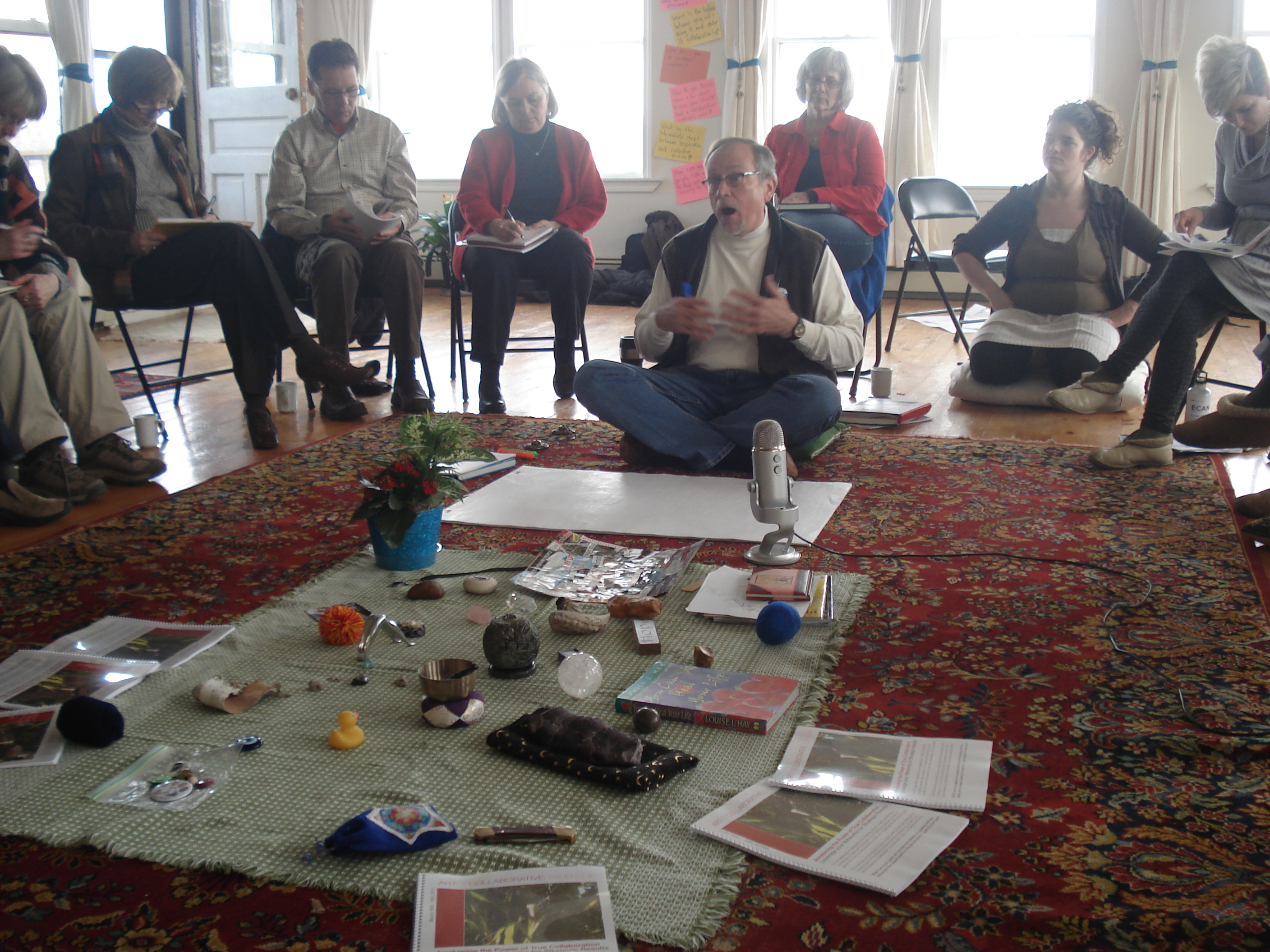
A week after the Art of Collaborative Leadership it is still hard to find the words to articulate the fullness of my experience in a succinct and coherent fashion, there were so many facets at play.  This post will focus on three: crossing an intergenerational divide, hosting the energetic component of dynamic space  and strategic results.

Intergenerational Composition

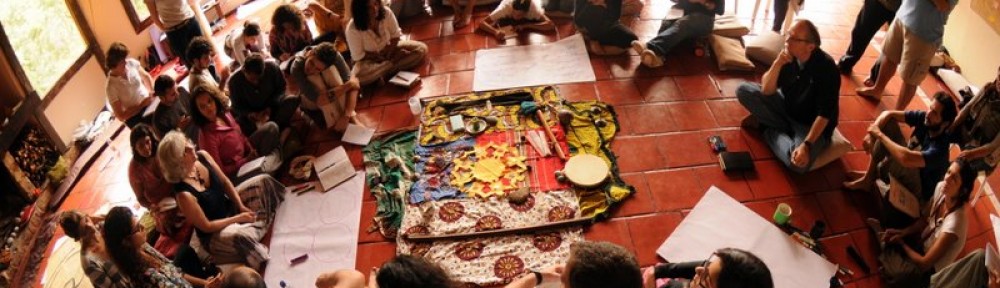
When we looked around the room at the 22 of us gathered at Pottery Lane, a beautiful day retreat centre right on the Northwest Arm of Halifax, we noticed that there was a pretty even representation of younger and older people (older being mostly around my age, give or take a few years).  In my own experience, this spontaneous even mix of generations has not happened before.  The gatherings I’ve been part of have generally leaned in one direction or the other.

This made the hosting team of myself, Jerry Nagel, Sophia Horwitz, Rachel Derrah, Ryan Deschamps and Marcello Lacroix (supported on the rim by Nancy Eagan and Martin Siesta) curious.  We became aware that the composition of our group was directly related to the composition of the hosting and calling teams and I realized this was likely true of all the hosting teams I’d been on.  As an example, in Brazil last October, the local callers and hosts were all young and the majority of people who showed up were young.  In the future, I know I will be paying even more attention to the composition of the hosting and calling teams in relation to the purpose and intention we are calling in and the richness of the intergenerational exchange.

Hosting the Energetic Component

The hosting team noticed early on in our three days that the energy in the group (showing up through individuals of course)  seemed at times fiery, at times disenchanted, at times hopeful, at times curious – and most often all of those things at the same time.  The energy seemed to be jumping all over the place – like soap bubbles floating in the air and popping.

It caught our attention and we began to wonder just exactly what was in the air and how to hold the space with lightness, intentionality and discernment.  In writing about it now it all sounds very professional, easy and sage.  In the moment, it requires intense presence to tune into what is in the space without overreacting or pouncing on individuals who bring very diverse perspectives but allowing all of it to show up in the room, while at the same time deliberately inviting in the opportunities and space for people to practice new skills they are learning in the moment.  A good reminder (if I needed it) about why it is important, even imperative, that we never host alone and that we create beautiful and strong relationships with our co-hosts so we feel fully supported and are able to observe the space from many different points of view and experiences.

In our design of the three days, we had already decided to invite participants to go on a silent hour long walk after lunch on day 2.  As we debriefed at the end of day 1 and talked about the energy in the room we needed to decide how far to delve into the energetic dynamics that were showing up so we could clear the air, wanting to balance it with our clearly stated purpose of learning more about collaborative leadership and the conditions that support it and carving out time for people to take projects and ideas they had walked in with to the next level of thinking and clarity.

We decided we would take half of the hour long walk and invite a dyads conversation, asking people to share with each other where they were experiencing tension and where they were hopeful.  We began to wonder if there was intergenerational tension in the room, so we further determined we would ask people to pair up with someone not in their age group.

The invitation into this walk became a defining moment of our collective experience.  As people were invited to pair up with someone not in their age group you could see the uncertainty as they looked around the room, wondering who on earth they were going to pair up with and who would do the inviting.  It was a momentary collective holding of the breath, obvious to all and quickly surpassed.

People walked and talked.  And when we all arrived back into the room, something had clearly shifted.  The energy had settled down and the room was even more ready for the learning that was to come.  Intergenerational tension was not the only factor in the tension in the room but the dyad conversations became a leverage point for releasing various aspects of the tension.

Strategic Results

We moved into a proaction cafe in the afternoon and five ideas flowed into the space looking for a next level of clarity and wise action steps.  Some people came with ideas just beginning to form and others came with critical issues they would be facing as they went back to work following this training.  Some left with a beautiful level of precision on their work.

At the end of this second day, when we were debriefing as a hosting team, we reflected on the waves and weave of the day.  We knew we’d hit the summit of the experience and our last day was about arriving home well.  We recognized that we still had a day we needed to enter with deliberateness and intentionality.  The day was a mix of personal leadership and more tools, models and methodologies to help people frame their work and experience well.

We brought in a compassionate listening exercise from Jerry’s work in Minnesota, taught the new model that Jerry, Chris Corrigan and others had evolved for resourceful communities and the two loops of systems change, and did a little methods cafe.  We allowed time for people to wrap up any unfinished business with people in the room and moved to a beautiful closing circle.  There was a greater hopefulness in the room than when we began, an excitement about results and, of course, a sadness in leaving.

The hosting team has committed to calling this group back together on April 11 in Halifax.  We want to continue to learn and grow from each other.  People who live elsewhere are invited to participate from their locations.

I am deeply curious about what more will emerge from this amazing little and powerful gathering. I am grateful to the hosting team for stepping so fully into this journey with me and have experienced new levels of depth in each of those relationships, individually and collectively.  My world is forever transformed and expanded because of this gathering.

My dear friend Marcello, who had committed to coming before we were even sure we were doing this, has had a lot of opportunity to reflect on this experience and a previous Art of Hosting experience as he prepares for the Art of Hosting training he is calling in Porto Alegre where he lives in Brazil in September – the subtle nuances, the dance with energy, the focus on results and the amazing power that can show up in well cared for and well tended spaces – because all of us cared for and tended the space.

I would be remiss if I did not mention Roberto and Anke from Conscious Catering who were as much a part of our experience as the place we were in – preparing food lovingly for us.

This is just a portion of my reflection from the Art of Collaborative Leadership.  There is so much more, including the shifting shape of my own leadership learning experience from start to finish and beyond.  Many more reflections to be sure from such a rich and enduring hosting experience.
Youth Philanthropy

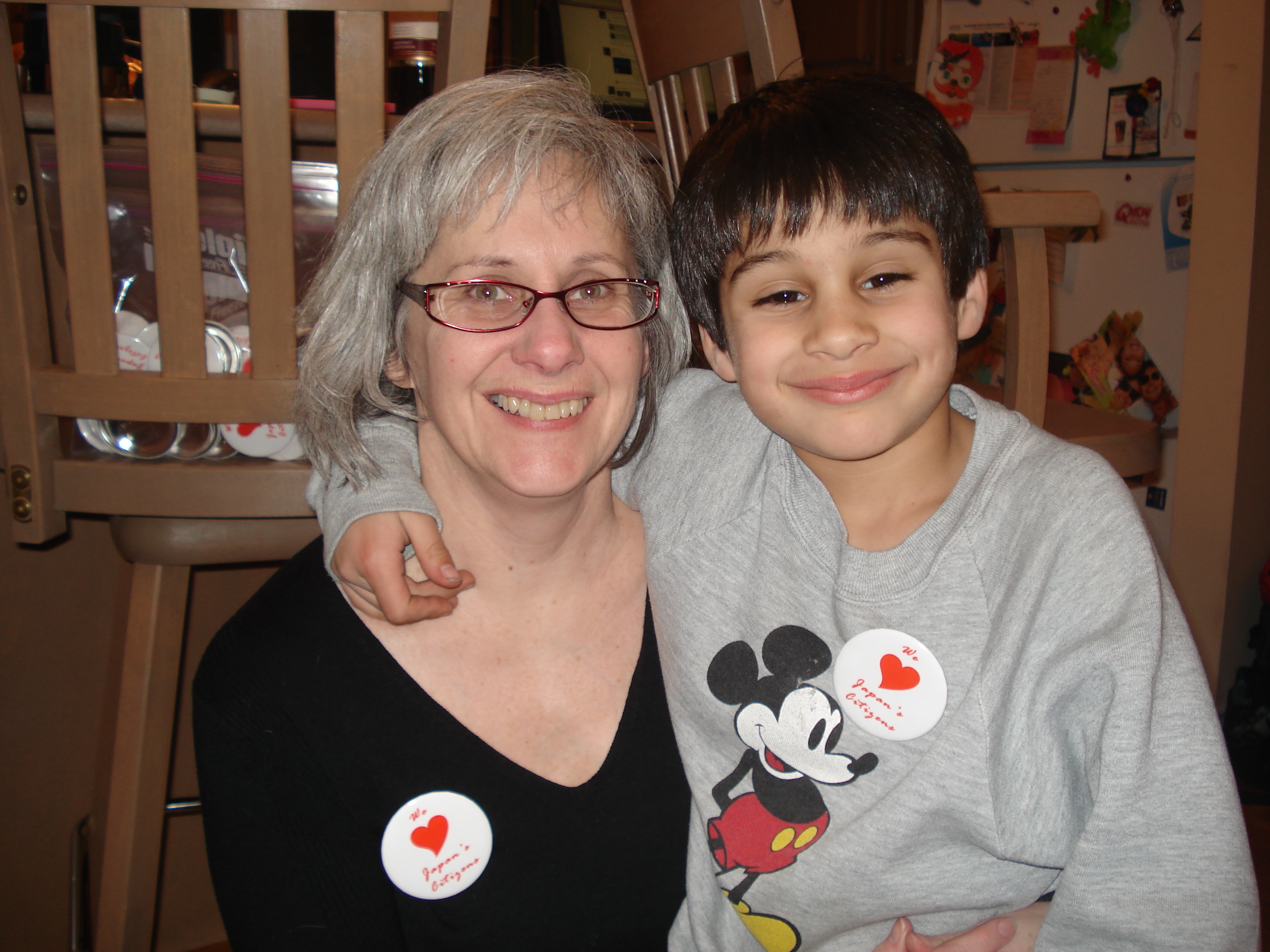
The moment my eight year old son, Shasta Tangri, heard about the earthquake and Tsunami in Japan, unprompted, he said, “We’ll have to make more buttons!”

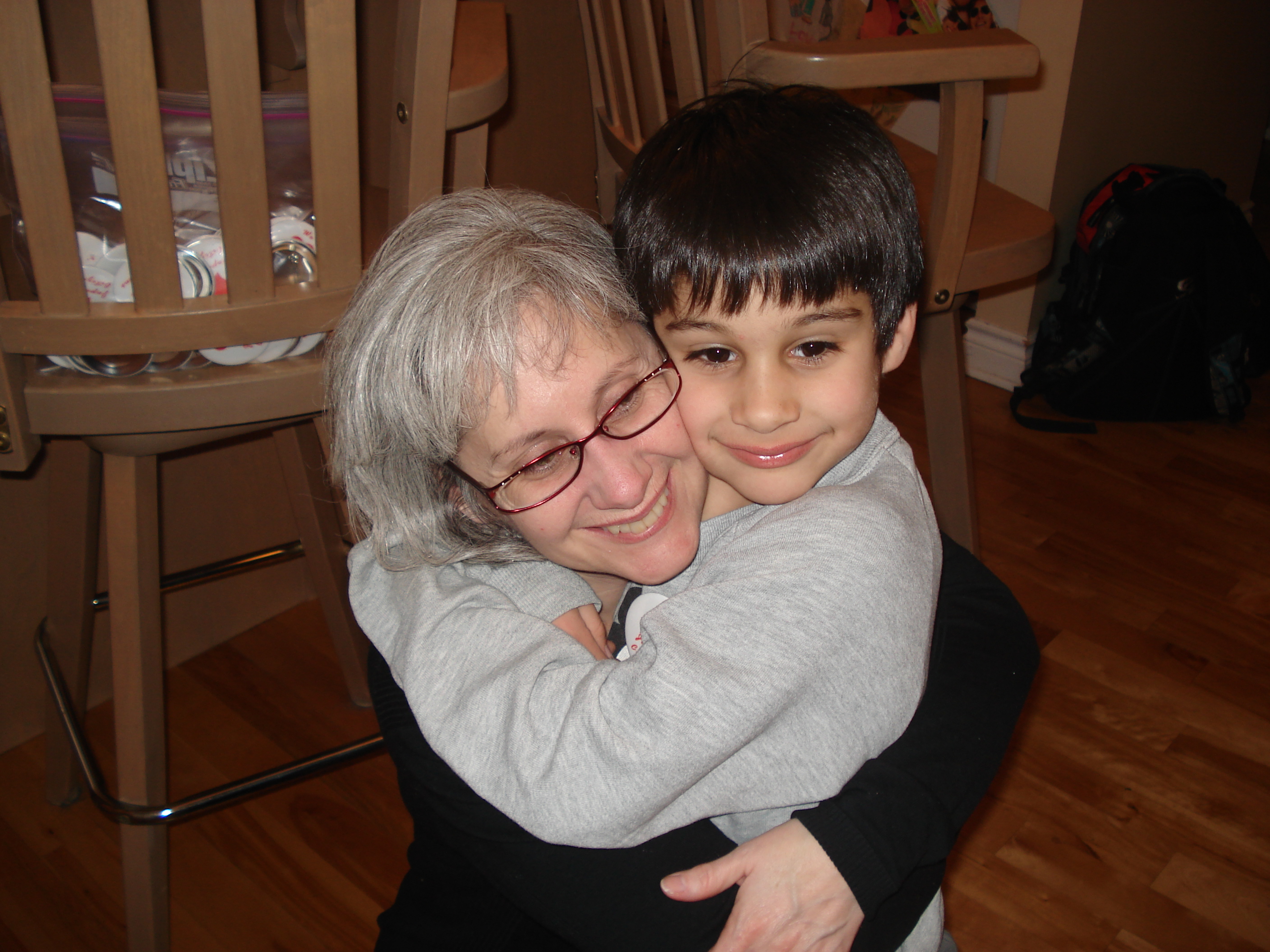
Kathy and Shasta

Shasta and me displaying the pins he created in support of Japan

In 2010 when the earthquake devastated Haiti, he decided to follow in the footsteps of his older brothers, Spencer and Jacob Dwyer.  Following 9-11 they decided to sell buttons to raise money to help the people of New York following the devastation created by the planes flown into the twin towers.  Their campaign was picked up by by friends, family, work colleagues and random strangers they met as they promoted their cause.   They raised about $1,500.00, were written about in the paper and were on television news.  Shasta knew about it because he had seen the newsclip often.  It inspired him and, of his own accord, he wanted to do the same thing for Haiti.  He sent the money he raised through to the Red Cross, his contribution was doubled by the government and he raised over $2200.

Now, he has a goal of $1,000 for Japan (he will also contribute through the Red Cross) and while it is early days I suspect he will surpass his goal pretty quickly.  He’s almost half way there after only a few days.  He is enthusiastic, unabashedly advocating for his project.  This well spoken youngster has no problem specifying his request of a minimum contribution of $2.00 and, of course, many give more including at least three people who have each given him $100.00  (I was one).

It is wondrous to see how many people respond warmly to the request made so beautifully and simply from a young man working from his heart having been touched by a tragedy affecting people half way around the world who he has never met.  It warms my heart.  Of course, I will do anything to support him in the unfolding of this path, as long it as it is one he chooses willingly and of his own accord.

A good friend of his has offered to help.  The Dartmouth Players Theatre, where he is in a theatre class through Upstage Studios,  has offered to let him have a table at their event this Monday so he can sell buttons.  His school is allowing him to sell buttons to children and teachers.  Tomorrow we will be knocking on neighbours’ doors.

As this has been unfolding in my home, I have had the opportunity this week to meet Stefanie Shute and Blair Ryan, founders of the Empathy Factory, a cool new initiative providing the opportunity for children to act on their innate generosity, developing ideas they feel passionate about so they can act on their desire to make the world a better place.

This work and these actions in my home and my community and further afield in the world continue to inspire my own deep sense of hope and optimism that we can consciously shift the shape of the world in beautiful and profound ways.  Shasta is already doing that for himself and for so many others at the same time.  What will you do to shift the shape of your world?

Shasta and me

Prototyping Collaborative Leadership at Capital Health – Citizen Engagement and Accountability

Citizen Engagement and Accountability Portfolio

In May 2009, the creation of a portfolio within Capital Health with the title of “Citizen Engagement & Accountability” presented a rare opportunity to create something that had no precedent.  The portfolio was launched in response to the strategic stream of Citizen Engagement that came out of the Strategic Quest work in 2007.

Lea Bryden was tasked with bringing together three functional areas under this new portfolio: Marketing and Communications, Community Health Boards and Patient Representatives.  In looking across the country, they found themselves virtually alone as there were no models to inform the portfolio development.

In January 2010, Kathy Jourdain and Tony Case, through Shape Shift Strategies Inc., were contracted to assist in shifting the shape of this portfolio.  The intent was to truly create a new portfolio with collective purpose, principles and streams of work and not just perpetuate the three existing functional areas under a new name.  Some of the functional work would be the same and new work would emerge through the process but all of it would be informed by the collective purpose.

This work was given context and framing by the following pre-existing pieces of work:

  • Our Promise
  • Declaration of Health
  • My Leadership: Being, Caring, Doing
  • Citizen Engagement Strategic Stream
  • 2013 Milestones

In addition to wanting to honour CEO Chris Power’s intention in asking the question: “What kind of future could we create if the vision of Our Promise and belief in our Declaration of Health showed up at each of our touch points in the course of our day?”, Lea also wanted to uncover the unique gifts and contribution of each member of the portfolio and understand how they came together as a collective.  And, it was  very much a mechanism to create a cultural shift to even greater transparency and accountability.

This process invited a design team to co-design the process.  There was initially a very specific invitation to a member of each of the three functional areas. As the process unfolded participation in the design process was completely open and transparent and those with the greatest interest and passion continued to participate in the process.  Some people showed up in the beginning because they thought they should and then kept showing up because they saw how their contribution directly influenced the design of each session.

This work took place over a period of four or five months to establish collective purpose, principles, priorities, and strategies.   It took into account other work that was underway in the organization, incorporating things like the budget planning process or the response to Capital Health’s community engagement recommendations right into the process so the portfolio could learn how and when to respond as a portfolio to other moving parts of the organization.

We knew we were making headway when we hit the groan zone.  The collective purpose and principles were articulated and we began to hear, “Oh good.  We have what we need.  Can we be done?  Can we get back to our regular work now?”  This was a signal to push back.  Lea did this by asking a simple question, “Where are we seeing evidence of our collective intention at work?”  The responses were amazing, informative and represented a turning point.

A philosophy of our work as consultants was to transfer collaborative leadership skills into the portfolio so it could flourish once our involvement came to an end.  The portfolio created a transition team to continue to guide the work and this team is also working collaboratively.

A key contributor to the success of this initiative was Lea’s willingness to foster collaborative leadership and her openness to growing her own awareness and skills in the process.

Like all significant culture shift initiatives, there are certainly bumps along the way.  But there is lasting change in the way this portfolio views itself, understands its work and engages with the public.

Prototyping Collaborative Leadership at Capital Health – Infusion

In March 2007 Capital District Health Authority (CDHA) in Halifax, Nova Scotia took on a planning process called Strategic Quest.  A significant component of Strategic Quest included public participation in an unprecedented way, shifting the shape of awareness and thinking at Capital Health.  The results were revealing and the impact continues to reverberate throughout the organization today, strongly influencing ongoing public participation in a number of areas and inviting collaborative leadership as a strategy to accomplish many of its goals.

One initiative I was involved with where Collaborative Leadership was an essential part of the process was Infusion: a gathering in November 2008 of 70 leaders from across North America, in our local community and within Capital Health, convened to inform what bold and unique leadership development within Capital Health could look like.

The planning process for Infusion, championed by Lea Bryden and led by Shape Shift Strategies, invited and modeled collaboration, shared leadership and shared responsibility.  A diverse group of people from across Capital Health were invited into the planning process.  Many identified the planning process itself as a leadership development opportunity as they experienced collaborative leadership in new ways, stretching beyond their original assumptions about how and what they could each contribute to this unusual event.

Achieving clarity of purpose was the first task.  It required a significant investment of time – several meetings.  It was a difficult task because there were multiple overlapping components all alive and unfolding as we were in this planning process.  We stayed in the conversation until sharp clarity was achieved and then rest of the planning process unfolded rapidly because it was guided by this clarity of purpose.  We also actively worked with Theory U in the planning process and for the event itself.

The planning process always had a forward momentum, even when people missed meetings.  As they came back in, they found their place in the process and continued to contribute constructively.  They could step into and out of the flow of the process without having to back track and rehash decisions made when they were not present.

The two day Infusion event drew on the talents of everyone on the planning team.  Invited guests: leaders from a vast array of backgrounds, many of whom were leadership consultants, were asked to bring their knowledge and expertise in a participatory way.  It was at times a challenging field to hold.  The team was able to hold its ground as we went through the fire of chaos, adjusting design in the moment and holding space for some anger and frustration that unexpectedly arose within the group because of the collaborative leadership we had been growing throughout the planning process.

Infusion did not end in a nice tidy wrapped up bundle and Lea Bryden, myself and the team were good to leave it that way while taking away the gems that guided the development of My Leadership – a truly unique leadership development initiative inside of Capital Health with a bold vision and goals that has since had 500 leaders complete and won a number of regional and national awards.


A 1500 Day Collaborative Journey

In November 2006, the Council of the College of Registered Nurses of Nova Scotia (CRNNS) embarked on a 1500 day collaborative journey, the likes of which they could hardly imagine was possible at the time.  What was clear was that the College had a vision and a mandate to grow inter-professional collaborative practice (IPCP) from pockets here and there across the province to a more widespread practice as one of the responses to a health care system in need of shifting the way services were delivered.

They knew this was not a mandate that could be achieved alone and they weren’t quite sure how to invite other professions into the conversation.  They contacted an Art of Hosting colleague of mine who invited me into the process and we worked with a team from the College to begin to clarify the work.

Early on we identified that this would likely be a long term process that would use Theory U to define the journey and Art of Hosting as the operating system. Before the journey could even begin, others needed to be invited into the conversation so that other people and organizations could identify what contribution and what level of support or commitment they were willing and able to offer.

The College hosted its first assembly in November 2006 to announce its mandate, speak what they were hearing in the system and being called to do, invite a broad array of health care professionals into conversations using processes like Appreciative Inquiry, World Café and circle which many participants experienced for the first time ever that day.

Out of this assembly a core team of about twenty-five people and financial support from a broad range of health organizations self identified to commit to a multi-year process that included two Art of Hosting retreats (one a sensing retreat and one a presencing retreat) to train the core team, deepen their understanding of the purpose and principles of the work and identify a strategy to move this mandate forward.  We called on Art of Hosting colleagues doing similar work in Ohio and in England to come and also support this initiative, bringing with them a wealth of experience and weaving in the stories from other places that increased the anticipation of successfully shifting the shape of collaborative health care in Nova Scotia.

The collaborators included: Annapolis Valley Health, Capital Health, College of Licensed Practical Nurses of Nova Scotia, College of Physicians and Surgeons of Nova Scotia, Dalhousie University, IWK Health Centre, Nova Scotia Association of Health Organizations (now Health Association of Nova Scotia), Nova Scotia Department of Health, Pharmacy Association of Nova Scotia, Registered Nurses Professional Development Centre and the Pictou County Health Authority.  The team included people from many of these organizations and was itself inter-disciplinary.

In between the two retreats, the core team embarked on a series of sensing strategies to broaden their own understanding of the health care system in Nova Scotia, identifying challenges and opportunities without assuming they already knew all the answers.  One purpose in this was to also engage a more stakeholders and learn from them what would capture their support, interest and imagination.  Seven group interviews and thirty five individual interviews were conducted, designed to elicit their private voice more than their public voice.  It is in the private voice that deep despair and incredible hope both reside.

The information that came back from these interviews was powerful.  So powerful it was used to invite back a large assembly of stakeholders in May of 2008 to hear the results and, most importantly, to hear the voices of the system spoken back into the room.  In response, somebody said, “What we are seeing is a crisis of the soul.”

We asked people: “What would you do that you’ve never done or dreamed of doing to change the future of healthcare?” They responded:

  • Change the way we deliver health care
  • Change the focus of health care
  • Change education of practitioners
  • Change what we say to communities
  • Change governance of health care
  • Change relationships and how we work together

We asked, “What should the purpose of the health care system be?”  To which they responded:

To create and maintain holistic, accessible support and care so that Nova Scotians may live well in a place they call home.


To facilitate and empower the individual and the community to create and maintain

optimum health as defined by the individual.


The purpose of the healthcare system is evidence based, person-focused, preventative, holistic, and uses a collaborative approach to optimize the health, safety, wellbeing and environment of people within their communities.

People made commitments that day and the College made a commitment to check back in later with their last assembly to acknowledge and celebrate progress.  That day happened in June 2010.

Six champion collaborative practice teams currently providing services in Nova Scotia were invited to present at the Assembly, modeling the way and illuminating the steps to successful collaborative care in Nova Scotia.

Have all the ideas identified in May of 2008 been implemented?  No.  But in 2010, there was far more collaborative care in Nova Scotia than there was in 2006 when the College began its quest and invited in collaborators, retaining its willingness to be a champion of this work and, at the same time, “letting it go” so that it could be co-created throughout the whole journey with those who stepped forward to share the leadership and responsibility of this work in Nova Scotia.  Other initiatives focusing on Collaborative Care also emerged during this time helping to expand awareness and the field of practice and this does not lessen the impact of the Inter-Disciplinary Collaborative Practice initiative in generating impactful responses to a system in need of change.

Some things have fundamentally changed.  Some things are still to come.

Relationship With Self: Base Point for All Other Relationships

The most important relationship to focus on, understand and heal is the one with self.  As you develop mastery in that pursuit, all other relationships automatically achieve a greater level of understanding and you put yourself in a place of conscious, intentional choice around each one.

This is a really difficult concept to grasp.  We live in a relational world.  We are always interacting with others and some people have a tremendous impact on our lives – good and bad. The Law of Attraction says we are consistently attracting to ourselves that which we focus on and tells us that we could actually attract anything we truly desire whenever we desire it.  Many of us have tried…. and failed.  I know I have.  But I have been successful too and the learning is that it doesn’t have to be hit and miss.  It could just as easily be consistently good as it has at times been consistently bad.

But in such an intertwined world how are we to know exactly how much power and impact we have as an individual?  Can’t our individual ability to attract be canceled out or muted by other people we live with, work with or are close to?  Or would we perhaps cancel out what someone else is trying to attract?  This is the question I have lived – and lived into –  for years now and even as I write this I see how either/or this scenario is.  Either I get what I want or someone else gets what they want but we both can’t get what we want unless we want the same thing.  What if it is actually different than this kind of scenario and many possibilities exist all at the same time?

I distinctly remember a few years ago feeling completely out of control and overwhelmed.  There seemed to be so many external circumstances (aka people for the most part) who impinged on my well being, my sense of self, my own competence and my clarity.  They created stress in my life, drained me of energy and fed habitual thought patterns in my own mind that I knew were not serving me and had the potential to make me gravely ill.

And I knew that I had attracted to me, and even created, even embraced, some of these circumstances.  What I had more difficulty grasping was how much of these difficult relationships and circumstances was me and how much was external to me or someone else.  And why?  Why did I attract such undesirable circumstances and relationships to myself because I would certainly never consciously have invited some of these things into my life.

Intellectually I grasped these concepts.  Living into them was a totally different story.

Then came the point, I also distinctly remember, when I knew I had to turn away from all the external stimuli and blame and turn inwards, turn off the vitriolic self talk,  to find the answers I was seeking.  Thus began an intense, deep, concept shattering phase of growth which began as an internal battle with loads of resistance and gradually shifted into a surrendering which now allows a beautiful, simpler unfolding of self and story which I embrace as part of my ongoing evolution or journey into open-heartedness.  And I couldn’t have done it without the support of a couple of different coaches I worked with over that period of time, dear friends and amazing healers.  The discovery and eventual joy in my journey was amplified because I learned to call on and lean into the support that was and is readily available to me.

I couldn’t change the people around me.  I tried.  I hoped.  I prayed.  I rationalized and bargained, “Yes, I know I’ve attracted this and contribute to it, but…..”  When I was out of options, out of hope and feeling myself slip away into a haze of oblivion I finally turned to the only relationship that I actually have the power to influence, shift and change: the relationship with self.  Sure I wanted to…. but did I have to go so deep?  Did I have to fundamentally change my views of myself and my life?  Did I have to let go of my sense of having been wronged and even harmed by others?   Couldn’t I just skate across the surface or go just under the surface?  Couldn’t I still hold onto some version of being right?  Did I have to fundamentally examine everything about me, take it all apart in order to invite the kind of dramatic change into my life I knew I was needing?  Damn.  Resistance.  Strong enough that it  required pushing through at times.

I learned, thanks to the lovely Sarita Chawla, that my emotions were the doorway into understanding what was really going on with me and I learned that when I  dissociated from my emotional state I was putting up strong barriers to the learning that was available to me.

As I broke down walls and reclaimed more and more of the essence of who I am, I began to stand stronger in the world.  I learned about healthy boundaries and I learned about allowing myself to show up more fully in the world and in my relationships.  I became clearer and clearer on what I wanted, what I didn’t want and what needed to shift in me in order for the dynamics of my relationships and my world to shift.

As I came to understand the relationship I had with myself better, I found ways to stand in my strength and my power and grew clarity about “my stuff” – what was mine and what wasn’t – and all the relationships around me began to also shift.  I found strength to walk paths I had cowered on before and I found the capacity to change the conversation.  I began to choose with who and how I wanted to be in relationship and more and more layers of protective coating began to fall away so I could show up in – and attract – more and more joy, delight, beauty and graciousness until I have come to the understanding that THIS is the baseline way of being.  Now I know that when my emotional state is anything other than joy, delight, beauty or love it is a signal to inquire into what’s going on, resolve within myself whatever needs tending to and reaching out, time and time again, for the assistance I need when I need it – because it is readily available and because we amplify possibility and healing when we do so.

I have learned more and more of the truth that it all begins and ends with my relationship with self.  When that it grounded, solid and resilient, so too is my capacity to show up in all the other relationships in my life – including the most challenging ones, the most beautiful ones and everything else in between.

Shifting the Shape of the Game

On the weekend, my eight year old son and I played mini-golf.  As I took the score card, he told me he didn’t want to keep score.  I found myself a bit attached to keeping score – what’s the point if we don’t?  But I agreed, grumbling a little in my mind.

It felt a bit strange starting, knowing we weren’t keeping score, feeling like my shots didn’t “count”.

On about the third hole, his first shot didn’t go very far.  In fact, you could probably say it failed.  He looked at me and asked if he could take it over.

Could he take it over? I realized his question was kind of pointless if we weren’t keeping score.  It didn’t matter if he “took it over” or not – it wouldn’t be reflected anywhere.  Of course, he could take another shot.

He asked the same question a couple more times and I told him it didn’t matter – of course he could.  And that was about when I realized it did matter – but in a different way than through the traditional lenses through which we were both seeing the game – me through the lens of keeping score in order for the game to have meaning and him through the lens of continuing to ask permission to re-do a shot to keep his score low.

We had shifted the shape of our game, but we both still playing by the old rules.  How often does this happen in the larger world?  How often do we continue to play by the old rules even when we know we want something different, even when the field opens up for something different to emerge.  It is only through awareness, reflection and mindfulness that we are able to fully embrace the shifting shape of the game and shape shift ourselves to flow well with the emergence that then becomes available.

In that moment of realization, the potential of the new “rules” opened up.  Not only could my son re-do a shot, but he could now “safely” develop his skill at the game without feeling the need to “cheat” to try to keep his score low.  So instead of sliding his ball into the hole, now he could “risk” hitting it to see what happened and learn how he could improve.

It was just a game of mini-golf — and it was so much more than a game of mini-golf.  Grateful to this youngster who is such a teacher in my life.

Art of Hosting: Example of a Collaborative Network

The Art of Hosting is an example of a collaborative network.  It’s not the only one but it is the one I am most familiar with and it is the one I find myself speaking about most often when the topic of new models of organization or business comes up.

The Art of Hosting network emerged organically, even before it was called Art of Hosting (AoH) as practitioners of dialogic processes gathered to inquire into what it was they did that was different and what were the conditions that contributed to their successful consulting or process work.  They created the conditions for relevant and meaningful conversations to occur in such a way that the conversations individuals, organizations and communities had were different and more impactful than the ones they traditionally had had and where wiser, more informed action often emerged.

As trainings were offered – always co-hosted by a team, they were a place of co-learning and open source sharing and such a meeting of mind, heart and spirit that people naturally wanted to stay in touch to continue sharing and learning.   Teams of hosts were invited into the same work together and variations of these host teams emerged as people newly introduced to AoH who wanted to deepen their understanding and practice began to call AoH trainings and join host teams.

Somewhere along the way, the AoH listserve was born and, as is typical of listserves, there are sporadic bursts of activity around themes that catch fire among some list serve members and there is also silence for some periods of time.

There were always people who carried a deep curiousity about this work and what, for many of the AoH practitioners I know, is a sense of deep calling.  They – we – work together often, deepening learning and often find each other at other gatherings like, for instance, ALIA.

From early on the notion of stewarding began to emerge and there have been many conversations along the way about what is stewarding, what is a steward, who is a steward, what is the AoH, how do we protect the integrity of this work, is there a brand, what do we do when someone calls an AoH training and no one in the network seems to know who they are.  These kinds of questions are integral to gatherings of stewards – practitioners who do not just use the AoH in their work but tend to the larger field.  A steward seems to be someone who understands deep within themselves what we call the DNA of the AoH – the formative field from which the AoH emerged.

Over the last decade, the number of AoH offerings has grown exponentially through public offerings and through client work that many of us are engaged in. These offerings have now occurred literally around the world, although not in every country yet.  We have experimented with forms of AoH like the Art of Participatory Leadership, the Art of Collaborative Leadership, the Art of Social Innovation, the Art of Harvesting, the Art of Protection, the Art of Humans Being and I’m sure there are more.

The AoH network is not without its faults or its own shadow.  It resists defined structure, hard and fast rules and continues to be organic despite calls from time to time for definitive answers.  It resists responding in traditional ways and roles.    Not everyone is happy with the way it works. And it works exceptionally well.

There is no central office and there are no staff.  While not a perfect system, AoH host teams are invited to share a percentage of the revenue earned in trainings to help support the technology that is key to connecting this global community and to offer something to those in this network who host this on our behalf.  And any of us can also contribute personally.

The AoH community is held together by a strong sense of purpose and principles in the work, a commonality of language and practice and core methodologies, processes, and world views. We understand that before we can host others, we must host ourselves and that we grow the body of knowledge and our own knowledge and practice through communities of practice.

It is easy to find people to work with on small and large projects and on systemic change work because there is such a strong alignment of principles and values.  I’m a sole practitioner but I’m not a sole practitioner because at any given time I either draw on the body of knowledge of the AoH or the mates I have in this network.  I have the privilege and benefit of often working on international hosting teams – here and elsewhere.

As the network grows, the sense of caring for the core of the AoH grows stronger amongst those of us who feel we are stewarding something here,  recognizing that it is completely impossible to control how it spreads, nor would we want to.  That is both the beauty and power of it – and the frustration.   It is a chaordic organization.

When we come together as teams to work together there are no hard and fast rules but there is certainly a sense of honour and integrity in relationships and of patterns of hosting and relationship.  We operate by agreement and we determine who and how host team members get paid by agreement achieved in conversation each time we gather.    People who are not part of this network sometimes have a hard time understanding that we don’t necessarily need a written contract to work with each other (like when one of my good friends was trying to get into Halifax to co-host with me and others and the customs officials asked several times to see the non-existent contract).

We care deeply about this work, about this body of knowledge, about this community and about the relationships we have entered into that are enduring for many of us.  We have a lot of conversation – purposeful conversation.  We don’t have a lot of structure.

A lot of information on AoH can be found on the website and on the community ning.  What I’m offering here is just one version of a very large story, the beginning of which I did not actually witness.  I don’t think this form of organization is the right form for every organization but with the clients I work with who are in a question of what next and how to structure their organization, I offer it out as an example to take some learnings from.  I also talk about World Cafe and Berkana, among others, as organizations experimenting with different organizational models.  Built on trust.  Built on relationship.  Purpose.  Principles.

And, it will be one of the collaborative networks used as an example during the Art of Collaborative Leadership next month in Halifax as we explore the conditions that foster good collaborative networks and what their role is in shifting the shape of the world.

Creating Conditions for Collaborative Conversations

Collaboration is a process where two or more work together with deeply held collective intention and determination to reach a shared objective.  As  the planning for the Art of Collaborative Leadership (March 16-18 in Halifax) begins, we are becoming even more curious about what it really means to be collaborative, the leadership or relational skills that foster collaboration and the subtle changes that can shift the shape of a relationship from defensive, tentative, co-existing or cooperative to collaborative.

The opportunity for collaborative relationships begins to show up when we recognize there could be more power or strength in creating a collaborative space or action.  It also begins to show up when we become curious about what more could happen if we could generate a space of shared understanding – although that usually starts from a place of  “I wish they understood us and our point of view better.”

If we want to change the nature of our conversations with others, we first need to change the nature of the conversations we have with ourselves – personally and/or organizationally.  What would need to shift in how you think about potential collaborators in order to open the space for a collaborative relationship to form and then deepen so it has the potential to create sustainable and fundamental shifts in the area/work/system you care about?

What are the different dimensions and depth of collaboration?  What does it take to stay in a collaborative relationship, especially during the episodes of difficulty that often challenge our understanding of the relationships we are in?

These are some of the questions we will be inviting into the Art of Collaborative Leadership.  What about you?  What questions are you holding?  Will you share them?  Will you come?

If you want to come, you can register at this Berkana site.  If you can’t come but want to contribute you can follow the conversation on Twitter using #a0cl or at the Art of Hosting Community Site.