Shaping Powerful Questions

One of the most asked questions at, and after, any Art of Hosting training is about the questions.  Developing powerful questions is a crucial element to creating the conversational space we are seeking.  People are hungry for greater understanding of how to create questions, especially after they’ve tried a check-in, check-out or cafe experience that didn’t quite have the intended result or impact.

Sometimes powerful questions appear, almost like magic.  We know they are powerful because we feel them.  But usually they are developed and shaped with great care – and often co-created with others.  It is not unusual for a whole planning meeting (and sometimes more) to focus just on question development for a process – which may seem a bit crazy until you’ve had the experience of well formulated questions in comparison to sessions where questions have not been shaped with the same care.

This post contains general thoughts on the shaping of powerful questions.  Later posts will focus on specific processes where questions are used, like check-in and check-out, World Cafe, Open Space, Appreciative Inquiry, Dyad and Triad Conversations and Deep Sensing Interviews.

Three Dimensions of Questions

In an Art of Hosting training in South Dakota this past July, was the first time I heard the three dimensions of powerful questions, coming from World Cafe work and community of practice.  The three dimensions are: scope or scale of the questions, assumptions in the questions and construction of the questions.

What is the scope of the question you want to ask?  If the scope is too big it may shut down conversation (how do we create world peace?) but you might want your question inspirational enough to allow people to gaze higher than they might otherwise (how have you created peaceful moments for yourself/your team/work/family? How could you do that more often or in a different setting?)

People tend to rise to the assumptions made in the questions so it is good to both notice the assumptions being made in the question and also to be intentional about them so the work is more appreciative and aspirational in service of purpose and intention and the greater work being tended to.

In considering how we construct questions, there is a continuum that flows from less powerful to more powerful.  The less powerful questions are ones that can be answered with a yes or no.  Moving along the continuum, more powerful questions begin with when or who.  The next level are questions that begin with how or what and even more powerful questions sometimes begin with why. I say sometimes, because sometimes the why questions also entrench people in their point of view if asked in such a way they invoke defensiveness.  Ask why questions in ways they evoke curiosity and then you’re onto something.

There is a timeliness we generate when we put the word “now” in our question.  “What you noticing now?”  “What has your attention now?”

Purpose and Intention

A key factor in question development is what is the purpose and intention – of your gathering, your meeting, the particular process the question is intended to shape or provide context for, the question itself?  What is the work you want the question to do and then what is the simplist way to ask the question? Purpose and intention is so central to question development that we go back to it again and again.

Language and Shaping

I like to use as much present and active language as possible.  Instead of asking, “What did you learn from that experience?” you might ask, “What are you learning from that experience?”  There is a supposition built into the question – that the learning is active and ongoing. If that fits the purpose and intention of the space you are wanting to create that’s great.  If not, a question targeted to the learning and conversation you want to encourage would be better.

If you are wanting to move in a certain direction, then create questions that presume in the direction you want to go.  “What is the shift you imagine will happen once you leave here and begin to apply what you’ve learned?” This question presume you want a shift and that you will put something into practice post the training.  For some it will inspire their imagination. When it doesn’t inspire someone, they will usually say so without detrimentally affecting the responses of others who are feeling inspired.

It is also okay to take a pulse of what’s happening in a group or process without assuming a direction.  This is particularly helpful when you want to sense into where a group is at, what you need to pay attention to or what might be simmering under the surface.  It is good to have people in a group name their experience sometimes without trying to shift into a particular direction.  The information that surfaces is then helpful in shaping design or process informed by what is present in the room or group, tracking always toward the purpose or intention of why you are in this conversation or work.  Sometimes diversions are necessary to ensure we get to where we ultimately want to go. You could ask a question like “What’s sitting with you now?”, “What question’s are percolating?”  Sometimes I might even ask, “What tension is arising in you at the moment?” but only if I am really sensing tension in the room, wanting to surface what’s there but not create it if it isn’t there to begin with.

Nuances in Question Development

Slight nuances in a question can lead to very different conversations. This is why we often sit with the questions we have drafted and imagine the kinds of responses a question might evoke, noticing how changing the question slightly could generate a different conversation.  Some examples: “What are you noticing in your environment right now?” compared to “What are you noticing in your environment that relates to this project?”  or “How have you been since we last gathered?” compared to ” How has the last gathering impacted you and your work?”  The first version of these questions is far more open ended while the second version is more targeted to purpose and intention.

Co-Creating Questions

It is hard to create really powerful questions all by yourself.  It is much more fun and generative to co-create with others what the questions could be.  Then when a nuance is discovered that makes the question more powerful, the whole group feels it, not just one person.  Collectively we know we’ve gone to a new level of depth.  When we co-create the questions we can start in the ball park of what we want to do and, through the conversation, discover what those nuances are that increase the the capacity of the conversations we are inviting to be meaningful and relevant to the participants we have engaged and the purpose for which we have engaged them.

Powerful questions can shift the shape of an individual and their pattern of thought, a team and its dynamics, an organization and its usual ways of thinking about things.  Imagining they can even shift the shape of the world….
Play is an Attitude

I am becoming more and more serious about play – as an attitude as much or more than as an activity.   These days I’m reflecting a lot on the Law of Attraction, abundance, energy, flow and what blocks flow.  I have been soaking up Abraham-Hicks and their teachings on the Law of Attraction.

Things like worry, stress, fear, negativity, seriousness of character all get in the way of attracting what you want in your life – anything that constricts the essence of who you are slows down the manifestation of what you want.   Anything that gives relief – laughter, joy, love, delight, hope, fun, playfulness – all fuel a vibration that attracts to you what you want to manifest, contributing to expansiveness.

There was a time, a long time ago, that I used to have fun and be fun to be around.  Wherever I was, there inevitably was laughter.  And somehow, when I was distracted by the seriousness of life, running a business, being in relationship, raising children, my natural joie d’vivre slipped away until all that was left was this grave seriousness, worry, fear and strain.  My world and my energy became more and more constricted and flow was blocked off.

One day, I noticed.  I looked up and looked around and I noticed I was all seriousness, intensity and negativity and lacked any sense of joyfulness or play in my life.  Couldn’t even really remember the last time I had laughed out loud or had any sense of fun. How had that happened?  Little bit by little bit the shape of my life had unintentionally and, in some ways, unwillingly, shifted. I was deep in my own shadow.

That day, that observance, marked the beginning of a long road back to joy.  I was blown away by habitual patterns, belief systems that locked me into seriousness and the impact of the voice of my inner judge.  I learned about the voracity of my inner judge by working through the book Soul Without Shame, learning how to identify and disempower it.  While it still shows up, it has less impact for much less time.  I have learned about understanding my emotions as a guide to my experience and as an inner guidance system.

Over the last few years I have been picking away at of the things that have constricted my energy and constricted flow in my life.  I have been opening up to a greater sense of expansiveness and to taking risks and this has been accelerating.

And, I have been learning about play and playfulness.  When I’m leading workshops, playfulness hasn’t been my strong suit.  I rely on other team members to bring that element.  I bring depth and intensity of connection to group process and I do it well.  What is being reawakened in  me is the idea that play doesn’t have to be an action, it is an attitude that opens up or shifts energy in individuals and in groups and particularly in me.  I have been observing how it galvanizes attention and curiosity in the best possible ways even in a room full of strangers.

I have witnessed the impact of play as an attitude in social settings, at home and in the work I do. It is infusing the relationships I have, and even chance encounters.  Play as an attitude brings with it a greater capacity to risk putting myself out there more, risk being wrong, risk trying things that might not work, risk showcasing the imperfection of being human.  It means the willingness to try without needing specific results to show up as proof of success.  Everything then becomes a learning situation which, oddly enough, then contributes to breeding success – and in beautifully fun ways rather than with a seriousness that brings everything down.

Play as an attitude encompasses joy, delight and expansiveness.  It opens up channels for Law of Attraction to work in  favourable ways, bringing wanted things into being.

Now, I smile more even when I’m alone.  I’m enjoying the expansiveness in my own vibrational frequency.  I am more energetic, eager and focused.  All because I am understanding play as an attitude.  I can still be really serious about my work, the integrity of all my relationships and the responsibilities I hold.  But when I infuse them with an attitude of play I bring alive two of my favourite rules – Rule 6a and 6b:

6a: Don’t take yourself so f—–g seriously!

6b: Don’t take other people so f—–g seriously!

These are two rules I have had to be reminded of often for a long time and now they are becoming integrated into my being along with the delightful attitude of play.  What things can you bring an attitude of play to that would enable you to shift the shape of your experience?

Reflections on the Art of Collaborative Leadership

A week after the Art of Collaborative Leadership it is still hard to find the words to articulate the fullness of my experience in a succinct and coherent fashion, there were so many facets at play.  This post will focus on three: crossing an intergenerational divide, hosting the energetic component of dynamic space  and strategic results.

Intergenerational Composition

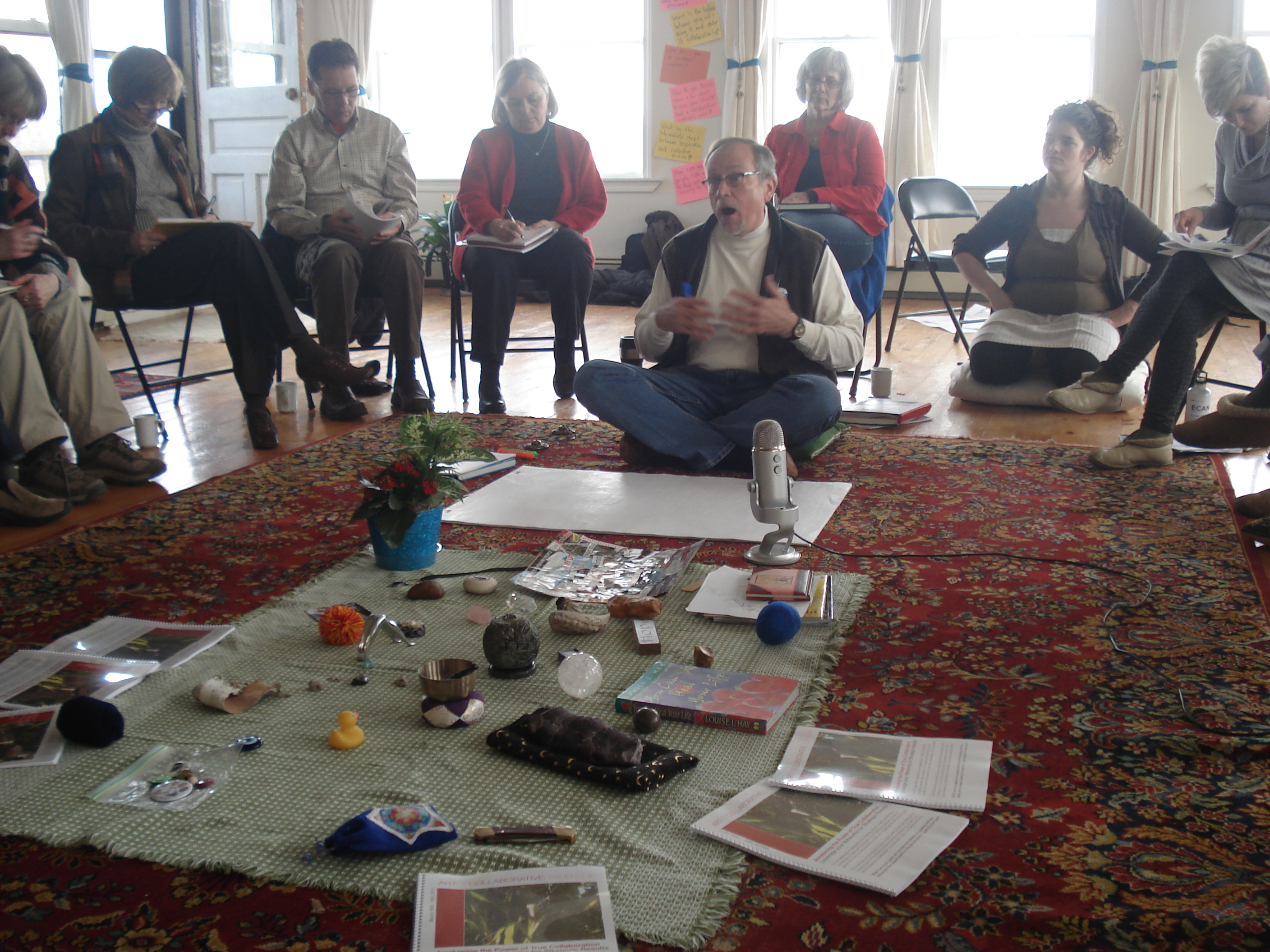
When we looked around the room at the 22 of us gathered at Pottery Lane, a beautiful day retreat centre right on the Northwest Arm of Halifax, we noticed that there was a pretty even representation of younger and older people (older being mostly around my age, give or take a few years).  In my own experience, this spontaneous even mix of generations has not happened before.  The gatherings I’ve been part of have generally leaned in one direction or the other.

This made the hosting team of myself, Jerry Nagel, Sophia Horwitz, Rachel Derrah, Ryan Deschamps and Marcello Lacroix (supported on the rim by Nancy Eagan and Martin Siesta) curious.  We became aware that the composition of our group was directly related to the composition of the hosting and calling teams and I realized this was likely true of all the hosting teams I’d been on.  As an example, in Brazil last October, the local callers and hosts were all young and the majority of people who showed up were young.  In the future, I know I will be paying even more attention to the composition of the hosting and calling teams in relation to the purpose and intention we are calling in and the richness of the intergenerational exchange.

Hosting the Energetic Component

The hosting team noticed early on in our three days that the energy in the group (showing up through individuals of course)  seemed at times fiery, at times disenchanted, at times hopeful, at times curious – and most often all of those things at the same time.  The energy seemed to be jumping all over the place – like soap bubbles floating in the air and popping.

It caught our attention and we began to wonder just exactly what was in the air and how to hold the space with lightness, intentionality and discernment.  In writing about it now it all sounds very professional, easy and sage.  In the moment, it requires intense presence to tune into what is in the space without overreacting or pouncing on individuals who bring very diverse perspectives but allowing all of it to show up in the room, while at the same time deliberately inviting in the opportunities and space for people to practice new skills they are learning in the moment.  A good reminder (if I needed it) about why it is important, even imperative, that we never host alone and that we create beautiful and strong relationships with our co-hosts so we feel fully supported and are able to observe the space from many different points of view and experiences.

In our design of the three days, we had already decided to invite participants to go on a silent hour long walk after lunch on day 2.  As we debriefed at the end of day 1 and talked about the energy in the room we needed to decide how far to delve into the energetic dynamics that were showing up so we could clear the air, wanting to balance it with our clearly stated purpose of learning more about collaborative leadership and the conditions that support it and carving out time for people to take projects and ideas they had walked in with to the next level of thinking and clarity.

We decided we would take half of the hour long walk and invite a dyads conversation, asking people to share with each other where they were experiencing tension and where they were hopeful.  We began to wonder if there was intergenerational tension in the room, so we further determined we would ask people to pair up with someone not in their age group.

The invitation into this walk became a defining moment of our collective experience.  As people were invited to pair up with someone not in their age group you could see the uncertainty as they looked around the room, wondering who on earth they were going to pair up with and who would do the inviting.  It was a momentary collective holding of the breath, obvious to all and quickly surpassed.

People walked and talked.  And when we all arrived back into the room, something had clearly shifted.  The energy had settled down and the room was even more ready for the learning that was to come.  Intergenerational tension was not the only factor in the tension in the room but the dyad conversations became a leverage point for releasing various aspects of the tension.

Strategic Results

We moved into a proaction cafe in the afternoon and five ideas flowed into the space looking for a next level of clarity and wise action steps.  Some people came with ideas just beginning to form and others came with critical issues they would be facing as they went back to work following this training.  Some left with a beautiful level of precision on their work.

At the end of this second day, when we were debriefing as a hosting team, we reflected on the waves and weave of the day.  We knew we’d hit the summit of the experience and our last day was about arriving home well.  We recognized that we still had a day we needed to enter with deliberateness and intentionality.  The day was a mix of personal leadership and more tools, models and methodologies to help people frame their work and experience well.

We brought in a compassionate listening exercise from Jerry’s work in Minnesota, taught the new model that Jerry, Chris Corrigan and others had evolved for resourceful communities and the two loops of systems change, and did a little methods cafe.  We allowed time for people to wrap up any unfinished business with people in the room and moved to a beautiful closing circle.  There was a greater hopefulness in the room than when we began, an excitement about results and, of course, a sadness in leaving.

The hosting team has committed to calling this group back together on April 11 in Halifax.  We want to continue to learn and grow from each other.  People who live elsewhere are invited to participate from their locations.

I am deeply curious about what more will emerge from this amazing little and powerful gathering. I am grateful to the hosting team for stepping so fully into this journey with me and have experienced new levels of depth in each of those relationships, individually and collectively.  My world is forever transformed and expanded because of this gathering.

My dear friend Marcello, who had committed to coming before we were even sure we were doing this, has had a lot of opportunity to reflect on this experience and a previous Art of Hosting experience as he prepares for the Art of Hosting training he is calling in Porto Alegre where he lives in Brazil in September – the subtle nuances, the dance with energy, the focus on results and the amazing power that can show up in well cared for and well tended spaces – because all of us cared for and tended the space.

I would be remiss if I did not mention Roberto and Anke from Conscious Catering who were as much a part of our experience as the place we were in – preparing food lovingly for us.

This is just a portion of my reflection from the Art of Collaborative Leadership.  There is so much more, including the shifting shape of my own leadership learning experience from start to finish and beyond.  Many more reflections to be sure from such a rich and enduring hosting experience.

Prototyping Collaborative Leadership at Capital Health – Citizen Engagement and Accountability

Citizen Engagement and Accountability Portfolio

In May 2009, the creation of a portfolio within Capital Health with the title of “Citizen Engagement & Accountability” presented a rare opportunity to create something that had no precedent.  The portfolio was launched in response to the strategic stream of Citizen Engagement that came out of the Strategic Quest work in 2007.

Lea Bryden was tasked with bringing together three functional areas under this new portfolio: Marketing and Communications, Community Health Boards and Patient Representatives.  In looking across the country, they found themselves virtually alone as there were no models to inform the portfolio development.

In January 2010, Kathy Jourdain and Tony Case, through Shape Shift Strategies Inc., were contracted to assist in shifting the shape of this portfolio.  The intent was to truly create a new portfolio with collective purpose, principles and streams of work and not just perpetuate the three existing functional areas under a new name.  Some of the functional work would be the same and new work would emerge through the process but all of it would be informed by the collective purpose.

This work was given context and framing by the following pre-existing pieces of work:

  • Our Promise
  • Declaration of Health
  • My Leadership: Being, Caring, Doing
  • Citizen Engagement Strategic Stream
  • 2013 Milestones

In addition to wanting to honour CEO Chris Power’s intention in asking the question: “What kind of future could we create if the vision of Our Promise and belief in our Declaration of Health showed up at each of our touch points in the course of our day?”, Lea also wanted to uncover the unique gifts and contribution of each member of the portfolio and understand how they came together as a collective.  And, it was  very much a mechanism to create a cultural shift to even greater transparency and accountability.

This process invited a design team to co-design the process.  There was initially a very specific invitation to a member of each of the three functional areas. As the process unfolded participation in the design process was completely open and transparent and those with the greatest interest and passion continued to participate in the process.  Some people showed up in the beginning because they thought they should and then kept showing up because they saw how their contribution directly influenced the design of each session.

This work took place over a period of four or five months to establish collective purpose, principles, priorities, and strategies.   It took into account other work that was underway in the organization, incorporating things like the budget planning process or the response to Capital Health’s community engagement recommendations right into the process so the portfolio could learn how and when to respond as a portfolio to other moving parts of the organization.

We knew we were making headway when we hit the groan zone.  The collective purpose and principles were articulated and we began to hear, “Oh good.  We have what we need.  Can we be done?  Can we get back to our regular work now?”  This was a signal to push back.  Lea did this by asking a simple question, “Where are we seeing evidence of our collective intention at work?”  The responses were amazing, informative and represented a turning point.

A philosophy of our work as consultants was to transfer collaborative leadership skills into the portfolio so it could flourish once our involvement came to an end.  The portfolio created a transition team to continue to guide the work and this team is also working collaboratively.

A key contributor to the success of this initiative was Lea’s willingness to foster collaborative leadership and her openness to growing her own awareness and skills in the process.

Like all significant culture shift initiatives, there are certainly bumps along the way.  But there is lasting change in the way this portfolio views itself, understands its work and engages with the public.

Prototyping Collaborative Leadership at Capital Health – Infusion

In March 2007 Capital District Health Authority (CDHA) in Halifax, Nova Scotia took on a planning process called Strategic Quest.  A significant component of Strategic Quest included public participation in an unprecedented way, shifting the shape of awareness and thinking at Capital Health.  The results were revealing and the impact continues to reverberate throughout the organization today, strongly influencing ongoing public participation in a number of areas and inviting collaborative leadership as a strategy to accomplish many of its goals.

One initiative I was involved with where Collaborative Leadership was an essential part of the process was Infusion: a gathering in November 2008 of 70 leaders from across North America, in our local community and within Capital Health, convened to inform what bold and unique leadership development within Capital Health could look like.

The planning process for Infusion, championed by Lea Bryden and led by Shape Shift Strategies, invited and modeled collaboration, shared leadership and shared responsibility.  A diverse group of people from across Capital Health were invited into the planning process.  Many identified the planning process itself as a leadership development opportunity as they experienced collaborative leadership in new ways, stretching beyond their original assumptions about how and what they could each contribute to this unusual event.

Achieving clarity of purpose was the first task.  It required a significant investment of time – several meetings.  It was a difficult task because there were multiple overlapping components all alive and unfolding as we were in this planning process.  We stayed in the conversation until sharp clarity was achieved and then rest of the planning process unfolded rapidly because it was guided by this clarity of purpose.  We also actively worked with Theory U in the planning process and for the event itself.

The planning process always had a forward momentum, even when people missed meetings.  As they came back in, they found their place in the process and continued to contribute constructively.  They could step into and out of the flow of the process without having to back track and rehash decisions made when they were not present.

The two day Infusion event drew on the talents of everyone on the planning team.  Invited guests: leaders from a vast array of backgrounds, many of whom were leadership consultants, were asked to bring their knowledge and expertise in a participatory way.  It was at times a challenging field to hold.  The team was able to hold its ground as we went through the fire of chaos, adjusting design in the moment and holding space for some anger and frustration that unexpectedly arose within the group because of the collaborative leadership we had been growing throughout the planning process.

Infusion did not end in a nice tidy wrapped up bundle and Lea Bryden, myself and the team were good to leave it that way while taking away the gems that guided the development of My Leadership – a truly unique leadership development initiative inside of Capital Health with a bold vision and goals that has since had 500 leaders complete and won a number of regional and national awards.


Art of Hosting: Example of a Collaborative Network

The Art of Hosting is an example of a collaborative network.  It’s not the only one but it is the one I am most familiar with and it is the one I find myself speaking about most often when the topic of new models of organization or business comes up.

The Art of Hosting network emerged organically, even before it was called Art of Hosting (AoH) as practitioners of dialogic processes gathered to inquire into what it was they did that was different and what were the conditions that contributed to their successful consulting or process work.  They created the conditions for relevant and meaningful conversations to occur in such a way that the conversations individuals, organizations and communities had were different and more impactful than the ones they traditionally had had and where wiser, more informed action often emerged.

As trainings were offered – always co-hosted by a team, they were a place of co-learning and open source sharing and such a meeting of mind, heart and spirit that people naturally wanted to stay in touch to continue sharing and learning.   Teams of hosts were invited into the same work together and variations of these host teams emerged as people newly introduced to AoH who wanted to deepen their understanding and practice began to call AoH trainings and join host teams.

Somewhere along the way, the AoH listserve was born and, as is typical of listserves, there are sporadic bursts of activity around themes that catch fire among some list serve members and there is also silence for some periods of time.

There were always people who carried a deep curiousity about this work and what, for many of the AoH practitioners I know, is a sense of deep calling.  They – we – work together often, deepening learning and often find each other at other gatherings like, for instance, ALIA.

From early on the notion of stewarding began to emerge and there have been many conversations along the way about what is stewarding, what is a steward, who is a steward, what is the AoH, how do we protect the integrity of this work, is there a brand, what do we do when someone calls an AoH training and no one in the network seems to know who they are.  These kinds of questions are integral to gatherings of stewards – practitioners who do not just use the AoH in their work but tend to the larger field.  A steward seems to be someone who understands deep within themselves what we call the DNA of the AoH – the formative field from which the AoH emerged.

Over the last decade, the number of AoH offerings has grown exponentially through public offerings and through client work that many of us are engaged in. These offerings have now occurred literally around the world, although not in every country yet.  We have experimented with forms of AoH like the Art of Participatory Leadership, the Art of Collaborative Leadership, the Art of Social Innovation, the Art of Harvesting, the Art of Protection, the Art of Humans Being and I’m sure there are more.

The AoH network is not without its faults or its own shadow.  It resists defined structure, hard and fast rules and continues to be organic despite calls from time to time for definitive answers.  It resists responding in traditional ways and roles.    Not everyone is happy with the way it works. And it works exceptionally well.

There is no central office and there are no staff.  While not a perfect system, AoH host teams are invited to share a percentage of the revenue earned in trainings to help support the technology that is key to connecting this global community and to offer something to those in this network who host this on our behalf.  And any of us can also contribute personally.

The AoH community is held together by a strong sense of purpose and principles in the work, a commonality of language and practice and core methodologies, processes, and world views. We understand that before we can host others, we must host ourselves and that we grow the body of knowledge and our own knowledge and practice through communities of practice.

It is easy to find people to work with on small and large projects and on systemic change work because there is such a strong alignment of principles and values.  I’m a sole practitioner but I’m not a sole practitioner because at any given time I either draw on the body of knowledge of the AoH or the mates I have in this network.  I have the privilege and benefit of often working on international hosting teams – here and elsewhere.

As the network grows, the sense of caring for the core of the AoH grows stronger amongst those of us who feel we are stewarding something here,  recognizing that it is completely impossible to control how it spreads, nor would we want to.  That is both the beauty and power of it – and the frustration.   It is a chaordic organization.

When we come together as teams to work together there are no hard and fast rules but there is certainly a sense of honour and integrity in relationships and of patterns of hosting and relationship.  We operate by agreement and we determine who and how host team members get paid by agreement achieved in conversation each time we gather.    People who are not part of this network sometimes have a hard time understanding that we don’t necessarily need a written contract to work with each other (like when one of my good friends was trying to get into Halifax to co-host with me and others and the customs officials asked several times to see the non-existent contract).

We care deeply about this work, about this body of knowledge, about this community and about the relationships we have entered into that are enduring for many of us.  We have a lot of conversation – purposeful conversation.  We don’t have a lot of structure.

A lot of information on AoH can be found on the website and on the community ning.  What I’m offering here is just one version of a very large story, the beginning of which I did not actually witness.  I don’t think this form of organization is the right form for every organization but with the clients I work with who are in a question of what next and how to structure their organization, I offer it out as an example to take some learnings from.  I also talk about World Cafe and Berkana, among others, as organizations experimenting with different organizational models.  Built on trust.  Built on relationship.  Purpose.  Principles.

And, it will be one of the collaborative networks used as an example during the Art of Collaborative Leadership next month in Halifax as we explore the conditions that foster good collaborative networks and what their role is in shifting the shape of the world.

Art of Collaborative Leadership March 16-18/11 Halifax

Can a focus on collaboration, collaborative networks and collaborative leadership as strategies for shift and change create leverage for more sustainable results and the means for  us to move beyond episodes of enthusiasm to fundamental shifts in our work, organizations and communities?

This is one of the questions we will be exploring at the Art of Collaborative Leadership, March 16-18, 2011 in Halifax.  Related themes that will guide and focus our time together:

  • Growing our knowledge  and ways of working with collaborative networks
  • Connecting people, ideas, initiatives in this city (and beyond) who are doing cool things and bumping up against similar challenges to co-learn and co-strategize how to move past those barriers
  • Furthering specific work that participants bring into the training ground so that they leave with clarity about what’s next in their work, project or big idea

An exciting and diverse host team has emerged for this AoCL – diverse in age, perspectives, background and experiences, linked together by our passion for hosting inspired spaces, co-creation and collaboration and for how much we care about what’s happening in the world right now, believing that Collaborative Leadership is one of the routes to shifting the shape of our world(s).

We will be using an on-line forum to begin before the training even starts and to continue to follow the questions and the group learning post the training.  (Anyone can follow us and contribute on Twitter #aocl).  We will be offering the opportunity for participants to join together in a group call or in a one-on-one conversation with someone from the host team (our hosts from New York and Minnesota are wanting to touch in with our community before they arrive for the training).  And we will offer a follow up about 45 days later along with the ongoing online conversation.  We are imagining we may spark a community of practice out of this training, linking to Envision grads and AoH people in this city.

What more will sprout out of this fertile ground?  We have no way of knowing but we are preparing to be surprised!  What about you?  Will you join us?  Will you contribute to the conversation?

The Art of Collaborative Leadership

What if we could grow our courage and resilience in working with the status quo that says it wants to change but doesn’t seem to know how?  What if all we need to do is connect with others doing amazing work in our town who are facing similar challenges so we can grow and learn together how to move beyond episodes of enthusiasm to sustainable, visible and fundamental shifts?

The Art of Collaborative Leadership is an emerging way to meet a world that is increasingly complex and concerned.  It is a training and, more importantly, a practice ground for people who want to discover how collaboration can shift the shape of the world as a new core leadership capacity.  This gathering will contribute to the collective understanding of the Art of Hosting field around the world on how to do this better, more strategically and more meaningfully.  It is to amplify the ways we are working now, partly thanks to social media, and illuminate the networks through which we currently achieve results so we can hone our skill at this and become even more strategic.

We build networks and collaboration through conversation that allows us to discover the cool things we are working on and the cool things there is to know about who we are, what we are passionate about and how we show up in the world.

Mark your calendar for March 16-18, 2011 and prepare to name, illuminate, connect and grow collaborative leadership and networks in this city and beyond.  Registration details available soon.  For an advance copy of the invitation send me a note.

The amazing hosting and calling team – myself, Martin Siesta, Nancy Eagan, Jerry Nagel, Sophia Horwitz, Ryan Deschamps, and Rachel Derrah –  looks forward to meeting you where we all are and leveraging that to see what emerges.

Social Media Changing Social Norms

Had a fascinating conversation with a small group of people at #PodCampHfx last Sunday about the role of social media in shifting the shape of the world.  I was particularly interested in its influence along the chaordic path – that place between chaos and order we seem to be navigating more and more frequently in the world right now.

The Chaordic Path

The Chaordic Field

I wanted to understand more the influence of social media on the chaordic path and  what the opportunity is to influence it more strategically or with greater intentionality.  I also shared the stepping stones of the Chaordic Path: need, purpose, principles, people, concept, limiting beliefs, structure and processes, and practice.

Social media facilitates networks or webs of people in making interconnected relationships more visible.  Partly because of this it is also driving greater transparency in today’s world.  Buzz spreads rapidly through Facebook or Twitter and it is a lot harder to hide information, indiscretions, faux pas’ or worse.  Even with privacy settings, you cannot control what someone else posts.

There was a time that technology was isolating for people.  It was easier to sit at home emailing people half way around the world than it was to go knock on the door of the next door neighbour.  The rise of social technology though is enabling people to connect and reconnect with each other in ways that also generates in person contact.  Friends in a city will find each other through social technology – on the web and in person.  There are examples of how Twitter friends, who may or may not have actually met each other,  arrive at conferences and then set up the opportunity to meet face-to-face.

What was most interesting in our chat at #podcampHFX was how often the word community popped up.  I have noticed that people are yearning for community and sense of connection and social media seems to have created pathways to community in surprising ways.  And the most intriguing thought: social media is transforming our social norms, changing the parameters of acceptable and non-acceptable behaviour, doing this broadly and maybe more swiftly than any other social norm shift in the history of civilized society.

I’m still reflecting on how social media is shifting the shape of our world and contributing to the regeneration of community.