
The Art of Hosting Conversations that Matter is a self-organized global network with no head office, no staff and no central authority or decision-making body. It can be an incredibly effective way to get work done – really important work – in addition to providing structures and processes to host conversations of any size. A few colleagues have recently been writing about what it – Art of Hosting – is – again.
Self-organizing is not to be confused with no organization or structure-less, which is what confounds some people and organizations as they try to understand what it is and is not. The seeming lack of structure always evokes the questions from participants like, how do I do what you do? How do I get involved? Who do I talk to? The seeming simplicity of many of the processes, when they are hosted well, makes some people believe that very little preparation time is needed and/or that anybody can do them. And, anybody can do them. But, good preparation goes a long way to ensuring good process and succcess. So does skill, experience and expertise. One Art of Hosting training does not a practitioner make.
There is a structure of involvement or engagement for the Art of Hosting that seems hard to describe, is not always obvious but is pretty simple. It does require some initiative and determination by people who want to be more involved since there is no official leadership development track like there might be in an organization. It can be harder to involve people in existing opportunities for a variety of reasons and many who truly want to deepen their practice create their own opportunities, whether that is internal to their organization or jumping into organizing an open enrolment program and inviting stewards (a requirement for an AoH training) to come and work with them (which is how both Jerry and I began our AoH paths).
In the lightly held AoH structure, there are Stewards, Practitioners and Apprentices. Some of us are all three of these things. In Philadelphia, where Jerry Nagel and I recently co-hosted an AoH training with two new colleagues, Rich Wilson and Mike Ritzius, we heard the term “leading through learning” and it seems a beautiful way to frame some of the AoH leadership and learning structure.
We are all learning even as we lead. Some – those of us who have been around longer and have been deep in the practices on an ongoing and regular basis – have more learning and experience that we can share with others even as we continue to learn from others, including new people in the practices. Others, on balance, may have more, sometimes much more, learning to do. We are not all “equal” in knowledge, experience or depth of practice although all are invited “equally” into the field and the key question may well be, where are we, each of us, in our own learning journey.

Rich Wilson, Jerry Nagel, Mike Ritzius
The experience Jerry and I had in Philadelphia with our two new apprentice co-hosts was exemplary – which got us thinking a bit about what makes for a good apprentice. This story is a good one to illustrate some things that work well.
A year ago Rich and Mike came to an AoH training in Minnesota that Jerry and I were co-hosting, having been introduced to Open Space through EdCamp, seeing the power and engagement of the structure and curious for more. Rich describes being persuaded to bring an idea he was pondering into the Design Process on Day 3. He says after the session he folded the paper up – really small – and promptly hid it when he got back home – the ideas generated were, in his words, “terrifying”. And yet, they worked on him and in him as the two of them went back to their jobs at the New Jersey Education Association. Mike and Rich began bringing the practices to every initiative they were involved in – with greater and lesser degrees of resistance and lots of successes.
Because they embarked early on with Jerry and me in creating a call for an AoH training in their area, which largely drew people involved in education and organizing, we got to hear about those successes along the way and we offered mentoring or coaching from time to time on their processes and approaches in the work they were doing. They were willing to ask for what they needed and they kept doing their homework and kept bringing the patterns and practices to the people they were with – leading through learning.
When the four of us sat down to design our three day AoH offering, Mike and Rich jumped at the opportunity to lead and co-teach some of the patterns since they had been using them in their work and developing a good understanding of them – teaches like the Chaordic Path, the Chaordic Stepping Stones, Divergence-Emergence-Convergence, The Four Fold Practice, Theory U, Reflective Listening, Two Loops.
As they offered the teaches, what struck Jerry and me was how well they understood the basics or foundations of the patterns they offered. They explained them clearly. They made room for input from the whole team. They did not unduly embellish what they offered and thus did not get lost in the teach as we have seen apprentices do from time to time. They did not feel the need to prove themselves as “experts”, they were not competitive with each other or with us and they were clearly excited to be working with us to deepen their learning. They value the learning field and they value deepening their learning with and from Stewards on the patterns, practices and processes.
They understand that in order for something to look simple – like a good World Café, Open Space or full on Art of Hosting training – you have to be well versed in the foundational steps, before embellishment, and do the planning and design work in advance. They have had each other to co-design and co-host with and now they have “infected” more people with the desire to have better meetings and get better, more engaged results.
They exemplify leading through learning and we are already planning what’s next. So, stay tuned.
 Each day, watching the news, social media feeds or just being out in public, we are bombarded by
 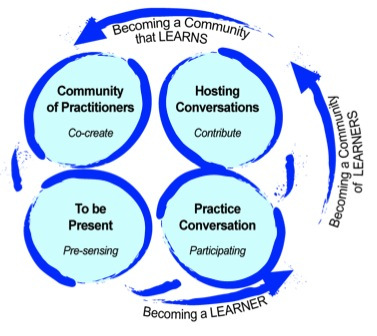 This pattern contains four practices that fold onto and into each other. For a simple pattern it contains much wisdom.
 ShapeShift