The Chaordic Path: The Dynamic Inter-relationship between Chaos and Order

One of the fundamental patterns used in Art of Hosting offerings – which for many of us includes our consulting practices or as practitioners in-house work environments – is the Chaordic Field or Chaordic Path. Like many of the patterns offered in AoH it is a helpful way to understand what is happening in the world, in our communities and organizations and within each of us individually. It gives us a lens through which to understand the increasing complexity in our environments and a pattern to work with to evoke collective learning and the real-time innovation necessary in a world and in times that are neither predictable nor stable and call for more flexibility as “more of the same” solutions are not addressing the challenges.

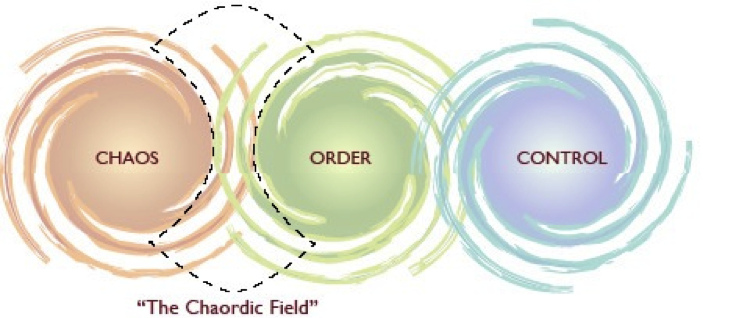
Originating with the work of Dee Hock in the development and evolution of Visa to an international network of financial institutions offering “one” credit card, Hock identified the patterns and forces of chaos, order and control that were at play in an animated process that came to the brink of failure at many points along the way.  It was clearly experienced that the greatest breakthroughs and emergent ideas came at the intersection of chaos and order, in a system that was more commonly situated in the realm of control.

Chaordic Path

Just when things seem the craziest is often when new ideas spark, bridges are built, aha’s become apparent and a way out of chaos naturally appears.  These patterns are evident in living systems, where a natural order exists, life cycles are vibrant and the greatest innovations happen at the edges.  While not static, living systems can be stable – or be in order – for long periods of time until disruption comes in some form of chaos – destructive weather patterns or fires – destabilizing the system for a time before new order emerges.

While the chaordic path is the story of our natural world – form arising out of nonlinear, complex, diverse systems – it can also be the story of how our teams, organizations and communities pay attention to human dynamics and function.   In our organizational systems, there is a tendency to want to meet chaos with control, to try to fix the situation or provide a ready made solution.  Many of us as leaders and managers have been educated, trained and promoted to do just this. But increasing complexity means control, particularly as it relates to the human dynamics of a situation, does not often enough lead to a resolution of the problem and may, in fact, exacerbate the situation. Solutions and ways forward are more likely to arise out of accessing the collective intelligence and collective wisdom of everyone, which can, at times, be a “messy” process until new insight and clarity emerges.

When facing new challenges that cannot be met with the same way we are currently working – cannot be solved by the same level of thinking that created them – new ways of leading and operating need to be learned and utilized to shift the shape of our experience with intentionality. It is during these times of uncertainty and increased complexity, where results cannot be predicted, that wise leaders invite others to share their collective and diverse knowledge to discover new purpose and strategy and decide a way forward.

It is in the phase of not knowing, before we reach new clarity, that the temptation to rush for certainty or grab for control is strongest. We are all called to walk this path with open minds and some confidence if we want to reach something wholly new.

“At the edge of chaos” is where life innovates — where things are not hard wired, but are flexible enough for new connections and solutions to occur.  To lead teams, organizations and communities on the chaordic path, leaders need “chaordic confidence,” to have the courage to stay in the dance of order and chaos long enough to support generative emergence that allows new, collective intelligence and wiser action to occur.

This can be a beautifully dynamic process.  To be in it with awareness and intentionality also means to take care of value judgments or beliefs often brought that one of these modes of being or operating – chaos, order or control – is  better or more valuable than the others. There is a place, a role and a time for each. A subsequent post will explore the upside and downside of each, recognizing that a flow and dynamic movement between each of these modes of being may be the leadership discernment needed for long term success.

Long Term Impasse at a Manufacturing Company Resolved With Two Hour World Cafe

Alanna Kennedy turned heads in our opening circle at the March 2014 Art of Hosting offering in St. Paul, Minnesota when she said she had recently hosted a World Café with welders at Emerson, the manufacturing company where she is a production manager. It was so successful she then did one with shippers.  A true life long learner (see about Alanna at the end of this post) and a third generation in manufacturing, she is not looking for what can’t be done, she is looking for how results can be achieved and success rates improved.  And in both of the Cafés she hosted, the outcome had immediate impact.
world cafe Fredericton 2013

In the case of the welders, there was a long term debate surrounding the criteria by which to measure and know if an individual welder was working within and meeting quality guidelines.  Everyone had a different idea.  In a way, the welders and the supervisors and engineers were speaking different languages with different worldviews. They were not able to hear each other across the worldviews and across assumptions of what they thought they knew about the other. The World Café method was an invitation into letting go of what they thought they knew and into becoming curious about what might be possible.

The original debate was about one measurement only – quality errors.  Welders resisted, speaking also about the individual signature of each welder and in some instances unclear written processes. There was a limiting belief, common in many places with many different work groups, that the welders, if left to their own devices, might want to negotiate for the greatest flexibility possible.  Welders know, like many trades and professions, that the quality of work of any one individual reflects on the quality of the whole.  They want high standards.

Alanna, being on the lookout for what works, sees opportunity in many processes and programs intended to address improving quality and operational standards.  Some forecast the failure of rate of programs like Lean and Lean-Six Sigma to develop lasting cultures of continuous improvement to be as high as 60%.  She calls this “fake lean”.   Overall, she says these programs are great at addressing the structure and technology questions for continuous improvement. However, they are lacking in the methods and tools to support the cultural and social development, or people questions, required to develop and sustain, through time, cultures of continuous improvement.  Alanna believes all change starts with social interaction. Change happens and work gets done through people, through the social systems. Enter the Art of Hosting Conversations That Matter, which she found through Action Learning, with an emphasis on working with human systems, recognizing that the wisdom is in the room with the group most directly affected by the proposed change and that there are a few processes specifically intended to elicit the collective intelligence.

After attending a World Café workshop offered by Jerry Nagel of the Meadowlark Institute in Minneapolis, Amy Lenzo of the World Cafe Community and others, Alanna brought fifteen welders from across the three shifts together for two hours in a world café process. They were paid for their time even if they were off duty during the World Café and they were invited into a series of conversations about criteria for assessing a welder’s work.  For this particular Café, managers were present but supervisors and engineers were not invited.  What emerged in two hours was a resolution to the long impasse and a structure that never would have emerged without this café conversation process.

The welders identified three distinct categories of standards: welding skills, manufacturing processes and the individual signature of the welder.  This is a more comprehensive structure than what was proposed by supervisors and engineers and a structure welders were willing to hold themselves and each other accountable to because they want their counterparts to uphold a certain level of professionalism on behalf of the whole.  The results were captured in a document that reflected the conversations and that document was approved by HR and executive managers.  The end result was the resolution of a long term impasse with a better quality of result than had been previously considered possible.

Alanna then did a World Café with shippers who needed new work stations.  Others in the organization had been trying to design a new work station for the shippers but many of the shippers hadn’t been included in the initial planning and they were obviously stalling.  They did not like the proposed design.  Alanna rounded up shippers from all three shifts for a two hour World Café process. There were three tables of five people. The shippers changed tables, circling around design ideas, sharing what would and would not work until three new work bench designs that they believed would support their needs were developed.  In the harvesting, the shippers were able to share their ideas and the reasoning behind their designs with the engineers.  The shippers had the opportunity to engage in a different type of dialogue.  Again, a resolution to an impasse was obtained within a couple of hours by using the world café process.

Was it worth paying the shippers and the welders for their time?  Was it worth a two hour investment of time to call upon the collective intelligence of the group most directly affected by the changes? Was it worth the risk of bringing social technologies to a manufacturing organization?  The results speak for themselves.

Many people who have attended an AoH training or are aware of the methodologies like world café, open space technology, circle practice, appreciative inquiry will often say, “That’s really great, but it will never fly where I work.”  That’s why Alanna turned heads when she said she worked in manufacturing.

When asked how she might respond to people who say, “It will never work here”, she offered, “You have to careful.  I used it where we were stuck and had been working on an issue. In preparation, I bought each of my colleagues a set of books – circle, open space, world café and action learning – and put them on their desks.  I talked to them.  I first gained the support of my peers.”

She was strategic in her approach. The need, purpose and intention for the café were clear.  She knew who she needed to have in the room, and who not to have. She knew the result she was after in each case – eye on the outcomes – and she understood the conditions that would lead to the generative conversations necessary for success.  She had the confidence to take, what for some people, is a risk.  “A critical piece to understand is that all change is facilitated and begins with human interaction.  If you don’t address that, you won’t get the desired results, no matter how good the plan or the technology.”

Why does AoH work? “Because it is not about mimicking what some other company or some other people did to achieve success.  It is about adaptive solutions generated from the people and systems most affected.”

About Alanna Kennedy
Alanna Kennedy

Alanna Kennedy

Alanna loves the manufacturing world.  She describes it as “a unique social laboratory” which is why she deliberately returned to this world after completing her PhD.  She is a “hands on” manufacturing professional formally trained and experienced in operations and materials management with an active interest in the research and development of social systems within organizations as they pertain to the development and sustainability of cultures of continuous improvement.

Her 2011 doctorate in Organizational Development with an emphasis on successful cultures of continuous improvement with a focus on the facilitation and implementation of Lean, Six Sigma, and SEAM (Socio-Economic Assessment of Management) methods is from the University of St. Thomas, MN, where she also completed her MBA in 1990 with a concentration in operations and systems excellence including the use of lean methods.  Her undergrad BA is from the Indiana University Bloomington in Cultural Anthropology and Psychology (1980) with a concentration in social systems and the application of macro economic theory in non-western societies.

She is certified in lean methods by the Society of Manufacturing Engineers.  She is CPIM certified by the APICS organization in production scheduling and inventory management, and is a licenced instructor for the global quality standards of electronics with the IPC Association.  She is also a licenced Brain Gym instructor, a kinesiology based program which uses physical movement to improve focus, learning and over all performance, combining it with Action Learning and Brain Gym and observing amazing, accelerated results for people working with stress and goal setting.

She will continue to pursue her curiosity about the integration of AoH practices and patterns with continuous improvement philosophies by doing a deeper dive into some of the individual methods and identifying opportunities for application in industrial environments.

Virtual Circle Check-In as an Entry Way to Practice

In the Art of Hosting Conversations That Matter Training where Jerry Nagel and I are part of the hosting team, after we experience circle practice, usually as a form of check-in on our first day, we offer a little teach on check-in and check-out practices as a routine part of a meeting structure and flow, as a way to help people arrive into the purpose of the meeting and to wrap up the meeting before everyone departs.  We share how we, like many of our colleagues, also do this with our calls or virtual meetings as we are part of many hosting teams where members are drawn from many locations.

A participant at a November 2013 training in Grand Rapids shared her experience with how using circle with a virtual work group shifted the shape of their experience.

hands shaking through computers

“I work pretty much 100% via phone. Today, I was bringing a group together after a few weeks unconnected during the holidays. Wondering how to loop everyone back into the groove, I recalled  one of the things we learned at AoH in Grand Rapids, about how a “circle” acts as a form of check in and grounding.  I explained briefly what we did at our AoH workshop with the circle and a structure. I asked them, if we actually had a physical circle, what structure would they place in it and what about it would they like to share.

“Wow!  It was amazing how their “structure” actually related to the previously stated goals of the group and their own stated goals.  This set the course for the rest of the meeting. What could easily have been a painful meeting listening to how busy everyone has been, blah, blah, blah – turned into an awesome meeting. Picking their “structure” back up set action in place for our next meeting too.

“Just wanted to let you know this stuff actually works – if we use it;)”

Love that last line – this stuff actually works – if we use it! Where is your entry point? How do you invite people so they feel invited, thoughtful about it and engaged?

WISE Women Using the Chaordic Stepping Stones

We love to invite the stories of how people use what they learn after attending an Art of Hosting gathering.  It sometimes seems daunting to bring new patterns and practices alive at work, in community or at home.  And sometimes it is hard to recognize yourself in some of the stories shared by the hosting team during the gathering, especially the larger, more high profile or long term stories.  So sharing where participants are stepping into practice in large and small ways helps illuminate many different entry points into shifting the shape of teams, organizations, communities and ways of being in the world – including in the first practice of the four fold practice of hosting self. This is the first such sharing of how Art of Hosting works for new and seasoned practitioners.  Perhaps you will see yourself or your starting point through these stories.

A team from the WISE Women organization in Newfoundland attended an Art of Hosting training in Fredericton in January of 2013.  They wanted to understand how to better support some of their clients in community engagement.  When asked a couple of months later how they were incorporating what they learned, this is what they shared.

“We definitely are using the practices and methods of the Chaordic Stepping Stones for our strategic planning sessions for the WISE/WEC Custer Project on Bell Island.   Currently working on the ‘Limiting Beliefs’.   Of course the awareness is helpful and making some of the beliefs conscious and shared has been bonding.”

Chaordic Path

She further shared, “Personally, I am using the World Café format for an upcoming ‘RED HAT Society’ Event I am hosting for 100 seniors in the community.  This format is working wonderfully for sharing of health related issues and information.”  – Linda Hickey


Navigating Decision Making Dilemmas

The increasing complexity of our environments – at work, in community and at home, time crunches and decision making pressures often leave us wanting for good decision making processes – especially when pressed for immediate action and results.  Key decisions taken by one individual – even one expected to make a decision – often fall short because one person does not always have the full picture or the decision meets resistance because people impacted were not involved in the decision making process. Collective decision making often misses the mark if dissension, debate or strong personalities dominate the process (meaning some people just give up or give in) and when it seems to take too much time we hit the panic button and believe any decision will do.  Yet how often are decisions revisited because not enough time was invested in the exploration of options or in creating the generative conditions for conversations that lead to eliciting the collective wisdom and intelligence inherent in any group? Or because leadership under the pressure of chaos or uncertainty turned into the heavier hand of trying to manage the situation?

There are some simple patterns and practices available through the Art of Hosting Conversations That Matter that offer us windows into understanding the human dynamics alive in any group and particularly groups or teams seeking direction or guidance through decision making.

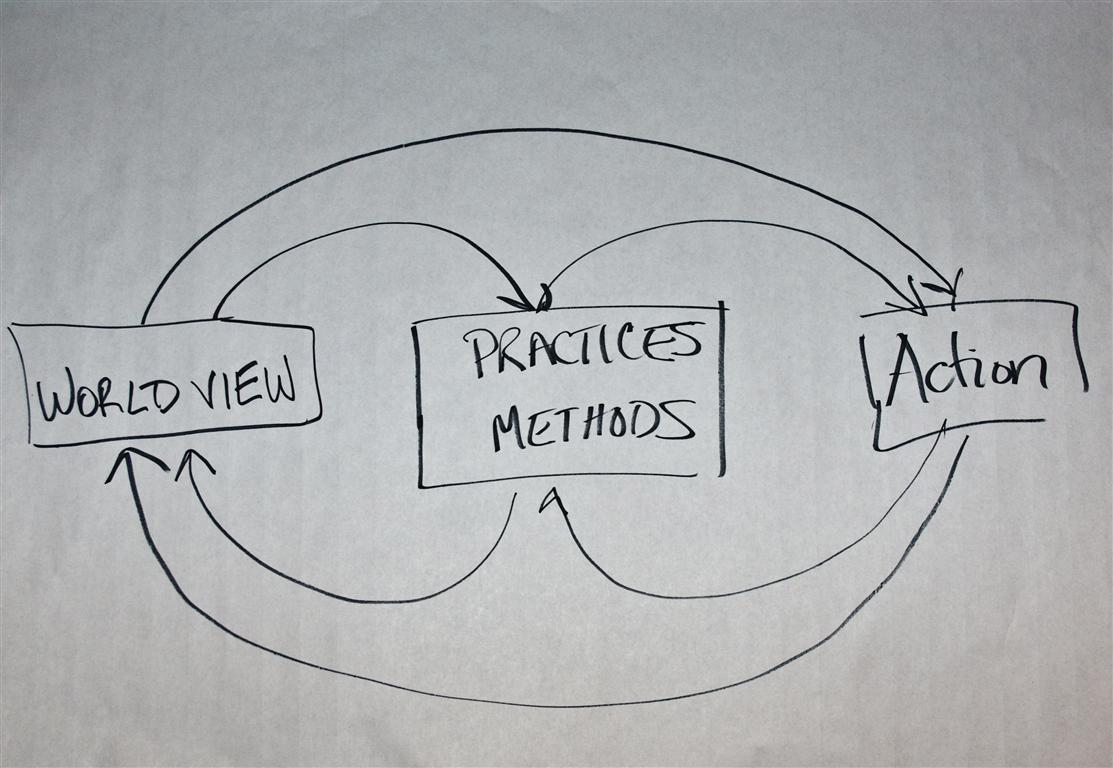
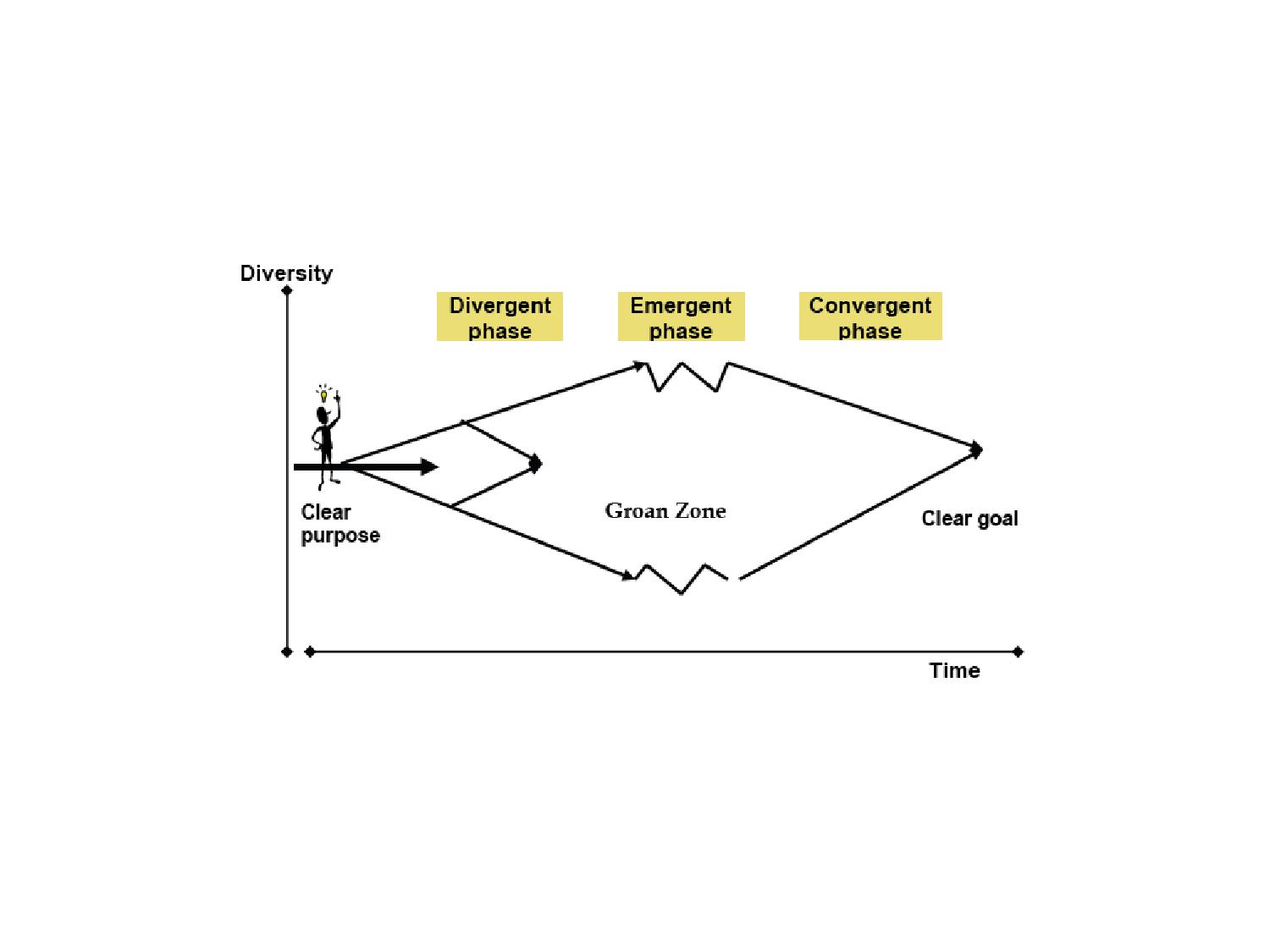
In May 2014, Shape Shift Strategies will be offering a one day workshop in Moncton (May 8) and in Charlottetown (May 15) to explore effective decision making practices.  The emphasis will be on the human dynamic conditions that lead more often to generative conversations and wiser decision making.  We will dive more deeply into the practical application of worldview, powerful questions and divergence/convergence in ways that support collective decision making in teams, organizations, communities and maybe even families.

WorldView hand drawn

Divergence-Convergence Diagram_000001

Information and registration details for both Moncton and Charlottetown are available through Eventbrite. Join us if you can.  Ask how you can bring this one day workshop to your team or organization.