Training together for clarity, love and courage in 2010
1
I have been following the news of the climate change talks in Copenhagen – mostly through friends of mine who are there – with growing interest. I have never really been a big believer that government or our political leaders are going to lead us to the solutions to the problems we face in the world – big or small. The culture they operate in – largely one of debate, negotiation and posturing – is very entrenched and makes it particularly difficult for them to shift.
If I only paid attention to the political conversations, it would be very disparaging indeed. However, the conversations that most capture my attention are around inner climate change. This is something we can all do something about – and must do something about!
This morning on Facebook, my friend Mitch Rhodes wrote: “at a gathering in Copenhagen, Archbishop Desmond Tutu spoke about being on the winning side. With our hearts and minds we must firmly believe we are on the winning side and shift to that place with conviction and dignity. It’s an inner struggle as much as an outer struggle.”
He also posted: “Many activists/protesters have anger in their hearts. A theory U-activist holds the power of love in their heart and facilitates the emergence of a just future. Gandhi comes to mind as an example.”
I have been a proponent of Theory U since I first came across it in 2005. I say yes to being a Theory U activist, holding the power of love in my heart. The way to shifting the shape of the world in a conscious and intentional manner is by each of us putting our stake in the ground, changing our own thoughts and behaviours and understanding that our actions make a difference in the world and to the world – no matter how big or small. By our thoughts and actions we will attract others who are also willing to shift and by doing so, we will build a larger and larger field of resonance for the greater shift we want to enact in the world.
Will you be lost in the apparent hopelessness of this large scale global crisis or will you contribute to healing the world (and self to as it turns out) fully, with your heart, mind and soul, firmly believing you are on the winning side, shifting to that place with conviction and dignity? I will meet you on the winning side!
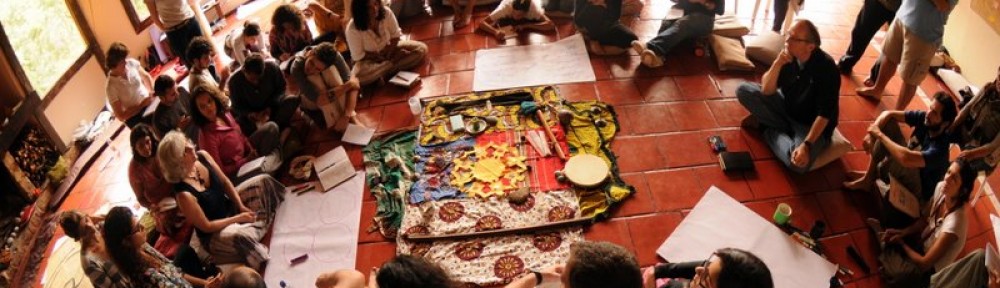
So, I know one day is not totally going to shift the shape of Halifax — however, it starts with shifting attitudes and this happened on Saturday, December 5 at Change Camp at the Halifax Hub. Sixty or seventy citizens of Halifax showed up in response to the question: What does Halifax as a vibrant city mean to you?
Using Open Space Technology throughout the day, fourteen exploration conversations happened in the morning and a number carried through into the afternoon developing some concrete steps. You can see the conversation topics here: Change Camp
Examples of shift: one of the groups wanted to talk about the vacancy rate on Barrington Street and how to revitalize this key downtown street. They realized there wasn’t much they could do about filling in empty building spaces but, after venturing out and taking pictures of the street, they did realize there was lots they could do to bring renewed vibrancy to the street itself. Shift in attitude. Shift in perception. This is just one of the many examples of ideas generated with action steps attached.
At the end of the day a number of participants reflected on the diversity in the room, the energy that remained high throughout the day and the renewal of hope. One older man reflected that he came with cynicism, fully expecting to leave at noon and now he was leaving at the end of the day feeling energized and renewed.
The people in these Change Camp conversations really sunk into the idea that if there is to be a renewal of community and a vibrancy in Halifax it comes from citizens – ordinary people who care about the place where they live and work and are really beginning to understand that that caring needs to show up as action – even small steps can leverage a large shift.
Kudos to Emily Richardson, a young, relatively new arrival to Halifax, whose imagination was captured by the idea of hosting a Change Camp and, because of this, magnetized the resources and assistance she needed to create an amazingly successful day – and to the Hub a truly inspired meeting place in downtown Halifax.
I helped out through Envision Halifax sponsorship of this event and it was a clear example of igniting a culture of civic engagement.
There is a new phenomenon in our world called H1N1. The news stories are all around the vaccine: availability of the vaccine, getting vaccinated, vaccination clinics, who has priority in being vaccinated, reactions to the vaccine, H1N1 assessment clinics, how many people have been hospitalized, how many have died, the cost of delivery, the pandemic nature of this flu.
There is an untold and evolving story around H1N1. It is the story of innovation, breaking down silos, working across departments, flattening of decision making structures, team engagement, people rolling up their sleeves and doing what needs to be done regardless of job description and everyone pulling together to face down the issues created by what is being called a pandemic – at least here in Canada.
Being around a lot of health care folx because of my work and being in frequent conversations about engagement, we began to muse about the level of engagement of health care folx, in particular, in the pandemic planning and the delivery of the vaccine. We came back to a familiar question: What is it about a crisis that brings out a sense of community, the power and clarity of a common goal, necessary resource allocation and alleviates common arguments, bickering or turf protection around role and resources?
How can we create these conditions in times when there is no crisis is often asked? We are operating from the premise that it is possible to create the same conditions without a crisis. During this particular conversation I began to entertain the question, what if it isn’t possible to fully recreate the conditions of crisis? For instance, the province of Nova Scotia has made available millions of dollars for the roll out of the H1N1 vaccine. Without the compelling argument of needing to control a pandemic outbreak of illness, as a for instance, what else other than crisis would so easily and readily garner financial and human resources. One of the reasons there is normally turf protection is because when we don’t have crisis the experience is that we have more limited resources and people have to advocate for their share of budget.
My question changed. Given that responding to the H1N1 crisis has temporarily transformed the relational field of how people are working together, what would it take to maintain some of the shift that has occurred and embed it in the organizational culture instead of allowing things to drift back – or spring back – to the way things have always been done – which is likely what will happen when the H1N1 pressure is off? How do we capitalize on the shifted shape of the relational field to allow operation along this chaordic edge or chaordic path all or most of the time?
There is an interesting opportunity here. As the pressure of crisis eases, will the lessons learned include new new ways of working together and the minimalization of structures and processes to support that?
 ShapeShift